.
I have tried a number of words to describe it, but the best I can do is "weird."
Really weird.
.
Monday, October 8, 2012


in praise of...?
.
Leaving aside (if that's possible) the people are who are incapable of praising others unless the praise is somehow to their advantage, it really is a pleasure to praise others. A job well done is a job well done and ... well ... it feels good to notice and extol it.
Perhaps all praise does partake of some self-serving exaltation, but I wonder if there isn't some praise that doesn't seek any return on the investment. I'm really not sure.
And even if there is no such thing as praise without serving the self, is that always such a bad thing?
Certainly it's a pain to be in the company of someone who is constantly angling for praise or praising things mindlessly. And similarly it is a pain to be in the company of someone who can offer no praise -- the hoarders of secrets that will enrich the keeper of such secrets.
I guess praise is something everyone figures out for themselves.
.
Leaving aside (if that's possible) the people are who are incapable of praising others unless the praise is somehow to their advantage, it really is a pleasure to praise others. A job well done is a job well done and ... well ... it feels good to notice and extol it.
Perhaps all praise does partake of some self-serving exaltation, but I wonder if there isn't some praise that doesn't seek any return on the investment. I'm really not sure.
And even if there is no such thing as praise without serving the self, is that always such a bad thing?
Certainly it's a pain to be in the company of someone who is constantly angling for praise or praising things mindlessly. And similarly it is a pain to be in the company of someone who can offer no praise -- the hoarders of secrets that will enrich the keeper of such secrets.
I guess praise is something everyone figures out for themselves.
.
Afghan war turns 12
.
Yesterday, America's war in Afghanistan turned 12.
Today, analysts are warning that a NATO (read American) pullout in 2014 is likely to lead to civil war.
Even before the U.S. invasion -- which followed unsuccessful attempts by both the British and the Russians to bring Afghanistan to heel -- analysts I can't immediately dig up but distinctly remember were warning that without a invasion war plan (attack, disable enemies, rebuild), America would leave behind all the ingredients for an unstable and divisive country.
Welcome to the prediction that went unheeded.
No one in their right mind ever claimed that we came into the world with a mistake-free make-up, but it is hard not to wonder if we have to be quite that stupid.
.
Yesterday, America's war in Afghanistan turned 12.
Today, analysts are warning that a NATO (read American) pullout in 2014 is likely to lead to civil war.
Even before the U.S. invasion -- which followed unsuccessful attempts by both the British and the Russians to bring Afghanistan to heel -- analysts I can't immediately dig up but distinctly remember were warning that without a invasion war plan (attack, disable enemies, rebuild), America would leave behind all the ingredients for an unstable and divisive country.
Welcome to the prediction that went unheeded.
No one in their right mind ever claimed that we came into the world with a mistake-free make-up, but it is hard not to wonder if we have to be quite that stupid.
.
the spiritual mooch
.
Somehow, an Internet definition of the word "mooch" hardly conveys the second-class, vaguely-slimy feel of the word:
Someone who raises his or her own stature by filching someone else's accomplishments is as common as it is unattractive. And yet who has not, at one time or another, been a mooch -- taken a bite out of some attractive situation or set of circumstances and then, before really finding out if it is true, spewed out a wisdom that is not yet honest nourishment? Who has not mooched?
Parsing and dissecting who is or has been a mooch -- who lives a second-hand lifestyle because their own lifestyle does not seem accomplished enough -- is an endless and fruitless chore. And forgiving the moocher because "everyone does it" hardly seems realistic: Mooching is pretty ick.
I do think, in spiritual endeavor, that keeping an eye on our own personal mooch is a good idea. Who could possibly find any peace while living according to someone else's lights or accomplishments?
Think "enlightenment" ... you get the idea.
.
Somehow, an Internet definition of the word "mooch" hardly conveys the second-class, vaguely-slimy feel of the word:
As an intransitive verb:
1. to take surreptitiously: steal
2. beg, spongeExample: He's always mooching off his friends, even thought he can easily pay his own way.
Everyone has probably known the guy or gal who never seems to have his or her wallet when the lunch bill is presented. And then of course there is the baseball fan who knows more about baseball than the players on the field. Or the thinker who knows every bit as much about parenting as a parent, every bit as much about writing as the writer, every bit as much about war as the soldier, or every bit as much about spiritual life as the adept.Origin: Probably from French dialect, "muchier," to hide, lurk
Someone who raises his or her own stature by filching someone else's accomplishments is as common as it is unattractive. And yet who has not, at one time or another, been a mooch -- taken a bite out of some attractive situation or set of circumstances and then, before really finding out if it is true, spewed out a wisdom that is not yet honest nourishment? Who has not mooched?
Parsing and dissecting who is or has been a mooch -- who lives a second-hand lifestyle because their own lifestyle does not seem accomplished enough -- is an endless and fruitless chore. And forgiving the moocher because "everyone does it" hardly seems realistic: Mooching is pretty ick.
I do think, in spiritual endeavor, that keeping an eye on our own personal mooch is a good idea. Who could possibly find any peace while living according to someone else's lights or accomplishments?
Think "enlightenment" ... you get the idea.
.
Sunday, October 7, 2012
a nice Zen autobiography
.
Just read Jeff Shore's autobiographical adventures on the Internet for the first time and found them very enjoyable:
Not least, "No doubt, I'm still the same old asshole. But somehow I can live with it now."
.
Just read Jeff Shore's autobiographical adventures on the Internet for the first time and found them very enjoyable:
Not least, "No doubt, I'm still the same old asshole. But somehow I can live with it now."
.
don't stop!
.
Yappy and neurotic as one of those miniaturized purebred dogs that doting dowager ladies seem to favor, the one-liner of encouragement calls out for attention this morning:
Don't stop!
Just don't stop!
Not "don't stop" as a matter of spiritual discipline or virtue or ethics or morality or something similar.
Just don't stop because ....
Since you can't stop -- since it is literally impossible -- just get with the program and...
Don't stop!
.
Yappy and neurotic as one of those miniaturized purebred dogs that doting dowager ladies seem to favor, the one-liner of encouragement calls out for attention this morning:
Don't stop!
Just don't stop!
Not "don't stop" as a matter of spiritual discipline or virtue or ethics or morality or something similar.
Just don't stop because ....
Since you can't stop -- since it is literally impossible -- just get with the program and...
Don't stop!
.
a mammoth legacy
.

An 11-year-old has been credited with the discovery of a mammoth carcass 2,200 miles northeast of Moscow.
The carcass has been named for the boy, Zhenya (Salinder).
As far as Warhol's "fifteen minutes of fame" goes, this strikes me as a pretty good one.
.

An 11-year-old has been credited with the discovery of a mammoth carcass 2,200 miles northeast of Moscow.
The carcass has been named for the boy, Zhenya (Salinder).
As far as Warhol's "fifteen minutes of fame" goes, this strikes me as a pretty good one.
.
Stewart vs. O'Reilly
.
It may say something about presidential politics and debates in America when two commentators from the opposite sides of the political spectrum rate a 10-12-inch story by the Associated Press.
 Jon Stewart, whose quasi-comedic "Daily Show" takes well-aimed pot shots at conservative positions, and Bill O'Reilly, a commentator for Fox News, an egregiously slanted news program, tangled good-naturedly on TV last night during "The Rumble in the Air-Conditioned Auditorium."
It wouldn't surprise me in the least if this event, staged between debate-one and debate-two of the actual presidential candidates, attained a wider audience than the actual presidential debates... that's how ludicrous 'serious' political discourse has become.
.
It may say something about presidential politics and debates in America when two commentators from the opposite sides of the political spectrum rate a 10-12-inch story by the Associated Press.

It wouldn't surprise me in the least if this event, staged between debate-one and debate-two of the actual presidential candidates, attained a wider audience than the actual presidential debates... that's how ludicrous 'serious' political discourse has become.
.
the society of others
.
Yesterday was an uncharacteristically social day.
In the morning, much to my surprise, Andy, who was once a colleague on the Saturday morning peace picket line, called to ask (more politely) where the hell I had been. In summer's heat, I had stopped showing up for the one-hour vigil outside the courthouse on Main Street. The heat was too strong for me and so the habit of not-going kicked in. Usually, Saturday morning vigils were, for me, an exercise in coalescing and dispersing -- coming together with little or no social interaction outside the one-hour event. So Andy's call was a surprise ... and perhaps an inspiration to get my act together and join the group once more.
Later, in the supermarket parking lot, I ran into Grumpy, a fellow I had met while trying out "The Wisdom Project," a conversational gathering at the Senior Center. I quit the group when I realized I didn't think much of creating a gathering on behalf of something called "wisdom." I always admired Grumpy for his background and good spirit ... a fellow, now in his 80's perhaps, who might have gone to college on a full scholarship except that his stepfather had two daughters from a previous marriage and hence many mouths to feed ... and so, after high school, Grumpy found himself learning a money-making bricklayer's trade ... and he did that for the rest of his working life. It was his wife who dubbed him "Grumpy" and, although he is unremittingly pleasant, the name stuck. And what saved his ass in his life was his love of and capacity for music ... banjo, guitar and I forget what other instruments. He still plays in a band. We chatted a bit in the supermarket parking lot ... and then moved on.
In the afternoon, Emmett Coyne, 73, a Catholic priest and author of "The Theology of Fear," came for a visit and dinner. Emmett and I had only met on the Internet and once by phone, but suddenly, there we were, sitting on the couch, sipping the wine he brought and gabbing. Emmett arrived around 4:30 and left at perhaps nine. The conversation ambled and meandered like a dog on a New York sidewalk, sniffing here, stopping there and occasionally lifting a leg for an inviting fire hydrant. Nothing, from spiritual life to personal background, was out of bounds, but there were moments to pause and correct what seemed to be an imagined misperception or point of emphatic agreement. Gift o' the gab, you might say, and it really was pleasant to be with a contemporary who had lived long enough to have opinions and biases but was not wedded to them in such a way as to impede the conversational flow with self-serving rants. Emmett seemed to like my 'chapel,' as he called the zendo I took him into the backyard to visit. I gave him a copy of my book, "Answer Your Love Letters: Footnotes to a Zen Practice," and he signed a copy of his which I had bought. My inscription to him: "For my new friend, Emmett Coyne, with all best wishes. SEMPER FI!" His inscription to me: "What hath fear wrought? The gift of a scintillating soul!" Eddies and currents....
I guess I was never trained well to credit the social interactions I can enjoy so much. Somehow, perhaps because of an upbringing that lacked the love I craved, the society of others can seem to underline with a piercing clarity a sense of loneliness ... and hence both social interaction and loneliness can feel lonely. The faith that others seem to embrace and credit -- the faith in social interaction -- is not a faith at which I am skilful or in which I seem capable of being convinced. It is strong medicine and I am probably too old to change my spots, so I have to content myself with the air I breathe. I may wish and wish ... but "if wishes were horses, beggars would ride." And the question poses itself -- quietly whispering in the background of social enjoyments -- on behalf of what disease is this medicine prescribed?
And, after a day dotted with social activity, I was as worn out as if I had been digging ditches all day. Worn out as a candle. Pleasantly ... but still....
.
Yesterday was an uncharacteristically social day.
In the morning, much to my surprise, Andy, who was once a colleague on the Saturday morning peace picket line, called to ask (more politely) where the hell I had been. In summer's heat, I had stopped showing up for the one-hour vigil outside the courthouse on Main Street. The heat was too strong for me and so the habit of not-going kicked in. Usually, Saturday morning vigils were, for me, an exercise in coalescing and dispersing -- coming together with little or no social interaction outside the one-hour event. So Andy's call was a surprise ... and perhaps an inspiration to get my act together and join the group once more.
Later, in the supermarket parking lot, I ran into Grumpy, a fellow I had met while trying out "The Wisdom Project," a conversational gathering at the Senior Center. I quit the group when I realized I didn't think much of creating a gathering on behalf of something called "wisdom." I always admired Grumpy for his background and good spirit ... a fellow, now in his 80's perhaps, who might have gone to college on a full scholarship except that his stepfather had two daughters from a previous marriage and hence many mouths to feed ... and so, after high school, Grumpy found himself learning a money-making bricklayer's trade ... and he did that for the rest of his working life. It was his wife who dubbed him "Grumpy" and, although he is unremittingly pleasant, the name stuck. And what saved his ass in his life was his love of and capacity for music ... banjo, guitar and I forget what other instruments. He still plays in a band. We chatted a bit in the supermarket parking lot ... and then moved on.
In the afternoon, Emmett Coyne, 73, a Catholic priest and author of "The Theology of Fear," came for a visit and dinner. Emmett and I had only met on the Internet and once by phone, but suddenly, there we were, sitting on the couch, sipping the wine he brought and gabbing. Emmett arrived around 4:30 and left at perhaps nine. The conversation ambled and meandered like a dog on a New York sidewalk, sniffing here, stopping there and occasionally lifting a leg for an inviting fire hydrant. Nothing, from spiritual life to personal background, was out of bounds, but there were moments to pause and correct what seemed to be an imagined misperception or point of emphatic agreement. Gift o' the gab, you might say, and it really was pleasant to be with a contemporary who had lived long enough to have opinions and biases but was not wedded to them in such a way as to impede the conversational flow with self-serving rants. Emmett seemed to like my 'chapel,' as he called the zendo I took him into the backyard to visit. I gave him a copy of my book, "Answer Your Love Letters: Footnotes to a Zen Practice," and he signed a copy of his which I had bought. My inscription to him: "For my new friend, Emmett Coyne, with all best wishes. SEMPER FI!" His inscription to me: "What hath fear wrought? The gift of a scintillating soul!" Eddies and currents....
I guess I was never trained well to credit the social interactions I can enjoy so much. Somehow, perhaps because of an upbringing that lacked the love I craved, the society of others can seem to underline with a piercing clarity a sense of loneliness ... and hence both social interaction and loneliness can feel lonely. The faith that others seem to embrace and credit -- the faith in social interaction -- is not a faith at which I am skilful or in which I seem capable of being convinced. It is strong medicine and I am probably too old to change my spots, so I have to content myself with the air I breathe. I may wish and wish ... but "if wishes were horses, beggars would ride." And the question poses itself -- quietly whispering in the background of social enjoyments -- on behalf of what disease is this medicine prescribed?
And, after a day dotted with social activity, I was as worn out as if I had been digging ditches all day. Worn out as a candle. Pleasantly ... but still....
.
Saturday, October 6, 2012
death brought to digital life
.
No longer need death be anything as final as ... well ... death.
In Austria, technicians are working to make digital remembrance a possibility, sewing digital markers into gravestones and bringing memories of those below to life.
No longer need death be anything as final as ... well ... death.
In Austria, technicians are working to make digital remembrance a possibility, sewing digital markers into gravestones and bringing memories of those below to life.
.
All you need is a smartphone equipped with a scanner to read the so-called "quick response" (QR) codes, the square of squiggles already widely used in advertising campaigns to unlock a trove of information for the curious.
The first QR codes will start appearing on graves in Austria within weeks, said Joerg Bauer, project leader for Austrian bereavement company Aspetos, who has been working on the QR project for five years.
"On the Road"
.
Beat Generation classic "On the Road" by Jack Kerouac is on display at the British Library in London ... all 120 feet of it. The scroll which Kerouac completed in three weeks in 1951 was rejected by 11 publishers, as I recall, before it finally hit the book stands.
As teenagers, we gobbled up Beat Generation stuff. It was positively built to coincide with our sense of iconoclasm ... both the iconoclasm of any conflicted and cranky teenager and the iconoclasm that targeted the stiff and studied ways that followed naturally from the horrific blood-letting of World War II. Who would not wish for a white picket fence in the wake of painful chaos? And who, following from that, would not wish to tear down the fences that held in the human spirit?
I read the beats -- reading was still in vogue then -- and loved the free-wheeling, brash challenges they laid down. I credit "On the Road" as a partial inspiration for hitchhiking across the country twice. But I never liked Kerouac's novel as much as my friends did. That was a secret I kept to myself then ... I just didn't think it was a very good book, for all its champagne fizz.
Looking back, no doubt with blurred vision, I am wistful for the beats. They seemed wild and full of sap, however nutsy. Looking back from today, they were juicy ... real "grape juice" as compared with the "grape drink" of Facebook and Twitter and blogs and other Internet assertions.
.
Beat Generation classic "On the Road" by Jack Kerouac is on display at the British Library in London ... all 120 feet of it. The scroll which Kerouac completed in three weeks in 1951 was rejected by 11 publishers, as I recall, before it finally hit the book stands.
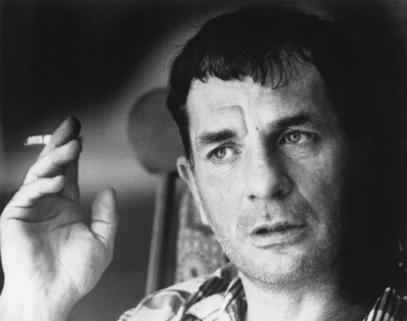 |
| Jack Kerouac |
I read the beats -- reading was still in vogue then -- and loved the free-wheeling, brash challenges they laid down. I credit "On the Road" as a partial inspiration for hitchhiking across the country twice. But I never liked Kerouac's novel as much as my friends did. That was a secret I kept to myself then ... I just didn't think it was a very good book, for all its champagne fizz.
Looking back, no doubt with blurred vision, I am wistful for the beats. They seemed wild and full of sap, however nutsy. Looking back from today, they were juicy ... real "grape juice" as compared with the "grape drink" of Facebook and Twitter and blogs and other Internet assertions.
.
visceral love
.
The pope's butler was convicted today of stealing papal documents. He was sentenced to 18 months in prison, a reduction of the three-year term that might have been imposed.
A papal pardon is widely expected. Who would know better than the Catholic Church what impact martyrs can have?
And, associatively, how interesting that those who yowl for "transparency" are seldom willing to apply the same yardstick to their own doings: Somehow, my secrets are always more compelling and worthy than your secrets.
.
The pope's butler was convicted today of stealing papal documents. He was sentenced to 18 months in prison, a reduction of the three-year term that might have been imposed.
Paolo Gabriele told the church court "I do not feel like a thief" and added that he did what he had done out of a "visceral love" for the church.
Gabriele was accused of stealing the pope's private correspondence and passing it on to journalist Gianluigi Nuzzi, whose book revealed the intrigue, petty infighting and allegations of corruption and homosexual liaisons that plague the leadership of the Roman Catholic Church.
Paolo Gabriele

A papal pardon is widely expected. Who would know better than the Catholic Church what impact martyrs can have?
And, associatively, how interesting that those who yowl for "transparency" are seldom willing to apply the same yardstick to their own doings: Somehow, my secrets are always more compelling and worthy than your secrets.
.
the chirping parakeet
.
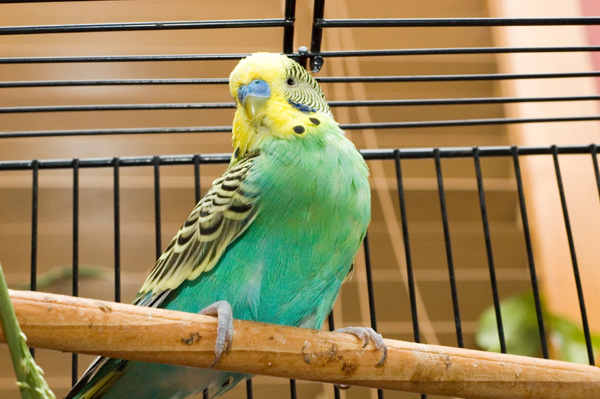
Like a parakeet chirping languidly in some nearby cage:
-- Is longevity laughter? I don't know, but I think it is.
 -- Victory can leave anyone gasping for air. Once the enemy is defeated, the loss of such a dearly-beloved friend strikes home ... and the loneliness resumes. The trophy case may be bright with new conquests, but are shiny statues really enough? Losing good friends is not so easy.
-- I suppose the 'goodness' of spiritual endeavor cannot be avoided. The obvious is obvious -- inspiration and all that. But how many are content to rely on goodness, to assert and elevate and waste their lives? Day after day, week after week, year after year. It might be funny if it weren't so sad. It strikes me as good fortune to find a discipline that is not content with goodness.
-- On Fridays, the local paper runs a Q-and-A profile of someone within its readership area. One of the questions asks, approximately, "If you could spend a day with anyone in history, who would it be?" My assumption is that most people would like to spend pleasant rather than unpleasant days. And if that is so, would admiration be a good basis on which to spend a pleasant day with anyone? It sounds like a loser to me.
-- Do parakeets belong in cages? They are bright and beautiful, but if you cage the bright and beautiful, how long will it be before it comes around and bites you on the ass?
.
Like a parakeet chirping languidly in some nearby cage:
-- Is longevity laughter? I don't know, but I think it is.
 -- Victory can leave anyone gasping for air. Once the enemy is defeated, the loss of such a dearly-beloved friend strikes home ... and the loneliness resumes. The trophy case may be bright with new conquests, but are shiny statues really enough? Losing good friends is not so easy.
-- I suppose the 'goodness' of spiritual endeavor cannot be avoided. The obvious is obvious -- inspiration and all that. But how many are content to rely on goodness, to assert and elevate and waste their lives? Day after day, week after week, year after year. It might be funny if it weren't so sad. It strikes me as good fortune to find a discipline that is not content with goodness.
-- On Fridays, the local paper runs a Q-and-A profile of someone within its readership area. One of the questions asks, approximately, "If you could spend a day with anyone in history, who would it be?" My assumption is that most people would like to spend pleasant rather than unpleasant days. And if that is so, would admiration be a good basis on which to spend a pleasant day with anyone? It sounds like a loser to me.
-- Do parakeets belong in cages? They are bright and beautiful, but if you cage the bright and beautiful, how long will it be before it comes around and bites you on the ass?
.
Friday, October 5, 2012
the Archdiocese of Sydney
.
Good people always wonder how much good they have actually done and how much better they might have done it. Others simply wonder why the applause wasn't louder.
Who has not looked back in sorrow? And who, as well, has not done what could be done to ease that sorrow or the wrongs committed?
No one can perfectly right the wrongs committed in the past. But there are better and worse attempts to do so.
In the "better" department, I think the Archdiocese of Sydney, Australia, came up with a pretty good principle in its attempt to address the matter of sexual abuse in its midst ... a principle that any organization or individual, religious or secular, might take to heart when trying to redress wrongs committed in the past:
Good people always wonder how much good they have actually done and how much better they might have done it. Others simply wonder why the applause wasn't louder.
Who has not looked back in sorrow? And who, as well, has not done what could be done to ease that sorrow or the wrongs committed?
No one can perfectly right the wrongs committed in the past. But there are better and worse attempts to do so.
In the "better" department, I think the Archdiocese of Sydney, Australia, came up with a pretty good principle in its attempt to address the matter of sexual abuse in its midst ... a principle that any organization or individual, religious or secular, might take to heart when trying to redress wrongs committed in the past:
.Helping victims always takes precedence over any concern to protect the church or the priesthood.
snooker championships
.
And, in sports news you may never hear,
 The Pakistan News Service reported the story.
Pakistan, a place viewed from the country I live in as a hideout for Afghan 'terrorists,' a country that has nuclear capabilities, and a land providing a diplomatic conundrum that might tax a genius, is also home to this once upper-crust sporting championship.
Sometimes, in the midst of all the things a person does know, the sheer enormity of what is not known comes calling.
Of all the games that involved cue sticks and balls (cue sports), I found snooker the most enragingly elegant. The table always seemed to be enormous when compared to pocket billiards or billiards without any pockets. I don't suppose my comparison of table sizes was accurate, but because snooker balls are smaller than those used on billiards tables, the table tends to look bigger ... gigunda in fact. A standard table is 12-feet by 6, but targeting an object ball at the far end of the table can feel like a sniper taking a 1,000-yard shot without a scope.
Naturally (who the hell else?), it was the colonizing Brits who invented the game and it would be many years before the hoi polloi would be admitted to snooker clubs. But pretty soon, the delights and challenges of the game -- irrespective of class -- filtered down until even a schnook like me might give it a whirl.
One of the hard parts of the game is the simple architecture of the pockets. In regular pocket billiards (pool), the pockets are angled on the edges. A player can luck out with an 'almost' shot if the ball bounces off one of the angles and then drops in for a score. Not so in snooker, where the pocket edges are rounded and an 'almost' shot (one not shot directly into the maw) simply bounces back and forth in the opening until it runs out of steam. A loser! Snooker demands a spot-on accuracy ... over vast reaches ... and there are other difficulties that would disqualify all but the most determined and attentive.
I never was much good at snooker. Billiards (the one without the pockets) was my game of choice. But it makes me happy to know that in a world I may think I know something about, someone is doing something delightful or perhaps not so delightful ... and I haven't ... got ... a ... clue!
.
And, in sports news you may never hear,
KARACHI: Mohammad Asif, Asjad Iqbal, Shahram Changezi and Sohail Shahzad qualified for the semifinals of the 4th National Ranking Snooker Championship after winning their respective matches at NBP Sports Complex Billiards Hall here on Thursday.
 The Pakistan News Service reported the story.
 Pakistan, a place viewed from the country I live in as a hideout for Afghan 'terrorists,' a country that has nuclear capabilities, and a land providing a diplomatic conundrum that might tax a genius, is also home to this once upper-crust sporting championship.
Sometimes, in the midst of all the things a person does know, the sheer enormity of what is not known comes calling.
Of all the games that involved cue sticks and balls (cue sports), I found snooker the most enragingly elegant. The table always seemed to be enormous when compared to pocket billiards or billiards without any pockets. I don't suppose my comparison of table sizes was accurate, but because snooker balls are smaller than those used on billiards tables, the table tends to look bigger ... gigunda in fact. A standard table is 12-feet by 6, but targeting an object ball at the far end of the table can feel like a sniper taking a 1,000-yard shot without a scope.
Naturally (who the hell else?), it was the colonizing Brits who invented the game and it would be many years before the hoi polloi would be admitted to snooker clubs. But pretty soon, the delights and challenges of the game -- irrespective of class -- filtered down until even a schnook like me might give it a whirl.
One of the hard parts of the game is the simple architecture of the pockets. In regular pocket billiards (pool), the pockets are angled on the edges. A player can luck out with an 'almost' shot if the ball bounces off one of the angles and then drops in for a score. Not so in snooker, where the pocket edges are rounded and an 'almost' shot (one not shot directly into the maw) simply bounces back and forth in the opening until it runs out of steam. A loser! Snooker demands a spot-on accuracy ... over vast reaches ... and there are other difficulties that would disqualify all but the most determined and attentive.
I never was much good at snooker. Billiards (the one without the pockets) was my game of choice. But it makes me happy to know that in a world I may think I know something about, someone is doing something delightful or perhaps not so delightful ... and I haven't ... got ... a ... clue!
.
it all boils down to....
.
Am I wrong or is it true that for anyone, in any given moment, "it all boils down to..." something.
Whatever a situation or set of circumstances may be, still there is a kind of mental shorthand that kicks in, a way of summing things up without all the blarney or tears that the entire situation can evoke. It's a simplification and a way of lightening what may be a pretty heavy load: "It all boils down to...." What it boils down to encapsulates the whole situation, much as a seed may encapsulate the beautiful flowers it can or will produce.
And of course what, precisely, it boils down to now is not necessarily what it boils down to later. Your "boils down to" is not mine just as mine is not yours. What things "boil down to" is a slippery customer and yet the mind may feel somehow better or less burdened that, for the moment, "it all boils down to...."
I wouldn't want to beat anyone over the head with it -- wax all spiritual-discipline about it -- but I do think it's interesting and worth noticing: If you can't boil things down, well, what is that like ... what does that boil down to?
What got me off on this kick was the old Zen teacher Rinzai who really boiled things down for me this morning with his, "grasp and use, but never name."
In my mind, you can't do much better than that, but that doesn't mean I won't try. :)
.
Am I wrong or is it true that for anyone, in any given moment, "it all boils down to..." something.
Whatever a situation or set of circumstances may be, still there is a kind of mental shorthand that kicks in, a way of summing things up without all the blarney or tears that the entire situation can evoke. It's a simplification and a way of lightening what may be a pretty heavy load: "It all boils down to...." What it boils down to encapsulates the whole situation, much as a seed may encapsulate the beautiful flowers it can or will produce.
And of course what, precisely, it boils down to now is not necessarily what it boils down to later. Your "boils down to" is not mine just as mine is not yours. What things "boil down to" is a slippery customer and yet the mind may feel somehow better or less burdened that, for the moment, "it all boils down to...."
I wouldn't want to beat anyone over the head with it -- wax all spiritual-discipline about it -- but I do think it's interesting and worth noticing: If you can't boil things down, well, what is that like ... what does that boil down to?
What got me off on this kick was the old Zen teacher Rinzai who really boiled things down for me this morning with his, "grasp and use, but never name."
In my mind, you can't do much better than that, but that doesn't mean I won't try. :)
.
the 'final' chapter
.
Today, surrounded by an early-morning fog, my TV mind is up and running, offering a spiritual sitcom to pass the time. Funny how smug I can be that at least my sitcom never has any 'boring' ads, while all the time it's just one bit of snake oil after another.
Today's episode concerns the final chapter in any religious compendium ... the completion of Bible or Torah or Vedas or whatever. This chapter has been forever hidden from gurus and saints and ordinary people of good will. In this morning's episode, it lies hidden beneath some unremarkable rock in the desert or in the interstices of an ancient stupa or just out of reach in some Basque cave where paintings adorn the darkened walls.
No one can ever find this final chapter -- the one that eludes even nut-brown men speaking in hushed tones of 'secret teachings.' But just because it can never be found does not mean this morning's sitcom cast of characters is not in hot pursuit. They've read the preceding chapters with care. They know the sweet beckoning of words and the exercises required within their meaning. But now it's time to close the book, to stumble upon the final chapter.
The logic of this sitcom quest is flawless: What has a beginning in Bible or Torah or Vedas -- in efforts sometimes feeble, sometimes fiery ... what has a beginning must have an end, mustn't it? And even if the final chapter (the last "book" among the other books) can never be found does not mean it cannot be found ... beneath some unremarkable rock, perhaps, or in the interstices of some ancient wall. Anyone's "Indiana Jones" might be inspired and go forth, eyes a-twinkle, bullwhip and revolver at the ready.
And finally, there it is ... the successful end to a grueling quest ... at last ... written in what seems to be a wobbly hand ... the final book that only the seeker himself can write ... and yet cannot be written at all...
No more canned laughter. No more prefabricated tears. No more fade-in, fade-out. No more mystery. No more blessings or curses. No more accolades or repentance. No more popes and panoply. No more morning fog ...
The Book of Laughter.
Don't you pity the poor bastard who tried to write it?
Who in their right mind would try to write while laughing?
.
Today, surrounded by an early-morning fog, my TV mind is up and running, offering a spiritual sitcom to pass the time. Funny how smug I can be that at least my sitcom never has any 'boring' ads, while all the time it's just one bit of snake oil after another.
Today's episode concerns the final chapter in any religious compendium ... the completion of Bible or Torah or Vedas or whatever. This chapter has been forever hidden from gurus and saints and ordinary people of good will. In this morning's episode, it lies hidden beneath some unremarkable rock in the desert or in the interstices of an ancient stupa or just out of reach in some Basque cave where paintings adorn the darkened walls.
No one can ever find this final chapter -- the one that eludes even nut-brown men speaking in hushed tones of 'secret teachings.' But just because it can never be found does not mean this morning's sitcom cast of characters is not in hot pursuit. They've read the preceding chapters with care. They know the sweet beckoning of words and the exercises required within their meaning. But now it's time to close the book, to stumble upon the final chapter.
The logic of this sitcom quest is flawless: What has a beginning in Bible or Torah or Vedas -- in efforts sometimes feeble, sometimes fiery ... what has a beginning must have an end, mustn't it? And even if the final chapter (the last "book" among the other books) can never be found does not mean it cannot be found ... beneath some unremarkable rock, perhaps, or in the interstices of some ancient wall. Anyone's "Indiana Jones" might be inspired and go forth, eyes a-twinkle, bullwhip and revolver at the ready.
And finally, there it is ... the successful end to a grueling quest ... at last ... written in what seems to be a wobbly hand ... the final book that only the seeker himself can write ... and yet cannot be written at all...
No more canned laughter. No more prefabricated tears. No more fade-in, fade-out. No more mystery. No more blessings or curses. No more accolades or repentance. No more popes and panoply. No more morning fog ...
The Book of Laughter.
Don't you pity the poor bastard who tried to write it?
Who in their right mind would try to write while laughing?
.
Thursday, October 4, 2012
if only God can pray to God...
.
Emmett Coyne, a Roman Catholic priest and author of "The Theology of Fear," is coming to dinner Saturday. I am looking forward to meeting him since we have had pleasant correspondence and talked once on the phone, but never actually met. Besides cooking dinner, I may even do some vacuuming.
But his advent puts my mind on a Christian frequency. Not that I am educated about Christianity, but when has ignorance ever stopped anyone from having an opinion or thought train?
And one of the thoughts that has always wondered me is this bit of child-like questioning:
If God is omnipresent (to be everywhere at the same time), then only God could pray to God. And if this is so -- as I think the word "omnipresent" suggests it is -- then I have two questions:
1. Why would anyone, deity or otherwise, bother praying to him/her/itself?
2. Who is this God who prays to God?
I have tried asking these questions in the past in serious settings and been met either by a robust silence that suggested I was not worthy enough to receive an answer or by a lengthy disquisition that managed to sidestep the question (esp. No. 2) altogether.
I realize that I have not always been kindly disposed towards Christianity in the past. The separation that belief implies strikes me as factually wrong-headed when applied as a foundational block of religion. But my crabbiness on that front does not extend to the questions I am asking.
I really would like to understand.
Maybe I will ask Emmett, but I would certainly welcome any other input.
.
Emmett Coyne, a Roman Catholic priest and author of "The Theology of Fear," is coming to dinner Saturday. I am looking forward to meeting him since we have had pleasant correspondence and talked once on the phone, but never actually met. Besides cooking dinner, I may even do some vacuuming.
But his advent puts my mind on a Christian frequency. Not that I am educated about Christianity, but when has ignorance ever stopped anyone from having an opinion or thought train?
And one of the thoughts that has always wondered me is this bit of child-like questioning:
If God is omnipresent (to be everywhere at the same time), then only God could pray to God. And if this is so -- as I think the word "omnipresent" suggests it is -- then I have two questions:
1. Why would anyone, deity or otherwise, bother praying to him/her/itself?
2. Who is this God who prays to God?
I have tried asking these questions in the past in serious settings and been met either by a robust silence that suggested I was not worthy enough to receive an answer or by a lengthy disquisition that managed to sidestep the question (esp. No. 2) altogether.
I realize that I have not always been kindly disposed towards Christianity in the past. The separation that belief implies strikes me as factually wrong-headed when applied as a foundational block of religion. But my crabbiness on that front does not extend to the questions I am asking.
I really would like to understand.
Maybe I will ask Emmett, but I would certainly welcome any other input.
.
taking credit for a lineage
.
How many institutions are willing to take credit for their lineage but are unwilling to take responsibility for their offspring?
I don't know.
I suppose the same question might be asked of individuals, but their irresponsibilities are generally less pervasive and perverse.
.
How many institutions are willing to take credit for their lineage but are unwilling to take responsibility for their offspring?
I don't know.
I suppose the same question might be asked of individuals, but their irresponsibilities are generally less pervasive and perverse.
.
activism and spiritual effort
.
Over the years, a number of people have visited the zendo here and brought with them a similar malaise: They were activists in one cause or another and somehow activism had left them depleted and dissatisfied. "Burnout" was the facile terminology some of them used. Perhaps spiritual discipline would restore them to a livelier and more peaceful existence.
I wonder how often it happens that the apparent or advertised "peace that surpasses all understanding" is used as a club in spiritual endeavor. Some great big spiritual woo-hoo -- the 'unconditional realm' or emptiness or Nirvana or something similar -- is held up in the mind as a golden orb, a magic clarifier, a disperser of all anguish or confusion. Nothing can compete with this spiritual peace ... and so nothing is allowed to compete with it. "Out, damned spot!"
But of course it's just the same old problem expressing itself on some new day.
"I want."
As there is nothing wrong with activism per se, so there is nothing wrong with spiritual effort per se. But using the one to club the other over the head -- activism as a means of silencing airy-fairy theoretical thinking or spiritual effort to still the unpredictable satisfactions of activism ... it's an endless game of Whac-A-Mole ... the activist spirit seeing zombie-like introverts; the spiritual-heights crowd dissing a foolish and endless attachment. And neither is wrong.
There is a difference between carefully planning and executing some activity with an underpinning of hope that it will turn out a particular way and carefully planning and executing the same activity ... and just seeing what happens. The activity may be aimed in a particular direction, but what happens is up for grabs and it is this unknowing is important. It's not indifference (the whole-hearted activity proves that), but it is more clear-headed and less prone to anything like "burnout."
"I want."
That'll screw the pooch every time.
And then too, as my Zen teacher once observed, "Without ego, nothing gets done."
An as team manager Tom Hanks snorted with exasperation in the 1992 movie "A League of Their Own" as he explained baseball to a worn-down player:
"Of course it's hard! If it were easy, everyone would do it."
.
Over the years, a number of people have visited the zendo here and brought with them a similar malaise: They were activists in one cause or another and somehow activism had left them depleted and dissatisfied. "Burnout" was the facile terminology some of them used. Perhaps spiritual discipline would restore them to a livelier and more peaceful existence.
I wonder how often it happens that the apparent or advertised "peace that surpasses all understanding" is used as a club in spiritual endeavor. Some great big spiritual woo-hoo -- the 'unconditional realm' or emptiness or Nirvana or something similar -- is held up in the mind as a golden orb, a magic clarifier, a disperser of all anguish or confusion. Nothing can compete with this spiritual peace ... and so nothing is allowed to compete with it. "Out, damned spot!"
But of course it's just the same old problem expressing itself on some new day.
"I want."
As there is nothing wrong with activism per se, so there is nothing wrong with spiritual effort per se. But using the one to club the other over the head -- activism as a means of silencing airy-fairy theoretical thinking or spiritual effort to still the unpredictable satisfactions of activism ... it's an endless game of Whac-A-Mole ... the activist spirit seeing zombie-like introverts; the spiritual-heights crowd dissing a foolish and endless attachment. And neither is wrong.
There is a difference between carefully planning and executing some activity with an underpinning of hope that it will turn out a particular way and carefully planning and executing the same activity ... and just seeing what happens. The activity may be aimed in a particular direction, but what happens is up for grabs and it is this unknowing is important. It's not indifference (the whole-hearted activity proves that), but it is more clear-headed and less prone to anything like "burnout."
"I want."
That'll screw the pooch every time.
And then too, as my Zen teacher once observed, "Without ego, nothing gets done."
An as team manager Tom Hanks snorted with exasperation in the 1992 movie "A League of Their Own" as he explained baseball to a worn-down player:
"Of course it's hard! If it were easy, everyone would do it."
.
killer with a kind streak
.
 The black mamba, one of the deadliest snakes on earth, produces within its neurotoxin venom a painkiller that is better than morphine, scientists say.
It is too soon to know for sure whether mambalgins will be useable for human beings, but in the meantime this quirk of nature has left researchers puzzled.
.
 The black mamba, one of the deadliest snakes on earth, produces within its neurotoxin venom a painkiller that is better than morphine, scientists say.
It is too soon to know for sure whether mambalgins will be useable for human beings, but in the meantime this quirk of nature has left researchers puzzled.
.
green light life
.
Bill, a man in his 50's who is going through a scalding labyrinth of divorce, came over for coffee yesterday. We sat on the couch and sipped and chatted: With luck, by tomorrow, the divorce papers would be signed and he could begin to distance himself from an unremitting rug burn in his life.
On a happier note, Bill had been invited to speak at a conference on cults -- to detail his own unfortunate experiences with a high-profile guru whose purportedly-gentle message was actually grasping and self-centered and harmful. Bill had been hurt, wrote a book about his adventures and was still, to some extent 'processing' the fallout. He had spent much of his life on one spiritual quest or another. The cult experience had been painful ... but later this month or perhaps next, he planned to go on a ten-day retreat not far from here. He was still questing and as I listened to him speak, I seemed to hear one example after another of a human being who longed to explain what was somehow unexplainable in his life, to put things in an order that would somehow produce peace, to discover and own some alchemical formula that would produce a long-awaited and much-sought ahhhhhh.

Explanations. Living a life based on explanations is invariably unsatisfactory and yet not-seeking explanations seems indelibly stupid.
Bill delivered his ruminations and adventures with the kind of well-ironed pleasantness of a man with something to protect ... carefully coiffed, in well-structured control, amiable and yet still looking for a way to be in control of the uncontrollable shit that life can dish up. If he could just be in control, find the Rosetta stone of all explanations, then things would seem less out of control, less wobbly, less capriciously unnerving ... and perhaps he could at last relax.
The blinking yellow traffic signal advises caution. It is not exactly green, not exactly 'go,' and yet not exactly red, not exactly 'stop.' Yellow tells passing drivers that there may be danger up ahead ... but on the other hand, there may be nothing but smooth sailing. A blinking yellow light advises attention and encourages doubt. Blinking, blinking, blinking ... who knows what may be around the next bend?
In spiritual endeavor, I guess everyone works up their own laundry list of blinking amber traffic lights -- warning signals that suggest you may end up in a ditch or maybe there was never anything to worry about in the first place. Still, they are a warning and worth heeding. Some of mine are:
Explanations.
Ecumenism.
Belief.
Hope.
Altruism.
Understanding.
And now that I start making a list, I realize the list is endless -- that there is nothing in spiritual life (or any other) that does not invite a serious caution ... a caution that may turn out to be 'nothing at all.'
And further, of course, there is the recognition that life does not put up traffic signals. Traffic signals are what I put up and observe and sometimes get tickets for ignoring.
Life -- for those who credit explanations -- is nothing but green light.
Going, going, gone.
.
Bill, a man in his 50's who is going through a scalding labyrinth of divorce, came over for coffee yesterday. We sat on the couch and sipped and chatted: With luck, by tomorrow, the divorce papers would be signed and he could begin to distance himself from an unremitting rug burn in his life.
On a happier note, Bill had been invited to speak at a conference on cults -- to detail his own unfortunate experiences with a high-profile guru whose purportedly-gentle message was actually grasping and self-centered and harmful. Bill had been hurt, wrote a book about his adventures and was still, to some extent 'processing' the fallout. He had spent much of his life on one spiritual quest or another. The cult experience had been painful ... but later this month or perhaps next, he planned to go on a ten-day retreat not far from here. He was still questing and as I listened to him speak, I seemed to hear one example after another of a human being who longed to explain what was somehow unexplainable in his life, to put things in an order that would somehow produce peace, to discover and own some alchemical formula that would produce a long-awaited and much-sought ahhhhhh.

Explanations. Living a life based on explanations is invariably unsatisfactory and yet not-seeking explanations seems indelibly stupid.
Bill delivered his ruminations and adventures with the kind of well-ironed pleasantness of a man with something to protect ... carefully coiffed, in well-structured control, amiable and yet still looking for a way to be in control of the uncontrollable shit that life can dish up. If he could just be in control, find the Rosetta stone of all explanations, then things would seem less out of control, less wobbly, less capriciously unnerving ... and perhaps he could at last relax.
The blinking yellow traffic signal advises caution. It is not exactly green, not exactly 'go,' and yet not exactly red, not exactly 'stop.' Yellow tells passing drivers that there may be danger up ahead ... but on the other hand, there may be nothing but smooth sailing. A blinking yellow light advises attention and encourages doubt. Blinking, blinking, blinking ... who knows what may be around the next bend?
In spiritual endeavor, I guess everyone works up their own laundry list of blinking amber traffic lights -- warning signals that suggest you may end up in a ditch or maybe there was never anything to worry about in the first place. Still, they are a warning and worth heeding. Some of mine are:
Explanations.
Ecumenism.
Belief.
Hope.
Altruism.
Understanding.
And now that I start making a list, I realize the list is endless -- that there is nothing in spiritual life (or any other) that does not invite a serious caution ... a caution that may turn out to be 'nothing at all.'
And further, of course, there is the recognition that life does not put up traffic signals. Traffic signals are what I put up and observe and sometimes get tickets for ignoring.
Life -- for those who credit explanations -- is nothing but green light.
Going, going, gone.
.
Wednesday, October 3, 2012
presidential debate -- the condom wars
.
Joe paused on the way out to his car today, looked across the street to where I was sitting on the porch, waved and called out, "You watching the debate tonight?" "Not on your life," I called back. "You watch for me."
What a pity.
I take voting as a responsible act and do it religiously, even if "nothing ever changes." But an Internet dictionary defines "debate" as "a discussion in which people or groups state different opinions about a subject" and both candidates have proven to my satisfaction that they are unwilling or unable to find, much less discuss, a subject.
War, the economy, education, health care ... each is addressed only to the extent one candidate can accuse the other having gotten it wrong, been a hypocrite ... blah, blah, blah. How can it be considered good citizenship to listen to this sort of stuff or accord it a designation as a "debate?"
Tonight, if assertions of the recent past are any example, each man will don a safe-sex condom and then moan as if it were as good as unsafe sex ... and it's pretty much a sure thing who's gonna get fucked.
.
Joe paused on the way out to his car today, looked across the street to where I was sitting on the porch, waved and called out, "You watching the debate tonight?" "Not on your life," I called back. "You watch for me."
What a pity.
I take voting as a responsible act and do it religiously, even if "nothing ever changes." But an Internet dictionary defines "debate" as "a discussion in which people or groups state different opinions about a subject" and both candidates have proven to my satisfaction that they are unwilling or unable to find, much less discuss, a subject.
War, the economy, education, health care ... each is addressed only to the extent one candidate can accuse the other having gotten it wrong, been a hypocrite ... blah, blah, blah. How can it be considered good citizenship to listen to this sort of stuff or accord it a designation as a "debate?"
Tonight, if assertions of the recent past are any example, each man will don a safe-sex condom and then moan as if it were as good as unsafe sex ... and it's pretty much a sure thing who's gonna get fucked.
.
losing it
.
Looking back, one of the things I liked about formal Zen practice is its ability to straighten out the matter of "loss."
It's a bit strange to think that sitting cross-legged on a cushion could address such an issue, but, as one Zen teacher once put it, "when has Zen ever had anything to do with sitting on a cushion?" Zen practice has to do with growing up and it doesn't take a Zen Buddhist to grow up ... anyone can do it.
Still, like some good-natured friend poking me in the ribs -- "see? I toldja so!" -- zazen, or seated meditation, provided a little quiet time in which to learn about things that it was harder to learn in the midst of the noise and haste.
Now before anyone decides to tip themselves over into a world of wallowing (spiritual) wonder -- and I dislike contributing to that function -- let me give a concrete example.
 Today is, according to the time gizmo on the lower right hand corner of my computer screen, Wednesday. As it happens, I knew it was Wednesday, but I like to double-check what I claim to know. (See Mark Twain: "It ain’t what you don’t know that gets you into
trouble. It’s what you know for sure that just ain’t so.")
Today is, according to the time gizmo on the lower right hand corner of my computer screen, Wednesday. As it happens, I knew it was Wednesday, but I like to double-check what I claim to know. (See Mark Twain: "It ain’t what you don’t know that gets you into
trouble. It’s what you know for sure that just ain’t so.")
As a retired person and at 72, the day of the week is not so necessary any longer. Young and old alike smile indulgently on an older person who can't remember right off hand what day of the week it is. But another way to look at it is, what difference does it make? Anyone with a work schedule or a doctor's appointment may say it matters quite a lot ... so OK. But otherwise, the importance and meaning of Wednesday is ... what? If I had to guess, I would say it is simply a choice ... not good, not bad, not informative, not not-informative ... just a choice.
And, seated on a meditation cushion, this is the sort of information that makes itself felt. It has nothing to do with better or worse, spiritual or non-spiritual ... it's just an opportunity to get your head screwed on straight. Seated on a meditation cushion (or just growing up), this minute recognition has wider implications. Joy and sorrow come calling like any Wednesday. Sitting on the cushion, vast gouts of sorrow and uncertainty at 8:13 a.m. on Wednesday segue seamlessly into vast bits of joy and certainty by 8:16 a.m. on Wednesday.
Where did the sorrow go? Where did the joy go? Intellectually, the talkers may tell us that "everything changes," but that's too chickenshit for me. Everything does change, but talking about it doesn't make it any easier. Only living it will do. Maybe zazen is just about learning to live honestly. Nobody likes sorrow ... so ... dislike the hell out of it! Everybody likes joy ... so ... love it to death!
On the cushion or in life, things seem to get lost, somehow. Wednesday turns to Thursday, joy turns to sorrow, understanding turns to ignorance ... wubba, wubba ... things get lost.
But the cushion, like life, goes further.
"Loss" presumes in its very definition that there was something in hand. In spiritual disciplines, there can be a lot of talk about "attachment" or "detachment" ... words that suffer from the same difficulty: To be detached assumes there was something to be attached to in the first place. But the cushion, like life, pokes you good-naturedly in the ribs, saying, "oh really?!"
Was it ever really Wednesday to begin with? And the answer is, of course, yes or no depending on whose mouth is open and whose tongue is wagging and whose needs are what. Can anyone lose what they never had in the first place? Can they have what they never lost in the first place?
Thinking, thinking, thinking ... sorrowing, sorrowing, sorrowing ... losing, losing, losing ... Wednesday, Wednesday, Wednesday.
No one can escape being alive, so why try? The cushion nudges good-naturedly. Life nudges good-naturedly. Is inescapable really all that bad? If you never had it, how could you lose it? If you never lost it, how could you have it? And trying to sneak up on it all is like trying to sneak up on your eyes ... intellectual and emotional gimcrack... wallowing in belief.
The Zen teacher Ummon once said, "When you can't say it, it's there. When you don't say it, it's missing." Bit by bit, the practice of zazen is, as I look back, a good one. Just taking a little time to smile with a friend who has poked you good-naturedly in the ribs. The same friend pokes Zen students and car mechanics in the same way.
Either one of them could, with a profound accuracy, point out that today is Wednesday. If you call it special or profound, your friend winks and whispers softly, "Don't be an asshole!"
.
Looking back, one of the things I liked about formal Zen practice is its ability to straighten out the matter of "loss."
It's a bit strange to think that sitting cross-legged on a cushion could address such an issue, but, as one Zen teacher once put it, "when has Zen ever had anything to do with sitting on a cushion?" Zen practice has to do with growing up and it doesn't take a Zen Buddhist to grow up ... anyone can do it.
Still, like some good-natured friend poking me in the ribs -- "see? I toldja so!" -- zazen, or seated meditation, provided a little quiet time in which to learn about things that it was harder to learn in the midst of the noise and haste.
Now before anyone decides to tip themselves over into a world of wallowing (spiritual) wonder -- and I dislike contributing to that function -- let me give a concrete example.

As a retired person and at 72, the day of the week is not so necessary any longer. Young and old alike smile indulgently on an older person who can't remember right off hand what day of the week it is. But another way to look at it is, what difference does it make? Anyone with a work schedule or a doctor's appointment may say it matters quite a lot ... so OK. But otherwise, the importance and meaning of Wednesday is ... what? If I had to guess, I would say it is simply a choice ... not good, not bad, not informative, not not-informative ... just a choice.
And, seated on a meditation cushion, this is the sort of information that makes itself felt. It has nothing to do with better or worse, spiritual or non-spiritual ... it's just an opportunity to get your head screwed on straight. Seated on a meditation cushion (or just growing up), this minute recognition has wider implications. Joy and sorrow come calling like any Wednesday. Sitting on the cushion, vast gouts of sorrow and uncertainty at 8:13 a.m. on Wednesday segue seamlessly into vast bits of joy and certainty by 8:16 a.m. on Wednesday.
Where did the sorrow go? Where did the joy go? Intellectually, the talkers may tell us that "everything changes," but that's too chickenshit for me. Everything does change, but talking about it doesn't make it any easier. Only living it will do. Maybe zazen is just about learning to live honestly. Nobody likes sorrow ... so ... dislike the hell out of it! Everybody likes joy ... so ... love it to death!
On the cushion or in life, things seem to get lost, somehow. Wednesday turns to Thursday, joy turns to sorrow, understanding turns to ignorance ... wubba, wubba ... things get lost.
But the cushion, like life, goes further.
"Loss" presumes in its very definition that there was something in hand. In spiritual disciplines, there can be a lot of talk about "attachment" or "detachment" ... words that suffer from the same difficulty: To be detached assumes there was something to be attached to in the first place. But the cushion, like life, pokes you good-naturedly in the ribs, saying, "oh really?!"
Was it ever really Wednesday to begin with? And the answer is, of course, yes or no depending on whose mouth is open and whose tongue is wagging and whose needs are what. Can anyone lose what they never had in the first place? Can they have what they never lost in the first place?
Thinking, thinking, thinking ... sorrowing, sorrowing, sorrowing ... losing, losing, losing ... Wednesday, Wednesday, Wednesday.
No one can escape being alive, so why try? The cushion nudges good-naturedly. Life nudges good-naturedly. Is inescapable really all that bad? If you never had it, how could you lose it? If you never lost it, how could you have it? And trying to sneak up on it all is like trying to sneak up on your eyes ... intellectual and emotional gimcrack... wallowing in belief.
The Zen teacher Ummon once said, "When you can't say it, it's there. When you don't say it, it's missing." Bit by bit, the practice of zazen is, as I look back, a good one. Just taking a little time to smile with a friend who has poked you good-naturedly in the ribs. The same friend pokes Zen students and car mechanics in the same way.
Either one of them could, with a profound accuracy, point out that today is Wednesday. If you call it special or profound, your friend winks and whispers softly, "Don't be an asshole!"
.
Tuesday, October 2, 2012
getting without giving
.
Feeling a bit crabby, I think I will practice what is so common in life and even more common on the Internet ... the habit of getting-without-giving.
Instead of writing here on a daily basis, I will keep a diary or do something that will satisfy the craving to write. I probably lack the determination/energy, but I'll give it a whirl.
You write it.
.
Feeling a bit crabby, I think I will practice what is so common in life and even more common on the Internet ... the habit of getting-without-giving.
Instead of writing here on a daily basis, I will keep a diary or do something that will satisfy the craving to write. I probably lack the determination/energy, but I'll give it a whirl.
You write it.
.
Monday, October 1, 2012
the price of income disparity
.
The well-heeled, of course, are not amused by diatribes against income disparity. They become even more enraged at any potential legislation (a tax increase for example) that might siphon off any of what they worked (or imagine they worked) so hard to achieve: "I've got mine. If you want something similar, go out and work for it. We are not socialists, after all."
Myopia is understandable when things are close to home, when they're in your backyard, so to speak. But you might think that with what are often degrees from Harvard, Yale, Princeton or Stanford, the anointed might consider the threat that income disparity poses in a great industrial country like China, where an aging and increasingly impoverished segment of the population threatens the stability of the whole... and thereby the well-heeled.
.
The well-heeled, of course, are not amused by diatribes against income disparity. They become even more enraged at any potential legislation (a tax increase for example) that might siphon off any of what they worked (or imagine they worked) so hard to achieve: "I've got mine. If you want something similar, go out and work for it. We are not socialists, after all."
Myopia is understandable when things are close to home, when they're in your backyard, so to speak. But you might think that with what are often degrees from Harvard, Yale, Princeton or Stanford, the anointed might consider the threat that income disparity poses in a great industrial country like China, where an aging and increasingly impoverished segment of the population threatens the stability of the whole... and thereby the well-heeled.
.
what's wrong with "I fucked up?"
.
Sometimes I think that individual or institutional credibility and integrity rests wholly or in large part on the willingness to say, "I/we fucked up."
What's wrong with "I fucked up?"
In Iran, the news agency Fars admitted that it had screwed the pooch when it published as actual news the spoof statistics of America's satirical "The Onion," which had asserted that rural white Americans "preferred Iranian President Mahmoud Ahmadinejad to Barack Obama."
Of course, like other institutions or individuals, Fars then fluttered and waffled and produced extenuating circumstances ... everyone fucks up, right? Look at all the other news organizations that have similarly made mistakes. And the longer the list of extenuating circumstances, the weaker and less credible individuals and institutions become.
What's the matter with "I fucked up," period? No face-saving excuses or explanations ... just straight up and straight across.
OK, it's idealistic.
But still....
.
Sometimes I think that individual or institutional credibility and integrity rests wholly or in large part on the willingness to say, "I/we fucked up."
What's wrong with "I fucked up?"
In Iran, the news agency Fars admitted that it had screwed the pooch when it published as actual news the spoof statistics of America's satirical "The Onion," which had asserted that rural white Americans "preferred Iranian President Mahmoud Ahmadinejad to Barack Obama."
"FNA makes every effort to ensure the accuracy of its reports, however very occasionally mistakes do happen."
Of course, like other institutions or individuals, Fars then fluttered and waffled and produced extenuating circumstances ... everyone fucks up, right? Look at all the other news organizations that have similarly made mistakes. And the longer the list of extenuating circumstances, the weaker and less credible individuals and institutions become.
What's the matter with "I fucked up," period? No face-saving excuses or explanations ... just straight up and straight across.
OK, it's idealistic.
But still....
.
outlawing 'conversion therapy'
.
Every once in a while -- not often, perhaps, but every once in a while -- a bit of common sense enters the public policy arena.
In California, Governor Jerry Brown made his state the first in the nation when he signed a bit of legislation that would outlaw "conversion therapy" for homosexual teenagers. Such therapy is premised on the notion that there is something wrong with homosexuals and what is wrong should be made right.
.
Every once in a while -- not often, perhaps, but every once in a while -- a bit of common sense enters the public policy arena.
In California, Governor Jerry Brown made his state the first in the nation when he signed a bit of legislation that would outlaw "conversion therapy" for homosexual teenagers. Such therapy is premised on the notion that there is something wrong with homosexuals and what is wrong should be made right.
It makes me wonder what other conversion efforts might take a lesson from California.The therapies "have no basis in science or medicine and they will now be relegated to the dustbin of quackery," Brown said in a statement.
.
shiny pennies
.
The dawn came up as thunderously and deliciously pink as a sunset today, then faded into a grey and gloomy overcast. "Red sky in the morning/ Sailors take warning./ Red sky at night,/ Sailors delight."
There is something vaguely irritating about finding that the old and homey sayings anyone might have learned at their mother's knee are as good as it gets ... that they cover the bases without any help from the new and shiny pennies of present-day interests and activities: "I" and "my times" are important and distinct, after all, and any experience or wisdom from the past could not possibly apply because if they did apply, how could "I" and "my times" twinkle like shiny pennies?
I traveled to the Himalayas, perhaps.
Or I ran a marathon.
Or I got laid in a Volkswagen beetle.
Or I had three children.
Or I once talked to Helen Keller.
 Or I made money and grew secretive and subtle as an earthworm.
Or I went broke and it made me feel uncertain and afraid.
Or I am in control.
Or I am out of control.
Or purple and green are my favorite colors.
Or I experienced a knockout spiritual opening.
Or I wished I could experience some spiritual knockout.
Or my shoelace broke.
Or I uncovered heinous crimes.
Or I committed heinous crimes.
Or I once did something perfectly.
Or my imperfections overwhelmed me.
Or I was young and now am old.
Or I am old but still I am young.
Or I learned a lot and find that forgetting a lot is not so bad.
Or I laughed.
Or cried.
Or I discovered that blue sky is blue.
Or ....
Or all the other shiny pennies, undimmed by the fact that shiny pennies are the norm, everywhere and always and so, in one sense, how shiny could they be? "Very," perhaps, or "not so very" -- no difference ... but shiny pennies cannot alter what anyone learned at their mother's knee, what they knew from the get-go.
Red sky in the morning/ Sailors take warning./ Red sky at night,/ Sailors delight.
Or not.
.
The dawn came up as thunderously and deliciously pink as a sunset today, then faded into a grey and gloomy overcast. "Red sky in the morning/ Sailors take warning./ Red sky at night,/ Sailors delight."
There is something vaguely irritating about finding that the old and homey sayings anyone might have learned at their mother's knee are as good as it gets ... that they cover the bases without any help from the new and shiny pennies of present-day interests and activities: "I" and "my times" are important and distinct, after all, and any experience or wisdom from the past could not possibly apply because if they did apply, how could "I" and "my times" twinkle like shiny pennies?
I traveled to the Himalayas, perhaps.
Or I ran a marathon.
Or I got laid in a Volkswagen beetle.
Or I had three children.
Or I once talked to Helen Keller.
 Or I made money and grew secretive and subtle as an earthworm.
Or I went broke and it made me feel uncertain and afraid.
Or I am in control.
Or I am out of control.
Or purple and green are my favorite colors.
Or I experienced a knockout spiritual opening.
Or I wished I could experience some spiritual knockout.
Or my shoelace broke.
Or I uncovered heinous crimes.
Or I committed heinous crimes.
Or I once did something perfectly.
Or my imperfections overwhelmed me.
Or I was young and now am old.
Or I am old but still I am young.
Or I learned a lot and find that forgetting a lot is not so bad.
Or I laughed.
Or cried.
Or I discovered that blue sky is blue.
Or ....
Or all the other shiny pennies, undimmed by the fact that shiny pennies are the norm, everywhere and always and so, in one sense, how shiny could they be? "Very," perhaps, or "not so very" -- no difference ... but shiny pennies cannot alter what anyone learned at their mother's knee, what they knew from the get-go.
Red sky in the morning/ Sailors take warning./ Red sky at night,/ Sailors delight.
Or not.
.
Subscribe to:
Posts (Atom)