Wednesday, September 11, 2013

testaments

-- Yesterday, my neighbor Joe crossed the street with his typical, bright, good-to-see-you smile stuck on his face. Was he back in the academic groove, I asked before he had reached the curb in front of my house? Joe is in his 60's and is taking college courses that will allow him, with a certificate, to counsel elderly people, an activity he already does as part of his church's outreach programs.

Brightly and ruefully, Joe described the course load he was taking this semester. Five courses -- three by day, one by night and one online. He had to read something like 50 pages a day of academic wisdom -- the viscous stuff that is full of things like semicolons. "I'm reading 50 pages a day!" he said emphatically and with a Jesus-H-Christ look on his face. And the teachers were frequently young and full of sincere pronouncements that lacked evidential support: Sincerity was enough for them ... they were right because they were sincere ... and Joe was not amused. "Am I going to have trouble with you?" one teacher asked him. And the answer that hung in the air without being spoken was, probably yes: People who have been around the block are less likely to sit still for 'important,' sincere, unsubstantiated, bushy-tailed generalizations.

Joe gave me all of this information and the conversation meandered here and there until, almost as an aside, he said, " ... and I found out I have leukemia." He was OK with it, he said -- found out about a month ago and the doctors were trying to determine if the disease were fast-moving or slow-going. Three important people in his life had died in recent times, so, in some sense, Joe said he felt "prepared." Well, sometimes it's true and sometimes its not, I suggested. Sometimes my death is as easy as a lima bean and sometimes it is heavy as smog. I didn't get to ask the questions that presented themselves in my mind because at that point in our conversation, Pat, Joe's wife, yelled out the door: She wanted something done and whatever she wanted done was more important than a couple of old farts gabbing in the street.

-- Later in the night, I was flipping idly around the TV channels and came upon "Frontline," my favorite news program. "Frontline" doesn't always address subjects that interest me, but whatever the topic is, it is generally addressed with some seriousness and some willingness to do the research. I hated finding "Frontline" because I knew that once I started watching, I would be up past my bedtime. Last night was no exception. The program had been dislodged, in part, by President Barack Obama's address to the nation: For the moment, the U.S. would not attack Syria. The rescheduling of "Frontline" meant I would get to bed even later than usual... and the Syrian refugees would continue to pile up and suffer still more.

Last night's "Frontline" was an encore presentation entitled, "The Suicide Plan." 

In one sense, the show was exactly what anyone might expect -- a detailing of organizations that gave those wishing to die concrete information and mental support. Since doctors and society at large withheld the medications that might make the process easier (sedatives like Nembutal), these organizations had come to the conclusion that helium, which anyone might purchase at a party store, was most humane... a plastic bag over the head; helium introduced; sleep; death. There was something grotesque and unkind about a social outlook that required the acquisition of such gizmos and gadgets. One man who was interviewed described the whole arena as "the next civil rights issue."

Watching the program, several small thoughts rose up: A. getting old or becoming painfully infirm is filled with one loss after another, a sense of losing whatever was controlled in the past. Physically and mentally, there is loss. This life does not fall into that category. It is empirically your business or mine. Spiritual or ethical caterwauling is for others to indulge in. Many if not most of the people contemplating suicide have made enough mistakes in life to know that making a mistake -- if suicide turns out to be one -- is not the end of the world. B. "rights" are social functions and, although a person wishing to commit suicide may recognize the social implications of his or her act (everyone saddles others with their actions), still the choice to commit suicide has nothing to do with rights: Clearly this is something anyone might do and whether they do it or not is entirely their business. C. there is something profoundly whopper-jawed about a social convention that finds some stigma or discomfort in the topic of death, whether willful or otherwise. Sure, there can be a great fear of what is called the unknown, but the overwhelming preponderance of empirical evidence suggests that what is born dies. In what way does it make sense to stigmatize or shy from the blueness of the sky? Oh well, one thing's for sure: We'll never talk the topic to death.

--  Associatively, I was in email contact with a chum and Zen monk, Brian Victoria yesterday. Brian had sent along something he had written and wanted feedback on. I gave it. Brian rewrote the piece and suggested I read the rewrite. I declined as politely as I could: Brian's meticulous academic research and clear writing only reach so far relative to my energy levels. I care about the miscues and misrepresentations of Zen Buddhism but much of it is tilting at windmills that are very well entrenched and unlikely to be swayed. I appreciate that anyone might want to tilt at such windmills and think it's important, but such tilting ... well, I run out of steam.

Brian heard me out and then wrote: "Thus, as you suggest, I'll just 'keep on tilting' for a while yet! And although we don't yet know each other that well, Adam, I do get the feeling that I am dealing, somewhere deep down, with a fellow 'tilter,' no?"

I felt mildly pinioned by the remark. Yes, I was a 'tilter' -- no point in being diffident or coy. But in what way, I wasn't entirely sure. Still, without much thought, I wrote back to him something that strikes me as close enough for folk singing:
Brian -- At my age, I guess I have to lie down and spread my legs for the moniker "writer." Writers are creators of conflict and if this is so, I guess I qualify as a fellow tilter. If I had to verbalize it, I guess I would say my tilt is on behalf of that bare-naked yearning/longing/knowing within ... the one that goes begging without discipline and yet, simultaneously, knows that no discipline or format can ever hope to touch what is yearned for, longed for and known. It's a windmill of some proportions. :)

Or maybe, despite a world I find incredibly touching and worthy of care, I just like flapping my tongue.

Don't forget to send me part two, in which, I'm assuming, the dragons and windmills will be somewhat more flagrant.

adam
As the Zen Buddhist teacher Shunryu Suzuki once said when asked how important zazen or seated meditation was:
It's important, but it's not that important.

Tuesday, September 10, 2013

dancing without the stars

Helena Modjeska
Last night, public television offered up a biography of Helena Modjeska, a Polish-born actress who made a 19th-century splash on the American and European stage. Her strength of character wowed me even as the biography itself felt a bit like a high-school term paper -- adequate and yet never telling me the color of this woman's blood.

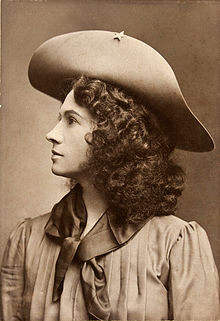
Modjeska stood out, stood tall, broke barriers, had vision, put her ass on the line, was generous and had a series of other definable characteristics, all as a woman in an era that was almost as constricted and stylized as sharia law when it came to women. She reminded me of another strong woman of about the same era: Annie Oakley.

Each may have had a quite self-serving agenda woven into their lives, but each had the courage to fend off and break through not just those who disagreed with them, but also those who agreed. Where the linguistic Puritans do not smother the scene, I would say both had balls.

Annie Oakley
Balls and I admire them. Partly, but as a lesser matter, I admire them for the trail they helped to prepare for all women (think "women's movement"), but mostly I admire them as human beings. I doubt that I would want to meet either one of them. As former Poet Laureate Billy Collins once observed about revered writers, "Meeting your favorite author is one of life's most reliable disappointments." But that doesn't dim my admiration.

And all of this mental cud-munchimg makes me wonder if there isn't an important difference between admiration and adulation. The line between the two may be thinner than an anorexic, but still, I wonder if a bit of tortured reasoning isn't in order ... separating what, for all I know, is inseparable.

This blog post may serve as a perfect example. Here I sit, mentioning a couple of famous women, women I admire, women I might adulate -- straight, strong, and no doubt conflicted ... human beings. However badly informed I may be, still I am grateful to them. They help to paint an admirable picture in my mind ... exhibiting and exercising traits I too might like to exhibit or exercise.

But simultaneously ... how many people do you know who mention the stars in the literary or spiritual or academic or athletic firmament merely as a means of assuring their own luster? If I talk enough about spiritual or athletic hot shots, does some of that luster rub off on me and elevate me in your eyes? It's a cheap-date technique, no doubt, but that doesn't mean it's not common.

From the couch-potato watching his favorite team play -- and cheering like a bandit -- to the utterly devoted spiritual apprentice who humbles himself before some authentic cross or liturgy or ritual or panoply of saints ... how much of it is admiration and how much of it is a means of activating some wider applause-meter ... the I-can-name-the-stars-therefore-you-might-wish-to-treat-me-as-a-star stuff... the devotee whose ability to get up off the couch is dubious at best... the sincere one resting on the laurels of sincerity?

I guess it's a human trait, getting caught up thinking that admiration should or could become adulation and that adulation is enough for an honest peaceful life. God knows I've been there and may yet again. But these days, I feel a bit more comfortable, as for example in Buddhism: Gautama is just another Helena Modjeska, another Annie Oakley, another example of something I admire, another instructor I find credible. Whether my own star is burnished in the mentioning of other stars is, in the end, useless, no matter how applause-worthy. No matter how I adulate or hug or praise such people, still I am stuck with the only farm I've got. Admiration strikes me as useful. Adulation does not.

What counts is the balls ... not dancing with the stars, just dancing.

Monday, September 9, 2013

the myth/tale of Israel

"Born and raised in Jerusalem in 1961, [Miko] Peled grew up in a prominent Zionist family; his grandfather signed Israel’s Declaration of Independence. His father, Mattiyahu Peled, fought in the 1948 war and served as a general in the war of 1967; later, after the Israeli cabinet ignored his investigation of a brutal 1967 Israeli war crime, he became a peace activist and leading proponent of an Israeli dialogue with the PLO." -- More from Wikipedia


found

Found without commentary on the porch steps today:


take your great teaching and stick it...

I am sick today. Sick and weak and I don't like it. Sick enough to think about seeing a doctor and I don't want to do that either. Not as sick as yesterday, it seems, but still nagged and weakened and wishing it would all go away.

Sick enough to be irascible -- if this is such a 'great teaching,' let those who mewl about 'great teachings' get taught!

I wonder who invented the word "shit!?"

"Shit" is such a wonderful word and even if words don't cure sickness, still they can be marvelous and mildly-soothing companions.

I think I'll stick with that:

Shit!

victory without a W

Painted and powerful and handsome, Serena Williams, 31, beat lanky and fluid and intense Victoria Azarenka, 24, in the U.S. Open tennis championship yesterday. Top dog from America defeated top dog from Belarus.

It was fierce to watch, even on TV. Even from an electronic safe distance, the intensity, the focus, and the unwillingness to fall prey to either despair or delight seemed palpable. This was no time for victory or defeat: Victory and defeat belong to the defeated ... this was serious. Each player made bad shots and good ones, but this was no time for "good" and "bad:" "Good" and "bad" would have dulled the blade necessary for this serious matter. This was serious. This was everything.

After the match, trophy in hand, Williams was quoted as saying, "I'm already thinking about what I could have done better. I think I'm a little crazy in that (way), like something must not be right because I don't even relish the moment enough." (Italics added.) She was also quoted as remembering how and why she got into tennis in the first place: True, her father had pressed her to do it, perhaps for the money, but she never thought about the money, she said, she just thought, "I want to win."

On the face of it, the situation was laden with victory and defeat. Thousands of fans sat in the sunshine in Arthur Ashe Stadium in Flushing, N.Y., to applaud and bask and be excited by a W (win). And the players too came to win a trophy and bragging rights and a lot of money. To win, to lose, to emerge victorious or defeated ... that's how games are played; that's how goals are formatted ... and in one sense, it's all true enough.

But what of the sense that "I don't even relish the moment enough?" What about the sense that the format of victory falls short of honesty? Sure, the majority of onlookers and the majority of the mind may accede to the format of victory ... but why is there a disconnect between the wildly-cheering victory and the sense that victory simply cannot put a period on the sentence? Why does a W fail to put its promised period on the sentence?

In the midst of any serious endeavor -- in the very middle of the thoughts, words and deeds required; in the place where gain and loss simply cannot be allowed to enter -- isn't it pretty much the same for anyone? It doesn't have to be some athletic contest -- any endeavor will do ... the kind of endeavor where 'why' and 'because' don't fill the bill and in fact get in the way; where the effort is whole-hearted and there is no time for extras: This is my life and it is so much my life that to say it's my life would be superfluous and, worse, gum up the effort. This is this ... everything and nothing all at once.

And later, later when the trophies are handed out and the crowd applauds and even I think I ought to be applauding ... later it is gone ... poof! What had been the blood of my precious blood in the moment is now ... well now it devolves into victory or defeat, a poor man's arena that cannot begin to describe or enter the whole-life that was expended in the attaining of it.

Has anyone not been to this seemingly strange land -- the one in which they are no longer doing something 'in order to' achieve something? The one in which relish and despair are not the point? The one in which "I do what I do because I do it ..." but the "I" is no longer a factor? The one that is filled with imperative and yet the imperative cannot be named.

I'm not so sure that it is a strange land. In the world of applause meters, perhaps it sounds screw-ball or scary and simply to express aliveness -- to let life live -- sounds too distant and lonely and contrary to all up-bringing. And yet who has not been there and later wondered why, somehow, s/he did not "relish" the victory enough?

Is it any wonder that military Medal of Honor winners feel embarrassed and confused and somewhat less than honorable?

Does life claim victory over life? I doubt it, but to acknowledge this land without victory strikes me as a potential W. It may not fit in the trophy case, but it does provide a savory relish.

Sunday, September 8, 2013

question/koan

Why do you keep asking questions to which you already know the answer?

wait for me!

The littlest ones, the ones slower and younger and weaker, always bring up the rear.

"Wait for me!" they call out to older and more competent companions -- their brothers and sisters who seem so impossibly big and knowledgeable and assured.

"Wait for me!"

I too want to be happy and fleet and strong.

"Wait for me!"

I too want to be perfect and whole and relaxed.

"Wait for me!"

I can see you up ahead or hear you around some nearby corner or imagine the likely places you might be... places I too want to be.

"Wait for me!"

Have you no pity, no kindness? I am little and weak and slow. I am trying my best and yet always I am in the rear, trying to join your perfectly coherent band, to burn as bright or smell as sweet.

I never quite catch up, never quite make it, never quite attain, never quite ascend ... never become enfolded in some envisioned certainty ...

Until one day, quite by chance, I hear the voice behind me calling ...

"Wait for me!"

seamless and smooth

A grey morning, sky as seamless and smooth and quiet and unrepentant as whipped cream.

How different might things be if the sky were to wake up each day hoping to become a prom queen or a car mechanic or a sage?

It may sound weird, but stranger things have happened.

Pass the strawberries, please.

Saturday, September 7, 2013

zendo visitors

For 'karma' buffs, I suppose it is either "good karma" or "bad," but I haven't got what it takes to play that game: Two people, quite independent of each other, contacted me today about coming here to practice zazen (the seated meditation of Zen Buddhism) tomorrow morning.

Two people?! I haven't touted the zendo in years and have gotten used to the peace and quiet that no-people can provide. Maybe there's some "karma" in it all. I've scratched my mental head and tried to remember what a "Zen Buddhist" is.

Two people are coming for a Sunday sitting. Out of nowhere -- two people.

I always enjoy meeting new people, but seldom imagine they will be interested in anything as minuscule as zazen. So tomorrow looks to be kind of nifty and kind of weird.

In advance of the event, I put out more energy than I really felt like and went out and gave the zendo a quick cleaning, added some new greens to the altar, and straightened of the cushions. The spiders were not amused. I want to be a good host, but I'm pretty rusty.

Then I smoothed out my mind a little with some mental Valium: "The only usefulness of anything that might be called a "Zen teacher" is his or her willingness to demonstrate to others what sort of jackass they don't need to be" -- i.e., be yourself.


OK ... that's enough of that. Time for a shower and some sleep.

KKK meets NAACP

I suppose there are a hundred reasoned analyses that could call the whole thing a stunt or a ruse or lie or a means of burnishing a tarnished image or phony as a three-dollar bill ...

But at the same time the U.S. is squirming in its efforts to find 'sound' reasons for its upcoming attack on Syria, there was something touching about the week-ago face-to-face sit-down between the representatives of the KKK and the NAACP in Wyoming. The meeting was thought to be the first of its kind between the two race-based organizations.

The Ku Klux Klan has a storied history of self-absorbed exclusiveness and cruelty. Its vile ignorance is not as unaffecting as its opponents might suggest, but lynchings and white supremacy are not generally part of the subtler repertoires.

The National Association for the Advancement of Colored People was formed in 1909 "to ensure the political, educational, social, and economic equality of rights of all persons and to eliminate racial hatred and racial discrimination."

The tip of the journalistic iceberg a week ago was that  Jimmy Simmons, the head of the Casper NAACP, and John Abarr, a KKK organizer, sat down and talked to each other. On the surface, it was dogs-and-cats, lions-and-lambs ... the unusual stuff that news organizations seek out and detail. At the end of the meeting, Abarr filled out an application to join the NAACP ($30) and made a $20 donation.

Was anyone's mind changed during the meeting? Was each faction jockeying to be seen in a better light? Was it all a ruse? Was the objective to make one kind of bullshit or another smell sweeter? Post facto, judgments and suspicions rained down upon the meeting.

But what crossed my mind was how important I think it is to revisit in concrete ways the conclusions anyone might accumulate over time. No matter how abounding the proof, no matter how elevating the glory, no matter how searing the sorrow, no matter how mountainous the 'facts' ... still, the willingness to set aside the "everyone knows that" (or, perhaps more important, "I know that") is one of the few capacities that helps to bolster an honest and potentially happier lifestyle. And just because a revisitation results in the same conclusion is no reason to sidestep a careful, face-to-face, from-the-get-go reassessment. It may be exhausting and it may feel like an exercise in futility and a waste of time ... but still....

Sit down with your black man. Sit down with your white man. It may be phony as a three-dollar bill. Do it anyway.

Living on conclusions and answers may be the best anyone's got, but it is such a fragile and incomplete lifestyle....

But that's just my conclusion.

Friday, September 6, 2013

"The Typewriter"

 Received in email ... for those of us old enough to remember what a typewriter is/was:

Leroy Anderson (1908-1975) was an American composer of short, light concert pieces, many of which were introduced by the Boston Pops Orchestra under the direction of Arthur Fiedler.  As with all his other compositions, Leroy Anderson wrote "The Typewriter" for orchestra, completing the work on October 9, 1950.  This particular orchestration was performed in a June 12, 2011 concert by members of the National Orchestra and Chorus of Spain in Madrid.


swimming with sharks ... the news

Nick Vujicic, an Australian motivational speaker who was born without limbs, swims with sharks at the Marine Life Park in Singapore, September 5, 2013.
REUTERS/Edgar Su

-- As the U.S. swims without protection among the no-win options in regard to the bloody civil war in Syria, it is hard not to think that whatever America does, it will water the same 'terrorist' soil that allegedly brought down the World Trade Center towers on Sept. 11, 2001. Others, including China and the American public, may demur, but the wheels on the bloody bus go 'round and 'round. The U.S. will strike and then pretend to be surprised/concerned/compelled by the unintended consequences that spend more American blood and treasure. Poor old America -- do nothing and you're fucked; do something and you're fucked. The problem, of course, is that the "you" in this, as other, instances is "us."

-- And you actually thought encryption might protect some modicum of Internet privacy! And to think that there are those who call Edward Snowden a traitor.
US and UK intelligence have reportedly cracked the encryption codes protecting the emails, banking and medical records of hundreds of millions of people.
Disclosures by leaker Edward Snowden allege the US National Security Agency (NSA) and the UK's GCHQ successfully decoded key online security protocols.
They suggest some internet companies provided the agencies backdoor access to their security systems.
--  And, harkening back to an age whose lessons were not learned, Adolf Hitler's personal body guard has died at 96. Rochus Misch attended the World War II dictator through thick and thin, right up until the end. "He was no brute. He was no monster. He was no superman," Misch said of the man he called "the boss."

Dragons rise up, blood-thirsty and furious, and dragons pass away, depleted and forgotten ... leaving the rest of us to cope with their infuriated, latter-day spawn.

leftovers ... with apologies

Most mornings, with a regularity that seems to be only slightly less compelling than taking a leak, I write. It's a long-standing habit and I try not to repeat myself ... and naturally fail. But writing takes energy and my energies are not always all they might be. This morning I spent some energy on a Buddhist bulletin board ... and pretty much shot my wad on a couple of responses which, for the moment, I cannot do better than regurgitate here. Oh well ....

The first response was on a thread entitled "We have no control":
My point is, even the smallest things depend on so many variables that it would be arrogant to believe we have any sort of control.
@betaboy -- My view is that there is nothing wrong with positing top-lofty observations that critique the current scene. Control is a serious, trip-stone ingredient in anyone's life, but trying to gain control by mentioning it hardly stills the waves.

The only option that makes much sense to me is to enter the world of arrogance -- of which we are all so deliciously capable -- and exercise the abilities of courage and patience and doubt. Where oh-so-smart intellect and oh-so-compelling emotion cannot still wind and waves, what actually clears things up and offers some chance at success?

My view: Pay attention; take responsibility; and see what happens. No one ever lived a happy, healthy life on a diet of kool observations.


The second response was on a thread entitled "Your body and strength:"

Someone once said of Buddhism (approximately), "Understanding is knowing not to cross the street in the face of an on-coming bus. Practice is for the bus you didn't see coming."

No one can outflank or out-think or out-believe life. No one can know the future and the future is invariably filled with buses no one saw coming... the times when all the skill and all the muscle in the world cannot address or solve or save the current circumstances. There are times when you can only do what you can do and what you can do is not very much.

If this is so, as I think it is, then there are two options -- either dissolve into a blob of helpless, hand-wringing, determinist jelly or develop a practice whose aim is not so much to cure things as to see them clearly. And if the latter course is chosen, then each individual must work with the capacities s/he has. You want strength -- OK, do physical strength. You want smarts -- OK work on being smart. You want love -- OK work on love. But no excuses, no pretenses this time -- just work on it, investigate it, and get to the bottom of it. It's not what something called "Buddhism" offers to you that counts; it's what you -- you personally -- bring to Buddhism.

Will such an investigation fend off the buses you didn't see coming? Don't be ridiculous! Will you save the world and lay all the nastiness to rest? Don't be silly. Just take what you have -- body, mind, intention and action -- and look into things.

There is no guarantee that such a course of action will work. Buddhism is a crap shoot. No one can know the future. But the question many Buddhists are faced with is a very simple "I may not know if it'll work, but is my current course working any better?" All the frou-frou promises of spiritual life may be very nice, but it is only individual willingness and action that elevates those promises from the fart-in-a-windstorm category.

Sorry for so much wind.


So much for stale bread and flat beer.

Thursday, September 5, 2013

what is useless

Once, as a very green editor at a book-publishing house, I was detailed to travel south out of New York and spend a weekend with John Bartlow Martin (1915-1987), a guy about whom I knew precisely nothing. My boss wanted me to read all of Martin's magazine pieces, precis them, and bring back recommendations for a collection that would allow the company to pay Martin for an in-the-meantime book while he worked seriously on what would later become an 800-page biography called ''The Life of Adlai E. Stevenson.''

As Martin sat at a cluttered dining room table, meticulously going over Stevenson's check-book stubs, I sat in another room, reading article after article. Most were non-fiction. I may have been exhausted by the effort, but even as a rank beginner, I could see this was good writing with a liberal leaning I enjoyed. Martin loved the little guy and so, with less evidence, did I.

When it came to meals and other social interaction, Martin was polite and open and generous. He put me at my ease. And at one point I could not help but ask him about his magazine writing: How had he gotten all that detail about the people and events involved? I had the sense that if I asked him which side of his head the local sheriff parted his hair on, Martin would have known. He admitted he was a stickler. He wanted to know everything, even if he never used it, because even if he didn't use it, the material added body and heft to what he did use.

For example, speaking of a horrific head-on collision in which, if I remember correctly, nine teenagers were killed, Martin told me that he knew the composition of the highway on which the night-time crash had occurred ... down to six or eight inches. Macadam, gravel, sand, tar ... he knew it all and not a single word had made it into the article itself.

I sat listening with what I hoped was a look of polite interest on my greenhorn, twenty-something face. I had a grasp on the agile defenses of politeness that could camouflage so much, so I was polite on the outside. Inside, my mental jaw had dropped to the floor: I was positively in awe of this guy whose efforts and outlook were all blood, sweat and tears. This was a guy who did work I could recognize as work -- and honor as work -- and yet ... he never even used it. I was drooling within to do as well... to know, even if I never used it. In my eyes then, and to a certain extent still, this was a man of substance, a guy who walked the talk. A first-class act.

Some years later, working as a newspaper reporter, I once gathered information for a five-part series on alcoholism. It was inspired, in part, on the fact that my mother was an alcoholic. At that time (1972), alcoholism was not widely recognized as the biggest drug problem in the United States. For example, in the course of researching, I heard that the New York Times had sent  three reporters to various parts of the country in order to assess what the biggest drug problem in the U.S. was. To a man, each of the reporters returned and said alcohol was the number one offender. Their editor did not believe them and sent them all back out to get written affidavits attesting to the their findings. The story was so bizarre that, as I did my own research, I called up the New York Times to find out if the story were true. I finally got hold of one of the reporters and he informed me that the story was, indeed, true.

Anyway, I gathered information for my series and as I did so, the research materials piled higher and higher on my desk. There was no Internet ... just books and reports and pamphlets and hospital budgets and cumulative costs to business and wrecked cars and home lives and interviews with dozens of different people. This stuff grew higher and higher on my desk. I had no place else to put it.

By the time the series came out, there were something like 500 pounds of paper material on my desk ... and that was just the most crucial stuff. The five articles, when saved in a folder together with a first prize from a New England news organization, weighed in at less than 12 ounces.

I didn't remember John Bartlow Martin then, but I do now. Not that I would put myself on a reporting par with him, but in the sense that I too had learned a little about the composition of the highway ... and never said a word about it. Had that unused research informed and brought depth to what I did? I believe it did but I sure as hell couldn't prove it. I had put heart and soul into the project and was exhausted by the time it was done, but how much of the accomplishment was attributable to what was known but never mentioned ... what was 'useless?'

I think about all this when I sometimes hear my children or others suggest, "why bother?" Why bother really digging in and digging down? Why bother following rivulets of curiosity that never amounted to anything? If it has no use, it must be useless. But is that really true?

Maybe it is, but I know I dislike talking with what I think of as the feather-merchants of any profession or topic -- the ones who can read the label on a can and regurgitate the information as if it were true; the ones who can quote the quotes and the quotes are appropriate, but the substance is missing ... the quotes are just a way of elevating their stock in a conversational or professional setting; the ones who have the answers without ever probing and living the questions. Feather-merchants.

Why bother? I can't pretend to know the answer to that. But I know that feather-merchant results are like eating a cake that is labeled "chocolate" but has so many short-cut fillers that it is the furthest thing from honest-to-god chocolate. I have no problem with someone who says, "I don't know." But I do have a problem with those who know the answer and imagine the answer is all they need.

I'm no longer so grouchy about the feather-merchant mentality. It may be dangerous and spread sorrow, but, well, the feather merchants are likely to inherit the earth. I do know that I appreciate those who dive deep and then, like as not, never even use it. There's meat on that bone and every once in a while I get hungry.

Is what is useless ever useless?

I doubt it.

Feathers may encourage flight, but I get irritable when the best that can be seen is a well-feathered nest.

sesshin

An email this morning told me that the writer had just come from his first sesshin in 30 years. Sesshin is the intensive retreat practice in Zen Buddhism -- a time from a couple of days to seven or more, generally. The retreat is devoted to silent meditation sitting, some walking meditation and a talk now and then. Yes, they generally feed you.

The email took me down a few minutes' worth of memory lane during which it occurred to me:

Everyone gets something different out of sesshin, I imagine. But one of the nice things -- or anyway one of the things I liked/hated -- was the fact that after sesshin there was no way in hell you could tell anyone what you had been doing for a week. For those unfamiliar with Zen practice, it sounded ... well, a bit weird, perhaps. But what was even more confounding was the fact that you couldn't even tell people who had been to precisely the same sesshin what had happened.

Sure, you could try. And sure, you could skirt the edges of one thing or another, but the fact was that no matter how heart-felt the effort, no matter how much you wanted to be "honest," something always seemed to be missing and every attempt was somehow half-assed and incomplete. At a time when you might wish to be your most open and clear and authentic, it was fake.

At first, I hated that fact.

Later I learned to relax and be grateful.

"Internet addiction" and "fairy circles"

-- In Pennsylvania, a hospital has set up an in-patient lock-down withdrawal clinic for "Internet addiction." Ten days cut off from a fix with the assistance of a large staff.

-- And, in the world of "fairy circles" ...

"The bizarre circular patches of bare land called "fairy circles" in the grasslands of Africa's Namib Desert have defied explanation, with hypotheses ranging from ants to termites to grass-killing gas that seeps out of the soil. But the patches may be the natural result of the subsurface competition for resources among plants, new research suggests."


the perfect moment


Suddenly, a coffee mug comes true...
Suddenly, a single facet of chandelier glass lets loose...
Suddenly, a kiss, unlike the hundreds that have preceded it, becomes a kiss...
Suddenly, the grubby bubble gum on a summer sidewalk fills up...
Suddenly, the pine tree along some glassy pond at dawn becomes, inexplicably, a pine tree...
Suddenly ....

Perrrfect.

Who has not felt that nanosecond of wonder in which things become complete ... complete beyond complete? When doubt is simply irrelevant. And who would not sell his soul to return to that moment that made perfect sense and had nothing to do with "making sense" or "wonder?" Again and again and again, anyone might try to replicate the action and conditions that, in that nanosecond, opened out into a perfection that left "perfection" in the dust.

But the replication never works. Trying has nothing to do with the "suddenly" moments, the moments which seem to arrive unbidden and leave all else in the shadows. And so the experience that was unbidden recedes into beckoning memory and the inadequate ministries of poets and spiritual salesmen... another bit of Tupperware to be attained.

What was incomparable sinks back into comparisons and contrasts, a merchandizing effort that found no footing in that single nanosecond that was a coffee mug or a kiss. Heaven is left to rely on hell and hell, of course, on heaven. Religion flourishes, but only on the basis of relief. Relief and wonder and bliss ... and it never works. If god, by whatever name, were as true as a coffee cup or a kiss, who in his right mind would trouble himself with religion and its bartering? When things come true, what miracle could that possibly be?

None of this matters much ... except that there is that nanosecond of the past, the time so assured that no man could claim it. Settling for wonders is such a dreary business. But it is a good pointer, I think. If the longing is somehow other than a coffee mug or a pine tree, then it has strayed from the nanosecond that inspired it, the one in which trying became strangely irrelevant ... just like "completeness".

The one nanosecond anyone might sell their soul for ... the one in which "wondrous" and "hellish" find no footing ... utterly personal and yet having nothing to do with preference or wonder or relief. The nanosecond that seems to point out that I have been making a mistake. It's not really a big deal, making mistakes, but that doesn't mean mistakes cannot be corrected. Asking a coffee cup to change its mind is an insane man's pastime. Sort of like yearning for heaven at the expense of hell.

It's a pity to forswear the nanoseconds that beckon. But if forswearing -- as through wonder or relief -- is the only game in town, go ahead and forswear, go ahead and try, go ahead and, while standing under a blue sky, proclaim it blue. Forswear and forswear and forswear until the energy runs out and at last ... it's just a coffee mug, right?

What nanosecond was ever alone ... or conjoined either?


Wednesday, September 4, 2013

Bedouin greeting

A nice nutshell of a greeting I always liked and was told came out of the Bedouin culture:

                 I SALUTE YOU AND I THANK YOU FOR YOUR LIFE.

snippets of news

News that caught my eye ...

Sergio Garcia
-- In California, an illegal Mexican immigrant who passed the California bar exam (on the first try) is seeking a law license -- a request many approve, but the Department of Justice does not.
The federal law was "plainly designed to preclude undocumented aliens from receiving commercial and professional licenses issued by states and the federal government," the DOJ said in court papers after the state's high court asked for the federal government's position.
In the long-running argument about "illegal immigrants," those immigrants are often relegated to professions like house-keeper and pool boy and pea-picker and fast-food worker. It's never spelled out that way, but that's the feeling that debaters bring to the topic. Sergio Garcia has met the educational demands of his profession and yet is badgered and questioned and suspected of all sorts of failure even though he has clearly been a success. So it goes in the land of -- sort of -- opportunity.

-- In a tone of ill-concealed anguish, my friend Frank sent me an email today that said, "Do I have a randomly skewed view, or has the US government and the American media basically ignored the fact that there are some 2 million Syrian refugees?" As the U.S. debates the possibility of military retaliation for the gas attack that left between 350 and 1,400 dead and dying Syrians, the plight of these refugees has lately received a kind of back-burner, heart-throb attention ... but really, everyone is thinking about front-burner war. Ain't-it-awful just does not have the simplistic cachet of a Scud missile. I mean sure, we care and all, but the complications and implications and hard work are too damned daunting. Moral indignation, like any other, seeks out a quick fix. Waging war is just plain easier than waging peace so .... 

Those who favor a strike will suggest that without reshaped conditions of power, no peace can be waged. But when anyone looks at the peaceful efforts in Iraq and Afghanistan ... where's the evidence? ... how much are they outshone by the righteous flash-bang of more death? How much bombing is necessary before the conditions for peaceful work are achieved? And once achieved, how many efforts are actually made to implement the conditions of peace? Perhaps if we sent our legislators to live in Iraq or Afghanistan there might be a different debate.

Two million refugees represent something more than 57 times the population of the bucolic, academics-and-Volvo-strewn community in which I live. Wipe out my home town 57 times over ....

-- Ariel Castro, a 53-year-old who pleaded guilty to 937 counts of  kidnapping, rape and aggravated murder as a means of escaping the death penalty, was found hanged in his Ohio prison cell Tuesday. Castro had held three young women hostage for close to a decade before one escaped and police were summoned. Castro was sentenced to life without parole plus 1,000 years. Did he jump or was he pushed ... did he hang himself or was he helped along in the endeavor? I suppose it doesn't matter, but it seems strange that a man who would accept a plea deal in order to escape the death penalty would then implement that penalty himself.

the good teacher

Everyone's been there and done that, I imagine -- sat in an audience while the teacher droned on and on and on, not so much as a means of addressing what you don't know but more as a springboard for elevating what s/he does. Under cover of 'helping' and 'compassion' such teachers pin endless medals of wisdom on their own chests.

It's pretty fucking tedious, but seldom is the practice called out because, after all, this is the teacher and I am the bumbling, stumbling, fumbling student.

There's a precarious line that separates the good teacher from the self-indulgent one, but still, hope springs eternal: I would, after all, prefer not to bumble and stumble and fumble quite so much.

Perhaps being left out of the equation is one of the prices paid for solving the equation.

cell phones in church


"don't lie"

Most religious and many secular organizations pay some homage to the encouragement, "don't lie." The encouragement is variously observed, but it is one encouragement.

Death, like lies, is variously observed in religious and secular settings. From gloomy to giggling to glorious, it is variously observed and I don't mean to make light of it, but did it ever cross anyone else's mind ....

Death, as one marker in life, is just an excuse for others to start lying about you.

Consider Jesus or Gautama or Mohammed. Granted, these were pretty high-profile guys, guys with more stature than you or me, but still, I think the principle is the same: Drop dead and the lies begin because the dead person is no longer around to correct or despair of or even wallow in the observations.

Would Jesus or Gautama or Mohammed really be willing -- if they were alive today -- to shoulder all of the accolades or opprobrium or shiny organizational building blocks that named them as inventors? Would they take that responsibility and embrace their complicity? Wouldn't that be more than any sane man would shoulder? Where would the room be to pick their noses or laugh at a good joke or snore or eyeball a hot chick at some local watering hole?

By what right or reality does death confer the smooth and soothing willingness to lock these men -- or any others -- up in a jail cell of convenience and convention? Wouldn't that be a death beyond death -- a denial of life ... and a lie?

And what's sauce for the goose is sauce for the gander: No need to be a high-profile spiritual leader or a villainous dictator. Uncle Howard and Aunt Minnie, once dead, suffer a similar fate, however benevolent and healing the intention and however limited their tableaux: Lock 'em up and throw away the key. These were "good" people or "famous" or "benevolent" or "evil" or ... well, there is no end to the shaping lies that limit a life that lacked any such limits. Most of us will suffer such a fate in very limited ways -- ways limited to family and friends and enemies.

Is there a truth anywhere that cannot and will not encourage the plumage of a lie? I doubt it. So I guess the best anyone can do when observing the encouragement "don't lie" is to acknowledge the lies they are bound to tell. Lies, like death, are not simply harmful or spooky, they are also just an aspect of life. Acknowledge, yes.

But don't fret too much: Life has a way of coming around to bite the liar on the ass. Consider the fate of guys like Jesus or Gautama or Mohammed. Consider the jail cells of applause or catcalls. Would you want anyone lying about you that way?

Isn't your life more interesting than that?

Tuesday, September 3, 2013

gloomy, sunny day

A delicate, delicate, delicate crescent moon rose in the eastern sky this morning ... seductive as a whisper ... beckoning to the sun.

I slept poorly last night, perhaps because today is the day I have to go to the bank and find a way to scrape together the rent/mortgage money. It is a prospect I do not like: A sense of being behind the financial curve is like a hungering case of body odor ... present and inescapable. And an email from the local newspaper editor saying he would "think about" the article I submitted (tr. I think I'll give this one a pass) seems to add to the B.O. blues.

My mother used to say, "Don't get hungry or tired." Hungry-and-tired skews the view and enhances a sense of being behind the eight ball. I am tired and imagine I should eat some breakfast. Being afraid of anxiety and sadness is a young man's sport, but a little cereal probably wouldn't hurt.

And now the sun is up, enticed from its darkened lair by a delicate, delicate, delicate crescent moon. It reminds me of the old saying, "A man chases a woman until she catches him."

"Burning Man"

Pippin, his Playa name, chats on the phone during the Burning Man 2013 arts and music festival in the Black Rock Desert of Nevada, September 1, 2013. The federal government issued a permit for 68,000 people from all over the world to gather at the sold out festival, which is celebrating its 27th year, to spend a week in the remote desert cut off from much of the outside world to experience art, music and the unique community that develops. REUTERS/Jim Urquhart
Dust envelops art installations during the Burning Man 2013 arts and music festival in the Black Rock Desert of Nevada, September 1, 2013. REUTERS/Jim Urquhart 


"Trying to explain what Burning Man is to someone who has never been to the event is a bit like trying to explain what a particular color looks like to someone who is blind. In this section you will find the peripheral definitions of what the event is as a whole, but to truly understand this event, one must participate."

Monday, September 2, 2013

beauty

Beauty, I suppose, requires distance.

The further away, the more beautiful a thing becomes ...

Until, at last, the distance becomes unbearable

And you turn around, reverse direction, and come so close

That at last the beauty can reveal itself.

No ... more ... beauty.

a love of institutionalization

Just thinking out loud....

Institutionalization of any given longing or goal is destined to corrupt the longing and goal for which the institution was created. You can take that to the bank. "Pure as the driven snow" as the goal may be, still, once institutionalized, the soot falls together with the silvered flakes.

In Zen Buddhism, for example, it is pretty much an institutional given that "there is an unbroken lineage" from the time of Gautama to the current setting in which that unbroken lineage is posited. For anyone willing to fact-check, this is a tortured bit of unreconstructed horse-pucky at best. (Check out Stuart Lachs who addresses the subject even if I am too lazy to dig out the specific citations just at the moment.)

I don't think it is unusual that institutionalization screws the pooch in any field of endeavor. The problems arise when anyone claims the institution does not, in fact, screw the pooch as regards the intended goal or solution or improvement. Just look at the buck and shuffle the Vatican has been reduced to of late as it tries to maintain an ascendant institutional position when its flaws (priest abuse, hierarchical autocracy, etc.) are put on parade. And "authentic" Buddhists are not hard to find.

I'd call it a sine qua non ... where there is an institution, it's time to be wary at least, assuming anyone takes the goal seriously.

But no one ever entered a sociable dining hall looking for a table-for-one. There is consolation and inspiration in company, so the impetus for institutionalization is very human and understandable. Let's eat together and inspire each other. Let's have an institution that will codify our social longings. I'd call this human.

OK, the goal may inspire some serious longing. The institution may provide a beckoning expression of intent. AND the institution is bound to screw the pooch. Those who think the institution cannot or would not screw the pooch lack sufficient experience ... or anyway that's my guess.

Devotees may yowl with anguish when they discover that their beloved has betrayed their love, that they have, in some sense, been had. But this is not to suggest the institution needs to be torn down. It is to suggest that whatever the institution, within or without, it is up to the devotee to find the truth within the lies. Supporting or criticizing the institution is not so much the point ... the point is that all formats have flaws (and some of them are damnable flaws indeed), but the truth that lay in the original longing is not to be denied. Does this mean another institution needs to be erected -- something more pure and noble and free from flaw? Maybe ... but all institutions, improved and otherwise, suffer from the same flaw. Those who, for example, claim a desire to return to the teachings of Jesus or Gautama have not yet returned far enough.

Just something to think about, I guess.

academic credentials ... or not

Noodling idly this morning, it occurred to me that academic accomplishments are a bit like the old joke about male endowment: "It's not the size that matters, it's what you can do with it that counts."

And the analogy holds true right down to the hopeful recipients who may whisper emphatically behind cupped hands, "Size DOES matter!"

What brought this to mind was a wider personal interest: Are there any studies out there that attempt to measure the relative intelligence/happiness levels of those who attend institutions of higher learning and those who don't? I don't mean just the money and privilege ... I mean in real time, between life's covers.

There are plenty of people who are smart as a whip and yet remain dumber than a box of rocks. And there are plenty of people who are dumber than a box of rocks who are just that -- dumber than a box of rocks.

Education is often touted as a key to success and those who lack it are mourned as people who have been denied an important opportunity ... an opportunity to step out of poverty, an opportunity to see possibilities, an opportunity to connect life's dots. I too can make some of that argument, but this morning I think of those people I know who lack academic degrees and whose outlooks I find refreshing and compelling and credible. They have had to rely on themselves and -- with a little luck -- have not turned out to be narrow-minded nitwits espousing some cult cause or flag-waving belief system. They seem to know stuff from the ground up ... "street smarts" it might be called, but whatever it's called, it is refreshing and convincing to hear their views because they really seem to know what they seem to know.

Is there an enormous difference between the bozos who are endowed with academic verve and those who are not? Similarly, is there an enormous difference between the savvy people endowed with academic verve and those who are not?

I'm still thinking about all this and may find the capacity or energy to turn it into a newspaper submission, so I leave it there for now ... finding the sweet spot between academic credentials and a lack thereof ... I'm still thinking about it.

Sunday, September 1, 2013

exit and entry

Since you cannot leave the zendo and never could, what pauper's psaltry led you to believe you could go in the first place?

Or leave
Or go
Or leave
Or go
Or leave
Or go

living in another's grave

Wrapped up in another's blankets,
Tucked in tight against the chill,
Put one more around my shoulders --
Loving, right and wise and kind.

As perfect as a winding sheet
These blankets protect, defend and save
Until perhaps the sun comes up
And shines warmly on another's grave.