Sunday, February 9, 2014
soaring and swooping
Like Messerschmitts and Spitfires, small birds dive and chase outside the porch windows this morning.
As far as I can tell, their intent is not as lethal as the Battle of Britain when the English sent up waves of under-armed (the ammunition was too weak to penetrate with assurance, but no one mentioned it) fighters to meet the German onslaught. Death was the hope in that swooping and soaring and derring-do during World War II: This morning's jinking and juking seems to spell spring and the woo-hoo of life.
With mounds of snow still on the ground, it all seems a bit premature, this rite of spring. But who am I to judge the seasons of life or the antics of small birds?
Today as well, a friend called to tell me his heart was acting in ways that, in the past, had informed him that something was more-seriously amiss. He was headed to the hospital.
These are conversations that the elderly pursue outside the hearing of the soaring, chirping young whose death is not yet assured.
Beneath the words, there is the whisper, "perhaps this is death ... who knows?"
Soaring and swooping under blue, blue skies.
old friends
Old friends understand. They really do.
And so today, the tendrils of guilt find small purchase in the face of an understanding I know my backyard zendo will extend. It is an old friend, this small building fifty or sixty feet behind the house where I live. Year after year, I have visited, at least on a weekly, Sunday basis, but sometimes more as well. We have become old friends, as slap-happy and inane as that may sound.
After so many years, I trust my old friend will understand that today I will not visit. The fallen snow is too much to shovel and I will do a little zazen in the house and imagine that my old friend will understand.
The zendo has never been happy in my visits and there is little reason to imagine it will be sad in my absence: Buildings don't 'understand.' But in this lack of 'understanding,' we understand each other as old friends do. We are tight as ticks with no tightness possible ... what better friendship could there possibly be?
It has been years and years (if ever ... I really don't recall) since I missed a Sunday sitting in the zendo that I built in 1998. But today I will not visit my old friend. Yesterday, I even turned away one prospective visitor: Besides the inability/unwillingness to shovel snow and create a physical path, there is a growing unwillingness/inability to extend myself metaphorically for 'others' ... a chore that can be as effort-ful as shoveling snow.
Old friends do not expend effort or extend themselves. "Sacred" and "profane" are too imaginatively arrogant.
They are old friends and that is enough.
And so today, the tendrils of guilt find small purchase in the face of an understanding I know my backyard zendo will extend. It is an old friend, this small building fifty or sixty feet behind the house where I live. Year after year, I have visited, at least on a weekly, Sunday basis, but sometimes more as well. We have become old friends, as slap-happy and inane as that may sound.
After so many years, I trust my old friend will understand that today I will not visit. The fallen snow is too much to shovel and I will do a little zazen in the house and imagine that my old friend will understand.
The zendo has never been happy in my visits and there is little reason to imagine it will be sad in my absence: Buildings don't 'understand.' But in this lack of 'understanding,' we understand each other as old friends do. We are tight as ticks with no tightness possible ... what better friendship could there possibly be?
It has been years and years (if ever ... I really don't recall) since I missed a Sunday sitting in the zendo that I built in 1998. But today I will not visit my old friend. Yesterday, I even turned away one prospective visitor: Besides the inability/unwillingness to shovel snow and create a physical path, there is a growing unwillingness/inability to extend myself metaphorically for 'others' ... a chore that can be as effort-ful as shoveling snow.
Old friends do not expend effort or extend themselves. "Sacred" and "profane" are too imaginatively arrogant.
They are old friends and that is enough.
Saturday, February 8, 2014
some pictures of the week
| The Tungurahua volcano erupts in Banos, Ecuador, February 1, 2014. REUTERS/Cris Toala Olivares |
| A graveyard is seen underwater in the village of Moorland in south west England, February 7, 2014. REUTERS/Toby Melville |
| A Central African Army soldier stabs the corpse
of a man, who was killed as he was accused of joining the ousted Seleka
fighters, in the capital Bangui, February 5, 2014. REUTERS/Siegfried Modola |
the Olympics
![]() |
| The Winter Olympics opened in Sochi, Russia, yesterday. The enormous event is made smaller by the throngs of reporters, each striving in his or her own way to make the event seem enormous-er. How I love the abilities of great athletes doing astounding things. And how I hate the television coverage in my country -- a coverage that bends over backwards for the best American performers rather than what I love -- the best performance. |
borrowed bubble gum
Feeling about as original as last night's lima bean, I'll borrow someone else's bubble gum this morning and let them blow the bubbles ... and try not to succumb to the ever-popular preening as if the light cast were my own.
The following quotes are lifted from Brian Victoria's 2007 essay, "Holy War: Towards a Holistic Understanding:"
But what interests me more and what I think is more important is that without acknowledging -- indeed, embracing -- these and other down sides of spiritual adventure, the spiritual adventurer is doomed to a half-known world of hosannas and sweet talk ... and the richness of the world he claims to espouse can never be realized. Dimwitted praise and posturing and public relations become ascendant and a rich reality goes begging. And this, from where I sit, is an enormous pity.
Truth to tell, I am not sure who is worse off -- the one who delights in pointing out that the emperor has no clothes or the one who claims that he does. Half a loaf may be better than none, but it is still only half ... and a greater nourishment will forever be out of reach.
And in what does that 'greater nourishment' consist? No man can tell another the answer to that question, but individuals can choose to discover the answer.
The following quotes are lifted from Brian Victoria's 2007 essay, "Holy War: Towards a Holistic Understanding:"
-- Men never do evil so completely and cheerfully as when they do it from religious conviction. -- Blaise Pascal, "Pensées"For me, the importance of these observations does not lie in the dancing intellectual delight critics can take in pointing out that religion is more full of hypocritical shit than a Christmas turkey. I wouldn't for a moment deny them that delight since, on the blood-stained cloth of history, the criticisms are certainly warranted.
-- Whenever a society must motivate its members to kill or to risk their lives, thus consenting to being placed in extreme marginal situations, religious legitimations become important. … Killing under the auspices of the legitimate authorities has, for this reason, been accompanied from ancient times to today by religious paraphernalia and ritualism. Men go to war and men are put to death amid prayers, blessings, and incantations. -- Sociologist Peter Berger
-- Positive thinkers and public relations officers for the faiths would repudiate this notion or evade the fact. They want religion to be nothing but gospel, good news. Apologists for the faiths usually minimize the distress that can come with religion or that religion can produce. You will not read about the destructive element in religious impulses in the advertisements for the church of your choice. Yet if the pursuit of truth is still to be cherished as a foundational theme in the academy, one must note the feature of religion that keeps it on the front page and on prime time: it kills. Or, if, as the gun lobbies say of weapons—that they do not kill; people do—one must say of religion that if it does not kill, many of its forms and expressions motivate people to kill. Experts on what motivates the scores of wars or, as some would have it, “tribal conflicts,” today know that not only do many belligerent partisans wear names like “Protestant” and “Catholic,” “Shi’ite” and “Sunni,” “Jewish” and “Sikh,” but leaders and followers alike fire on the demonized Other, the enemy, in the name of God or the gods. -- Martin Marty, "An Exuberant Adventure...."
But what interests me more and what I think is more important is that without acknowledging -- indeed, embracing -- these and other down sides of spiritual adventure, the spiritual adventurer is doomed to a half-known world of hosannas and sweet talk ... and the richness of the world he claims to espouse can never be realized. Dimwitted praise and posturing and public relations become ascendant and a rich reality goes begging. And this, from where I sit, is an enormous pity.
Truth to tell, I am not sure who is worse off -- the one who delights in pointing out that the emperor has no clothes or the one who claims that he does. Half a loaf may be better than none, but it is still only half ... and a greater nourishment will forever be out of reach.
And in what does that 'greater nourishment' consist? No man can tell another the answer to that question, but individuals can choose to discover the answer.
Friday, February 7, 2014
idealism ... activism
Last night I got into rewatching "Reds," a 1981 movie about the life and times John Reed, author of "Ten Days That Shook the World," a much-acclaimed and moderately-good first-person account of the the Russian Revolution of 1917.
Though a bit fluffy, the movie is shot through with portrayals of the socialists, communists, artists and activists of the era. It was a time of considerable idealism in artsy Greenwich Village on Manhattan's lower west side and around the world. It was a time when people got the shit kicked out of them by police sent to quell protests over working conditions, women's rights, voting and a number of other issues. Watching the movie made me feel I were watching an earlier version of a today that is likewise tinted by waxing oppressions, though the expressions are often less bald and, as yet, patently brutal.
The Soviet dictator Joseph Stalin would later complain that he had not been given enough prominence in Reed's book. Reed focused more sharply on the thought-shapers and idealists of the Revolution -- Vladimir Lenin and Leon Trotsky.
And perhaps Stalin was right. Lenin and Trotsky helped light the idealist fuse that overthrew an imperial Russia ruled by tsars, but Stalin was a good example of the harsh dictatorship that followed in the idealist wake. Had Reed lived (he died in 1920 and was buried in the Kremlin wall), his idealism might have been tempered by the ruthless realities that followed from a bold and shining dream. On the other hand, maybe it wouldn't: Like George Orwell in "Homage to Catalonia," Reed did not pretend to be "objective" ... he was hip-deep in ideas and ideals.
Revolution! Change! Idealism! "Reds" is shot through with boisterous ferment, even if the actors and actresses are almost all nicely dressed and intelligent and hence, somehow, fluffy. Idealism addresses real issues, but those real issues have blood coursing through their veins and can be higglety-pigglety in their workaday realities.
"Reds" is not especially gritty, though it splices in interviews with individuals who could actually remember the people being portrayed in the Hollywood version of events. It is as if the movie hoped, through historical testimony, to lend credibility and substance to the somewhat fluffy actors.
And in one such bit of historical testimony, a fellow observes:
A guy who's always interested in the condition of the world and changing it either has no problems of his own or refuses to face them.I can imagine activists everywhere cringing at being nailed so neatly to the wall. No one has "no problems" so what is it s/he might be refusing to face? Is s/he chickening out and what would be the upshot if s/he didn't chicken out? And further, does such a redirecting of energy and intent serve a worthwhile purpose ... more worthwhile, perhaps, than getting to the well-tailored bottom of his/her own problems?
What at first seems a painful thrust strikes me as simply opening a discussion. Sometimes activism can serve as a camouflaging cover-up. Sometimes the cover-up simply pales by comparison with the positive results that can and sometimes do evolve. And sometimes, perhaps, there is no cover-up at all... though I admit to being skeptical about that, given the interconnectedness of events and thoughts.
I can't help but think of the activists and do-gooders who have shown up here to practice zazen or seated meditation. Many have been wrung out, confused, bereft and limp as a wet wash cloth. Somehow all of their very-good efforts have not brought them an envisioned peace of mind. They need a new perspective and as yet have no idea what that perspective might be. Some imagine they need to throw in the activist towel -- fuck activism! -- and take up, perhaps, gardening... or any other activity that would not demand so much energy with such mixed results.
I've seen the same wan confusion on the faces of those who have pursued spiritual adventures as well: So much effort, so much time, so much sacrifice for what can feel like a depressing bupkus: I...can't...do...this...any...more.
It is at this point that others may offer chitter-chatter about expectations and how they need to be reworked. OK, it may be true. But I think there is something to be said for just allowing the confusion and sense of loss have its day. It may be confusing and the way forward may be unclear and the disappointment may be vast, but ... well, a little quiet helps to still the noise.
Or maybe not ... it's just a discussion.
Thursday, February 6, 2014
after the snow
speed-trap warnings OK'd
Drivers who pass through police speed traps and then flash their lights to warn oncoming drivers of the trap that awaits them are on solid constitutional grounds, a Missouri court has ruled.
Speed traps provide income to many a small town and you can imagine that the cops and town fathers might be irked if their best laid plans should go awry.
Of course official reasoning cites "safety" as the main concern when it comes to radar-reliant speed traps, but the safety involved has a strange tendency to generate welcome income.
Speed traps provide income to many a small town and you can imagine that the cops and town fathers might be irked if their best laid plans should go awry.
Of course official reasoning cites "safety" as the main concern when it comes to radar-reliant speed traps, but the safety involved has a strange tendency to generate welcome income.
probing a tale of survival
Could Jose Salvador Alvarenga really have set sail from Mexico in December of 2012 and survived the 13 months at sea that ended last week when he landed 5,500 miles from home in the Marshall Islands?
The Associated Press attempts to sort out the probabilities of such a tale as Alvarenga told.
CNN reports that Alvarenga's health has deteriorated and that he is back in the hospital.
The Associated Press attempts to sort out the probabilities of such a tale as Alvarenga told.
CNN reports that Alvarenga's health has deteriorated and that he is back in the hospital.
yanking an Ivy League chain
Passed along in email:
| A realistic statue of a sleepwalking man in jockey shorts has gotten upscale Ivy League women's college Wellesley's knickers in a twist. |
tabernacles and tantrums
Doesn't all spiritual life begin as wishful thinking? This morning, in a somewhat sleep-deprived state, I think it does... wishing the spring floods would not wash away the newly-planted crop; wishing the loneliness could be appeased; wishing for some surcease that can hardly be named; wishing the shoelace might never break; wishing for a realm in which wishing was no longer so insistent.
And from that initial wish, however it shapes itself, it is easy to find others who have similar wishes, similar longings, similar uncertainties. Like bits of blobulous mercury on a table top, the wishes meld into each other and suddenly -- spiritual or otherwise -- the tabernacles and tantrums of a social effort coalesce and religious communities take shape.
The harmonies of a collective voice are warming, soothing, convincing and seem to take the edge off what had begun as a single cry, this solo wish. Religions are born and you can see their gilded roof peaks from afar. What was wishfully alone now has company. God, it is lovely to be in the company of fellow believers! How long I have wished alone! How grateful to be assuaged in the company that knows my song!
In secret times, I used to think there was some trick to spiritual life, to religion, to codified wishful thinking. Of course I never called it a trick ... but in secret times I wished it might be so -- that if I sang my hymns loud enough or ironed my robes perfectly enough or prostrated frequently enough or followed the rules closely enough or believed deeply enough then, suddenly, at some unknown time, my wish would be fulfilled ... some light switch would be flicked and ... and ... and things would suddenly be OK ... and even better than OK ... sort of a super-OK ... not blissful, perhaps, but super-OK. "Heaven," perhaps, or "enlightenment" or some realm whose name I honestly didn't know but wished for ... secretly I thought it might descend upon me. Secretly, I thought there was a trick and I, like other credulous companions who had come before, could know it... and in knowing it, my wishful thinking might come true.
And who knows -- maybe I was right. Maybe there is indeed a trick. And if there is, then perhaps it can be stated in this: You have to be what others only believe. You have to step away from the enfolding chorus of wishers and well-wishers, the ones who diluted the loneliness and fired up the determination and shaped a scene of tabernacles and tantrums. Step away into the place that once was just a formative wish. Step away and stand up.
To step away in this way means that you can now move freely among the believers. Their tabernacles and tantrums are OK. Not imperative, but OK. Wishful thinking is OK. Not imperative, but OK. Step away and there is no improvement ... you simply are what others may choose to believe.
Are things "better?" Yes and no: When you step away, the word "better" does not compute ... and it is better. The trap snaps shut, but the quarry is (so to speak) missing.
It's tricky shit ... without the trick.
I sure do wish I could hit the lottery!
And from that initial wish, however it shapes itself, it is easy to find others who have similar wishes, similar longings, similar uncertainties. Like bits of blobulous mercury on a table top, the wishes meld into each other and suddenly -- spiritual or otherwise -- the tabernacles and tantrums of a social effort coalesce and religious communities take shape.
The harmonies of a collective voice are warming, soothing, convincing and seem to take the edge off what had begun as a single cry, this solo wish. Religions are born and you can see their gilded roof peaks from afar. What was wishfully alone now has company. God, it is lovely to be in the company of fellow believers! How long I have wished alone! How grateful to be assuaged in the company that knows my song!
In secret times, I used to think there was some trick to spiritual life, to religion, to codified wishful thinking. Of course I never called it a trick ... but in secret times I wished it might be so -- that if I sang my hymns loud enough or ironed my robes perfectly enough or prostrated frequently enough or followed the rules closely enough or believed deeply enough then, suddenly, at some unknown time, my wish would be fulfilled ... some light switch would be flicked and ... and ... and things would suddenly be OK ... and even better than OK ... sort of a super-OK ... not blissful, perhaps, but super-OK. "Heaven," perhaps, or "enlightenment" or some realm whose name I honestly didn't know but wished for ... secretly I thought it might descend upon me. Secretly, I thought there was a trick and I, like other credulous companions who had come before, could know it... and in knowing it, my wishful thinking might come true.
And who knows -- maybe I was right. Maybe there is indeed a trick. And if there is, then perhaps it can be stated in this: You have to be what others only believe. You have to step away from the enfolding chorus of wishers and well-wishers, the ones who diluted the loneliness and fired up the determination and shaped a scene of tabernacles and tantrums. Step away into the place that once was just a formative wish. Step away and stand up.
To step away in this way means that you can now move freely among the believers. Their tabernacles and tantrums are OK. Not imperative, but OK. Wishful thinking is OK. Not imperative, but OK. Step away and there is no improvement ... you simply are what others may choose to believe.
Are things "better?" Yes and no: When you step away, the word "better" does not compute ... and it is better. The trap snaps shut, but the quarry is (so to speak) missing.
It's tricky shit ... without the trick.
I sure do wish I could hit the lottery!
Wednesday, February 5, 2014
"Kids for Cash"
Kindly referenced below as a comment in "a militarized America" is a documentary that opened today in Philadelphia.
"Kids for Cash" documents thousands of Pennsylvania kids sent to jail by two judges who took $2.6 million in kickbacks from the builders and owners of privately operated prisons.
If the horror of six or seven assault-rifle-armed cops entering an apartment when executing a warrant for someone alleged to have committed credit-card fraud is spooky/terrifying ("a militarized America"), how much the worse is it to envision a system in which the judiciary sends away our children for minor infractions ... for years? And yes, Mr. and Mrs. Not-My-Kid, these kids were frequently white.
This is not turn-the-other-cheek territory, this land in which both the fear and the purported defense against that fear are commingled and manipulated by the same hands.This is a territory in which, I am ashamed to say, I suspect gun-ownership may turn out to be the only refuge.
This is a realm of rabid behavior.
And when confronted by a rabid animal, there is seldom a non-violent choice.
"Kids for Cash" documents thousands of Pennsylvania kids sent to jail by two judges who took $2.6 million in kickbacks from the builders and owners of privately operated prisons.
If the horror of six or seven assault-rifle-armed cops entering an apartment when executing a warrant for someone alleged to have committed credit-card fraud is spooky/terrifying ("a militarized America"), how much the worse is it to envision a system in which the judiciary sends away our children for minor infractions ... for years? And yes, Mr. and Mrs. Not-My-Kid, these kids were frequently white.
This is not turn-the-other-cheek territory, this land in which both the fear and the purported defense against that fear are commingled and manipulated by the same hands.This is a territory in which, I am ashamed to say, I suspect gun-ownership may turn out to be the only refuge.
This is a realm of rabid behavior.
And when confronted by a rabid animal, there is seldom a non-violent choice.
U.N. chastens Vatican
VATICAN CITY (AP) - A U.N. human rights committee denounced the Vatican on Wednesday for "systematically" adopting policies that allowed priests to rape and molest tens of thousands of children over decades, and urged it to open its files on the pedophiles and the bishops who concealed their crimes.
In a devastating report, the U.N. committee also severely criticized the Holy See for its attitudes toward homosexuality, contraception and abortion and said it should change its own canon law to ensure children's rights and their access to health care are guaranteed.
The U.N. blasted the "code of silence" that has long been used to keep victims quiet, saying the Holy See had "systematically placed preservation of the reputation of the church and the alleged offender over the protection of child victims." It called on the Holy See to provide compensation to victims and hold accountable not just the abusers but also those who covered up their crimes.
a militarized America
It's not quite clear from the TV news report, but it seems that six or seven police officers, dressed in battle gear and carrying assault rifles, burst into an Iowa home last Thursday as they executed a search warrant for someone who had used a credit card fraudulently. None of the people in the house had a criminal record beyond a dismissed theft charge. Police did not find what they were looking for. Needless to say, the police scared the crap out of the people inside.
Let me see: Six or seven heavily-armed men, under color of authority, are needed to apprehend a person or persons accused of credit card fraud? Here's a Washington Post blog post by Radley Balko that details the incident.
What scares the crap out of me is not so much the welcome-to-our-dictatorship implications of the Iowa incident but the sense that the whole matter will be written off or glibly camouflaged ... OK, the cops screw up now and then, but hey, it was just one bad-apple incident in a barrel of activity that will 'protect' us all in the long haul... sorta like drones and the massive gathering of private Internet or phone information. Let's just forget about this one incident, paper it over, and keep militarizing police and other forces.
It is somehow flabbergasting that the people who profit most by the sowing of fear and the 'defense' against that fear -- often red-white-and-blue, self-professed patriots -- see no downside to the diminution of democracy. I don't really expect them to feel shame -- they are a shameless lot -- but even at the level of income assurance, authoritarianism may keep the masses in line, but the flow of income is slowed.
Once, this country was a leader in thought and invention. Now, perhaps, it will be first as well in the ascendancy of the mediocre and ruthless and self-serving. No sense in letting Russia and China and third-world dictatorships get all the glory.
Let me see: Six or seven heavily-armed men, under color of authority, are needed to apprehend a person or persons accused of credit card fraud? Here's a Washington Post blog post by Radley Balko that details the incident.
What scares the crap out of me is not so much the welcome-to-our-dictatorship implications of the Iowa incident but the sense that the whole matter will be written off or glibly camouflaged ... OK, the cops screw up now and then, but hey, it was just one bad-apple incident in a barrel of activity that will 'protect' us all in the long haul... sorta like drones and the massive gathering of private Internet or phone information. Let's just forget about this one incident, paper it over, and keep militarizing police and other forces.
It is somehow flabbergasting that the people who profit most by the sowing of fear and the 'defense' against that fear -- often red-white-and-blue, self-professed patriots -- see no downside to the diminution of democracy. I don't really expect them to feel shame -- they are a shameless lot -- but even at the level of income assurance, authoritarianism may keep the masses in line, but the flow of income is slowed.
Once, this country was a leader in thought and invention. Now, perhaps, it will be first as well in the ascendancy of the mediocre and ruthless and self-serving. No sense in letting Russia and China and third-world dictatorships get all the glory.
Tuesday, February 4, 2014
be-song-ing
When I die, I think I'd like to become a song.
Naturally, I'd like to become a song I like, but, the more I think about it, any song will do.
Even if only the singer likes it or sings it, that's what I think I'd like to be: Edgeless, un-own-able, and somehow moving.
Maybe someone else will bring a banjo and we can be-song together.
Naturally, I'd like to become a song I like, but, the more I think about it, any song will do.
Even if only the singer likes it or sings it, that's what I think I'd like to be: Edgeless, un-own-able, and somehow moving.
Maybe someone else will bring a banjo and we can be-song together.
burnout
Burnout.
Yesterday, I went over to the local paper to get my picture taken. I dislike having my picture taken, not least because it memorializes for all posterity just how unphotogenic I seem to be ... and there it is, staring me in the face.
The paper needed a head shot to go with a monthly column I recently agreed to write. Having come to the agreement last Friday, and being as anal-retentive as I can be, I immediately went home and wrote something, which I then sent to a couple of friends for reaction.
They were kind enough to indulge my request, but the key word is "kind." I realized that I didn't really want "kind," I wanted a gut-level, brass-knuckles assessment: Was the piece internally consistent and logical? Was it sluggish and boooorrrrring? How did it feel? How did it taste?
The topic is religion's contributions and encouragements to the world of war ... the contradictory nature of thou-shalt-not-kill combined with religion's implicit and explicit encouragements to kill in a time of state-sponsored conflict.
Anyway, when I went over to the paper to get my picture taken, I stopped by the executive editor's desk (the guy with whom I had struck the deal) and asked him if he'd run a comb through what I had written thus far. He agreed and then -- will wonders never cease? -- passed along his comments later the same day. The critique was not unkind, but it felt like open-heart surgery without the anesthetic.
And as soon as I received it -- being as anal-retentive as I can be -- I went to work revising and reshaping. I stayed up past my bedtime. I felt the piece shape-shifting -- losing its seriousness, taking on the ballast of mediocrity ... but getting less abstruse and perhaps a little clearer into the bargain. I didn't feel that I HAD to make corrections according to the suggestions; it's just that I could see their point and usefulness and therefore made some changes.
The effort was focused and without any awareness of time.
I went to bed exhausted and simultaneously wired.
Which accounts, perhaps, for the almost-entirely-blank-slate that greeted me this morning when I looked around for something to write.
Yesterday, I went over to the local paper to get my picture taken. I dislike having my picture taken, not least because it memorializes for all posterity just how unphotogenic I seem to be ... and there it is, staring me in the face.
The paper needed a head shot to go with a monthly column I recently agreed to write. Having come to the agreement last Friday, and being as anal-retentive as I can be, I immediately went home and wrote something, which I then sent to a couple of friends for reaction.
They were kind enough to indulge my request, but the key word is "kind." I realized that I didn't really want "kind," I wanted a gut-level, brass-knuckles assessment: Was the piece internally consistent and logical? Was it sluggish and boooorrrrring? How did it feel? How did it taste?
The topic is religion's contributions and encouragements to the world of war ... the contradictory nature of thou-shalt-not-kill combined with religion's implicit and explicit encouragements to kill in a time of state-sponsored conflict.
Anyway, when I went over to the paper to get my picture taken, I stopped by the executive editor's desk (the guy with whom I had struck the deal) and asked him if he'd run a comb through what I had written thus far. He agreed and then -- will wonders never cease? -- passed along his comments later the same day. The critique was not unkind, but it felt like open-heart surgery without the anesthetic.
And as soon as I received it -- being as anal-retentive as I can be -- I went to work revising and reshaping. I stayed up past my bedtime. I felt the piece shape-shifting -- losing its seriousness, taking on the ballast of mediocrity ... but getting less abstruse and perhaps a little clearer into the bargain. I didn't feel that I HAD to make corrections according to the suggestions; it's just that I could see their point and usefulness and therefore made some changes.
The effort was focused and without any awareness of time.
I went to bed exhausted and simultaneously wired.
Which accounts, perhaps, for the almost-entirely-blank-slate that greeted me this morning when I looked around for something to write.
Irish music
Woke on this shimmering pink morning with a couple of Irish songs rattling around in my head -- one a love lament, Eileen Aroon, and the other a wry and rollicking appreciation of death, Isn't It Grand, Boys.
There was no especial reason or associative connection I could see in the arrival of this music. It seemed to pop up out of nowhere and I just enjoyed it and felt a little like a jukebox into which someone had dropped a couple of quarters.
Monday, February 3, 2014
man survives 13 months at sea?
It seems an iffy tale at the moment, but that doesn't stop it from being a tale worth telling: A man who says he set sail from Mexico on a shark-fishing expedition in December of 2012 came ashore Monday in the Marshall Islands, some 5,500 miles away. He survived on fish, birds and turtles.
Nothing wrong with telling a whopper, if whopper it be, from time to time: Consider the nooks and crannies of spiritual life. And who would have imagined the Seattle Seahawks could trounce the Denver Broncos as they did yesterday, 43-8, in football's Super Bowl?
reality check
I had thought it was the Bible itself, but it seems to have been St. Augustine, one of the titans of Christianity, who observed in a more-delicate-but-nonetheless-pointed Latin that all of humanity is born "between shit and piss." (Inter faeces et uriname nascimur.)
This bon mot may be taken in a number of ways, I imagine, but one of them is as an encouragement not to get too big for our britches -- something along the lines of "we all put our trousers on one leg at a time." The observation can act as a reality check in what may be a heart-felt sea of credulous certainty or religio-philosophical swooning.
A chain-yanker.
Heaven knows that anyone could occasionally do with a yanking of his or her soaring chain -- to be brought down from the nosebleed heights of some dearly-beloved understanding. Spiritual life or no spiritual life, I think this is true. But, since I am interested in spiritual adventure, I think it is particularly true in that realm.
The question that enters my mind is not so much whether such a reality check is necessary, but rather why.
In ordinary terms, I suppose we might wax smarmy about the advantages and good sense of exhibiting some humility in the course of daily life. Fat heads are a dime a dozen and a little perspective never hurt ... starting in the bathroom mirror, perhaps. But praising humility and attempting to live within its confines is a bit facile from where I sit. Sometimes I think there are as many humble-pie bad actors as there are self-involved blowhards. So why else might St. Augustine or any other decent spiritual adviser yank my chain?
My Zen teacher's teacher once asked a student (or perhaps gathering ... I wasn't there): "Which is more important -- sitting or shitting?" The slickly quick-witted will know immediately that this is a trick question. Intellectually, it's not hard to evade the thrust. Zen practice leans heavily on the fiery and sometimes ferocious business of seated meditation (zazen). The meditation is aimed -- or so it can seem -- at "attaining enlightenment" or something similar. "Attaining enlightenment" is sometimes portrayed as all-important in the realm of Buddhism and hence it is easy to see why anyone might give sitting a very, very, very important place: The odds of "attaining enlightenment" drop off significantly in the mind of someone devoted to zazen when zazen is taken out of the equation.
And into this framework of intense devotion and practice, suddenly someone delivers the very ordinary function of shitting: Get real! Get a life! Cut the crap! But why? Is it simply to teach a lesson in oh-so-serene humility ... a world of Steppin Fetchit devotion to some overarching wonder like "Buddhism" ... some institution or institutionalized thought realm like the Catholic church? Is the encouragement meant to lift up the institution or philosophy or religion while putting the arrogant devotee in his place? Well, there are certainly people who insure their own stature or the stature of their institution by playing this card... it has a way of producing donations, dontcha know.
But I think there is a more important role that down-home, chain-yanking observations play. Their object is not so much to instill fear or a toe-in-the-sand humility or to create cookie-cutter saints. Rather, their function is to encourage the devotee to know that spiritual life means whole life. It's not just the soaring possibilities of heaven or the dreary potential of hell -- the wonders of enlightenment and tut-tutting about delusion or ignorance: It's just your life and how many lives can anyone lead?
Everyone shits, everyone pisses. Everyone is born, everyone dies. Everyone is ignorant, everyone is enlightened. Zen students sit and Zen students shit. Some days are better than others ... but still, it's whole life, isn't it? Just how long is anyone willing to be batted back and forth between better and worse, perfumed and stinky, elevated and diminished?
Can anyone escape these facts? So ... is there a sensible reason for trying?
Sometimes -- that's sometimes ... no need to make a self-serving fetish out of it -- indirection is the most direct route.
Take a shit or take a sit ....
See what I mean?
This bon mot may be taken in a number of ways, I imagine, but one of them is as an encouragement not to get too big for our britches -- something along the lines of "we all put our trousers on one leg at a time." The observation can act as a reality check in what may be a heart-felt sea of credulous certainty or religio-philosophical swooning.
A chain-yanker.
Heaven knows that anyone could occasionally do with a yanking of his or her soaring chain -- to be brought down from the nosebleed heights of some dearly-beloved understanding. Spiritual life or no spiritual life, I think this is true. But, since I am interested in spiritual adventure, I think it is particularly true in that realm.
The question that enters my mind is not so much whether such a reality check is necessary, but rather why.
In ordinary terms, I suppose we might wax smarmy about the advantages and good sense of exhibiting some humility in the course of daily life. Fat heads are a dime a dozen and a little perspective never hurt ... starting in the bathroom mirror, perhaps. But praising humility and attempting to live within its confines is a bit facile from where I sit. Sometimes I think there are as many humble-pie bad actors as there are self-involved blowhards. So why else might St. Augustine or any other decent spiritual adviser yank my chain?
My Zen teacher's teacher once asked a student (or perhaps gathering ... I wasn't there): "Which is more important -- sitting or shitting?" The slickly quick-witted will know immediately that this is a trick question. Intellectually, it's not hard to evade the thrust. Zen practice leans heavily on the fiery and sometimes ferocious business of seated meditation (zazen). The meditation is aimed -- or so it can seem -- at "attaining enlightenment" or something similar. "Attaining enlightenment" is sometimes portrayed as all-important in the realm of Buddhism and hence it is easy to see why anyone might give sitting a very, very, very important place: The odds of "attaining enlightenment" drop off significantly in the mind of someone devoted to zazen when zazen is taken out of the equation.
And into this framework of intense devotion and practice, suddenly someone delivers the very ordinary function of shitting: Get real! Get a life! Cut the crap! But why? Is it simply to teach a lesson in oh-so-serene humility ... a world of Steppin Fetchit devotion to some overarching wonder like "Buddhism" ... some institution or institutionalized thought realm like the Catholic church? Is the encouragement meant to lift up the institution or philosophy or religion while putting the arrogant devotee in his place? Well, there are certainly people who insure their own stature or the stature of their institution by playing this card... it has a way of producing donations, dontcha know.
But I think there is a more important role that down-home, chain-yanking observations play. Their object is not so much to instill fear or a toe-in-the-sand humility or to create cookie-cutter saints. Rather, their function is to encourage the devotee to know that spiritual life means whole life. It's not just the soaring possibilities of heaven or the dreary potential of hell -- the wonders of enlightenment and tut-tutting about delusion or ignorance: It's just your life and how many lives can anyone lead?
Everyone shits, everyone pisses. Everyone is born, everyone dies. Everyone is ignorant, everyone is enlightened. Zen students sit and Zen students shit. Some days are better than others ... but still, it's whole life, isn't it? Just how long is anyone willing to be batted back and forth between better and worse, perfumed and stinky, elevated and diminished?
Can anyone escape these facts? So ... is there a sensible reason for trying?
Sometimes -- that's sometimes ... no need to make a self-serving fetish out of it -- indirection is the most direct route.
Take a shit or take a sit ....
See what I mean?
Sunday, February 2, 2014
bartender joke
Passed along in email...
This is SERIOUSLY NOT for the pure of heart, the raunch-averse, or anyone who is inclined towards right speech: Bartender joke.
Republicans etc. for illegal drugs
Legalization of drugs seems to be gaining an unlikely ally -- the otherwise moral straight arrows of big business. Between clean-living and money, I think we can guess where a bought-and-paid-for Washington will eventually come down. And you thought illegal drugs were just for the hippy-dippy constituency.
Case in point: Colorado's recently-approved marijuana laws have hit a snag. Many banks and credit-card companies will not process pot-sale credit-card transactions because they fear the fallout from federal laws that still make marijuana illegal. Without credit-card transactions, the tax bonanza (almost $20 million this fiscal year with skyrocketing potential thereafter) Colorado expected from marijuana sales threatens to go up in smoke as pot is forced into an all-cash business: If you can't track it, you can't tax it.
I just have a feeling that clean-living advocates are about to have a change of heart ... but of course, as usual, they will not take responsibility for it.
Case in point: Colorado's recently-approved marijuana laws have hit a snag. Many banks and credit-card companies will not process pot-sale credit-card transactions because they fear the fallout from federal laws that still make marijuana illegal. Without credit-card transactions, the tax bonanza (almost $20 million this fiscal year with skyrocketing potential thereafter) Colorado expected from marijuana sales threatens to go up in smoke as pot is forced into an all-cash business: If you can't track it, you can't tax it.
I just have a feeling that clean-living advocates are about to have a change of heart ... but of course, as usual, they will not take responsibility for it.
Marijuana is considered an illegal drug by the federal government, and laws such as the Bank Secrecy Act carry severe penalties for banks. Last week, U.S. Attorney General Eric Holder said the feds will soon issue regulations opening banking services to state-sanctioned marijuana businesses.
Saudi Arabia leads the way
Coming soon to a 'legal' system near you:
DUBAI, United Arab Emirates (AP) -- Saudi Arabia's King Abdullah has ratified a new counter-terrorism law that rights activists say criminalizes speech critical of the government or society.The law states that any act that "undermines" the state or society, including calls for regime change in Saudi Arabia, can be tried as an act of terrorism. It says that any Saudis and non-Saudis, both in the kingdom and abroad, can be tried under the new law for assisting in such acts.Police can also raid homes and offices without prior approval. One activist says the law essentially codifies practices already largely in place in Saudi Arabia. He spoke anonymously for fear of retribution.The law, which is 41 articles long, went into effect Sunday. It was published in full in the government's official gazette Um Al-Qura Friday.
getting stuck
To the extent that spiritual effort has a direction or goal, I think that sometimes it gets turned on its head.
Spiritual effort is not about getting where you aren't.
Spiritual adventure is about getting where you already are.
Being where you are means you can go anywhere.
Being where you aren't means you get stuck.
Spiritual effort is not about getting where you aren't.
Spiritual adventure is about getting where you already are.
Being where you are means you can go anywhere.
Being where you aren't means you get stuck.
Saturday, February 1, 2014
poor food for poor folks
I always like it when someone gives an on-the-ground report of some bit of ballyhooed goodness or altruism ... as for example this article passed along in email about the diet provided to an elderly woman who once had dietary choices but now has none ... and relies, like Blanche DuBois, on "the kindness of strangers" who might see their own kindnesses as kind.
ancient unexplained structures
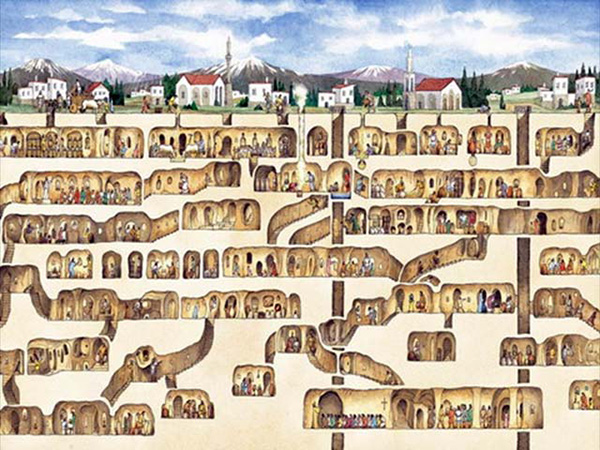
Passed along in email, this article about ancient and very advanced structures, including an 18-story underground dwelling in Turkey that could sustain 20,000 people and dates from 2,800 years ago ... and possesses magical acoustics.
writer's angst
As if collecting the bits and pieces of a broken glass on the kitchen floor, today I sweep up the shards remaining after I stayed up past my bedtime last night. I shouldn't do that, but I did.
Yesterday's activities led me to stay up late ... late and writing and thinking and writing some more.
I met Larry Parnass, the executive editor of the local paper, in a cafe that lies about equidistant from his work and my home. We had made a cup-of-coffee bet about whether President Barack Obama would mention the recent death of folk singer Pete Seeger in his State of the Union Address. I lost the bet -- Obama did no such thing -- and I went to the cafe to pay up.
The cafe itself was awash in colossally-white people who seemed to be doing things like "networking." They were all -- I swear it, all! -- wearing the kind of casual shoes you can buy in stores that have "hiking" in their names ... not really hiking shoes, but looking as if the wearer were an outdoors enthusiast ... striding the sylvan paths, eating impeccable food and healthy, dontcha know ... healthy and (sotto-voce) well-heeled in a way that would never mention its economic comforts. People sat with their laptops open or with sections of the New York Times held earnestly before their eyes.
The coffee and pastries really were good and soon enough Larry and I were ensconced in an easy conversation that blotted out the WASP-y surroundings that I couldn't have recognized if I weren't similarly infected. We chatted newspapers and personal lives ... it was very comfortable. The Gazette -- the local paper -- is small and hometown and feeling all the Internet bruises that larger papers are. I like it, but its demise seems to be foreordained.
Finally, Larry got around to what I had half-suspected he was going to get around to -- how would I like to write a monthly column for the paper for which I had written several columns before? I would have carte blanche for subject matter and the newspaper would remunerate me with a free subscription ... which constituted a pay hike, since everything I had previously written was for free. Anyway, because I am retired and because I write daily as a matter of habit and because I like to shoot my mouth off and because not paying any bill (the newspaper subscription in this case) is good news on my fixed income, I said I'd do it. The ship may be going down, but it is a ship I am happy to go down with.
But the moment I said I'd do it, I felt a sense of angst and helplessness: What the hell was I going to write about? Never mind that I get up every morning with one topic or another tap-dancing in my mind ... seriously, what was I going to say? Where did I get off making a promise of the sort I had?! It was one thing to write freely but the matter seemed to take on a whole new quality when there was a promise and a deadline involved.
But then I got home and discovered there was in fact something I wanted to write about -- the complicity of religion in blood-soaked military adventures. The minute I discovered an actual-factual bit of subject matter, my mind was like a dog on a bone ... gnawing, gnawing, gnawing ... shaping the argument, trying to whittle it down to 750 words, finding ways to make it straightforward instead of just solemn. And that kept me up well beyond my bedtime. The deadline may be 20 days off, but I felt compelled to get it on the rails -- to make some initial effort, to see if it held water, to wonder whether the objective could be reached in so small a space. I wouldn't blame anyone for describing my concentration as "anal-retentive."
By the time I looked up, I had written a rough attempt, had been in contact with a fellow in Mexico who knew something about the St. Patrick's Battalion, had sifted through old emails that were relevant to the topic and was, for the moment, finished. It was 11:30 ... way past my bedtime.
And I woke up this morning paying the price.
Sleep is no joke.
Yesterday's activities led me to stay up late ... late and writing and thinking and writing some more.
I met Larry Parnass, the executive editor of the local paper, in a cafe that lies about equidistant from his work and my home. We had made a cup-of-coffee bet about whether President Barack Obama would mention the recent death of folk singer Pete Seeger in his State of the Union Address. I lost the bet -- Obama did no such thing -- and I went to the cafe to pay up.
The cafe itself was awash in colossally-white people who seemed to be doing things like "networking." They were all -- I swear it, all! -- wearing the kind of casual shoes you can buy in stores that have "hiking" in their names ... not really hiking shoes, but looking as if the wearer were an outdoors enthusiast ... striding the sylvan paths, eating impeccable food and healthy, dontcha know ... healthy and (sotto-voce) well-heeled in a way that would never mention its economic comforts. People sat with their laptops open or with sections of the New York Times held earnestly before their eyes.
The coffee and pastries really were good and soon enough Larry and I were ensconced in an easy conversation that blotted out the WASP-y surroundings that I couldn't have recognized if I weren't similarly infected. We chatted newspapers and personal lives ... it was very comfortable. The Gazette -- the local paper -- is small and hometown and feeling all the Internet bruises that larger papers are. I like it, but its demise seems to be foreordained.
Finally, Larry got around to what I had half-suspected he was going to get around to -- how would I like to write a monthly column for the paper for which I had written several columns before? I would have carte blanche for subject matter and the newspaper would remunerate me with a free subscription ... which constituted a pay hike, since everything I had previously written was for free. Anyway, because I am retired and because I write daily as a matter of habit and because I like to shoot my mouth off and because not paying any bill (the newspaper subscription in this case) is good news on my fixed income, I said I'd do it. The ship may be going down, but it is a ship I am happy to go down with.
But the moment I said I'd do it, I felt a sense of angst and helplessness: What the hell was I going to write about? Never mind that I get up every morning with one topic or another tap-dancing in my mind ... seriously, what was I going to say? Where did I get off making a promise of the sort I had?! It was one thing to write freely but the matter seemed to take on a whole new quality when there was a promise and a deadline involved.
But then I got home and discovered there was in fact something I wanted to write about -- the complicity of religion in blood-soaked military adventures. The minute I discovered an actual-factual bit of subject matter, my mind was like a dog on a bone ... gnawing, gnawing, gnawing ... shaping the argument, trying to whittle it down to 750 words, finding ways to make it straightforward instead of just solemn. And that kept me up well beyond my bedtime. The deadline may be 20 days off, but I felt compelled to get it on the rails -- to make some initial effort, to see if it held water, to wonder whether the objective could be reached in so small a space. I wouldn't blame anyone for describing my concentration as "anal-retentive."
By the time I looked up, I had written a rough attempt, had been in contact with a fellow in Mexico who knew something about the St. Patrick's Battalion, had sifted through old emails that were relevant to the topic and was, for the moment, finished. It was 11:30 ... way past my bedtime.
And I woke up this morning paying the price.
Sleep is no joke.
poor little rich boy
Passed along in email this morning came this Politico assessment of how the rich are "freaking out" in the face of mounting income-inequality criticism.
While the argument seems a bit tenuous, the divisiveness of the economic facts and the potential for class warfare (the kind with blood), strikes me as possible if not probable.
Subscribe to:
Posts (Atom)