Saturday, September 13, 2014

shadow of the wishbone


Rationally, wishbones and other soothsaying artifacts, are ridiculous. How is a chicken bone or a rabbit's foot or a coin or even a piece of the "one true cross" supposed to insure good fortune in the yet-to-come? Rationally, we're smarter than that.

And yet, what a long and compelling shadow the ridiculous casts. No matter how many times Charlie Brown tries to punt the football, still, Lucy pulls it away at the last moment and Charlie Brown ends up on his butt...again.

You hoped and believed and set aside the doubts that accumulated based on previous experience and ....

Aargh! Sometimes it's easier to believe what is unbelievable and stupid is smarter than smart because it feels better ... the shadow is too compelling and butt bruises seem to fade into the distance.


photos from Reuters

Serena Williams bounces a ball as she serves to Caroline Wozniacki of Denmark during their women's singles finals match at the 2014 U.S. Open tennis tournament in New York, September 7, 2014.
REUTERS/Adam Hunger
  
A handmade sign to deter trespassers hangs in the front yard of Fernando Rivera Jr.'s house in Brownsville, Texas September 2, 2014.
REUTERS/Rick Wilking
  
Olympic and Paralympic track star Oscar Pistorius reacts as he listens to Judge Thokozile Masipa's judgement at the North Gauteng High Court in Pretoria, September 11, 2014.
REUTERS/Kim Ludbrook/Pool
Former U.S. presidents Bill Clinton and George W. Bush laugh on stage during a Presidential Leadership Scholars program event at the Newseum in Washington September 8, 2014.
REUTERS/Jonathan Ernst

Friday, September 12, 2014

cancer

The nut-brown doctor said this afternoon that she hoped it would take four to six weeks to winkle out whether a nodule on my right lung were cancerous and to do something about it.

Medically, she is forced into a worst-case-scenario mode and to assume that, though small and potentially-treatable, the nodule is indeed cancerous. It might turn out to be benign. This cancer template comes on top of a series of other heart-related treatments that currently need fine tuning.

Cancer. I may be in denial, but there is something quite factual in it.

But also, I missed my nap today, so I can't really muster the energy to be frightened or depressed.

I suppose a good night's sleep can rectify that.

with thanks to the CIA

Never let it be said that the CIA is unwilling to do its part to 'protect' an American nation of 318 million people spread out over 3.71 million square miles.

A BBC story that lacks any internal substantiation asserts today that "the Islamic State (IS) militant group may have up to 31,000 fighters in Iraq and Syria - three times as many as previously feared. (italics added)"

The story is part of a wider set of announcements gearing up for U.S. military action in Syria and environs. On Wednesday, president Barack Obama announced, for example, a willingness to use American air power to help root out and destroy the IS -- Islamic State -- movement. By some convoluted logic, IS poses a direct threat to the United States.

As with al Qaeda before it, few if any specifics attend on IS' nefarious intentions in Cleveland or Mobile. The media provide enough information to frighten people, but not enough to inform them. It is easy to blame Osama bin Laden for the terror attacks in the United States on Sept 11, 2001, but it is less popular to recall that after the attacks, bin Laden denied any involvement despite previous attacks for which he gladly shouldered the public-relations responsibility. Only later did this leader of an organization guesstimated to number 200-2000 claim responsibility.

Let's see: If IS numbers 50,000, that means that the danger to U.S. 3.71 million citizens may exist, but also can be called small ... small enough to stop using paranoia as a means of running a government. True, diversionary tactics (tactics that cost untold millions) can divert attention from difficulties that actually afflict the nation, but still ... just because fear is a possibility does not mean it is credible or deserves to detract from serious problems.

Fear is so earnest and easy.

Thursday, September 11, 2014

Buddhist music = more and better rice

Farmers in a village in East China's Fujian Province have claimed that Buddhist music playing in the fields has helped them to increase their rice production.
Output in Liangshan village went up by 15% after residents installed 500 lotus-shaped speakers in the rice paddies to engulf the crops in a wave of soothing mantras, the Global Times newspaper reports. Local authorities say the musical rice fields also yielded larger grains, while the silent paddies with no music suffered from pests.

fondly held conviction

A bit fluffy-headed, but ...

What kind of (wo)man would not examine with care a circumstance or event that formed the basis of a belief that led to action that would be harmful to others?

I guess the answer is, damn near everybody. At some point, the mind calls for decisiveness and damn the contrary torpedoes, those bits and pieces of uncertainty or doubt that touch a fondly-held conviction or belief.

Still, even if there is no perfect certainty ... still I think it's worth examining: The greater the potential harm, the more thorough the examination.

On Sept. 11, 2001, passenger jets were crashed into New York's World Trade Center towers with devastating effect. Today memorial gatherings were held. Since 9/11, the carelessly-examined word "terrorism" has been given a big boost. After an investigation that left significant questions unanswered...

... last night, U.S. President Barack Obama OK's bombing strikes inside Syria and Iraq as part of a "relentless effort" to root out an Islamic State movement accused of extremism and, by some convoluted measurements, poses a threat to the United States.

Like Japan's invasion of China in 1937, there are always "good reasons." America has its reasons. The Islamic State has its. Whether those reasons are carefully or carelessly examined can help measure the depth of the folly to come.

And that goes for the good stuff as well... the utterly personal stuff.

Reactions to Obama's announcement.

Wednesday, September 10, 2014

more war ....


Thirteen years after the Sept. 11 terror attacks, this was supposed to be a season of relief, with Iraq managing on its own and most U.S. troops finally ending their combat duty in Afghanistan. Instead, Americans are bracing for another upsurge of military engagement in a region where one war blurs into another. Across the world, a generation has now grown up amid this continuous conflict, and there's no end in sight.
In 2009. U.S. President Barack Obama won the Nobel Peace Prize.

sesshin with Eido Shimano shut down

A Zen sesshin/retreat in progress at a Jesuit center in Switzerland has been halted after the Jesuits found out it would be hosted by Eido Tai Shimano.

Below is an excerpt of a letter from the director of the LaSalle-Haus describing what happened.

The retreat of Eido Shimano was not part of our program. The European Rinzai Sangha had rented our guest house and our staff was not informed about the coming of Eido Shimano.

Being a catholic retreat centre we have very strict rules regarding misconduct.

After having been informed of Eido Shimanos coming to our center and being aware of the fact that he is a a controversial figure regarding issues of misconduct, I informed him personally, that he had to leave our center which he did a day after the sesshin had started.

Yours

Tobias Karcher
 A more detailed look at the misconduct to which Karcher referred can be found on the Shimano Archive.

nacht und nebel


After World War II, she was awarded the Croix de Guerre and the George Cross for her valor, but during her training with the Special Operations Executive, she was described as “clumsy”, “pretty scared of weapons”, “not over-burdened with brains” and with “an unstable and temperamental personality.” 

Noor Inayat Khan
Whatever the truth was, Noor Inayat Khan was able to transmit vital information to the British during her brief underground life in occupied France. She outlasted many of her radio-transmitter colleagues, whose shelf-life was usually no more than six weeks before being rounded up by the Germans. Records would later show that she never gave information to her interrogators. 

Sold out by one of her own compatriots, she was eventually sent to a concentration camp in Germany, consigned to what he captors referred to as "nacht und nebel," (night and fog) Hitler's decree that aimed to ferret out those who resisted in conquored lands: "The decree was meant to intimidate local populations into submission by denying friends and families of the missing any knowledge of their whereabouts or their fate. The prisoners were secretly transported to Germany, vanishing without a trace." 

All of this and more like it was depicted more clearly on a public television program I watched last night. And a part of what I found interesting was that this 100-pound woman was the offspring of an American mother and a Sufi father, the latter of whom imbued her with pacifist tendencies, an encompassing view of human beings, and a vision of spiritual life that brought all persuasions together. Her spiritual life was not just an afterthought.

Noor Inayat Khan was, perhaps, deeply spiritual ... and became a spy.

And how true is that progression for anyone committed to spiritual practice -- a deep personal conviction and practice that leads the devotee not to being a monk or nun or other spiritual functionary but rather to expressing themselves according to time and circumstance and personal persuasion? It occurs to me that spiritual devotion is like the joker in a deck of cards ... it goes with any other card and redoubles or fulfills its meaning. Standing alone, a joker shows potential, but it is only in tandem that its light grows bright.

For a long time, I used to think that the only way to express an understanding of Zen Buddhism was to become a monk. Spiritual practice was the most important thing in the world and being sidetracked by other adventures was frivolous by comparison. How could anything hope to outshine the importance and clarity and universality of spiritual adventure? I was pretty damned serious....

Serious enough to sign up at an American monastery with an eye to becoming a monk. I was lucky enough to recognize within a couple of months that I was wrong: Whatever 'spy' lurked within began to clamor for a reality check. I was no monk. I might be less certain of what card I did want to attach this joker to, but monk-dom, while a perfectly understandable direction, was not for me.

Maybe there's a generalization in all this ... or maybe not. Maybe one thing to remember in serious spiritual practice -- the kind that grimaces at feather-merchant lip service -- is that the objective is to be who you are; to stop trying to be who you're not.

Easier said than done, perhaps. But ... do it anyway. Why consign a perfectly good joker to a world of night and fog?

Tuesday, September 9, 2014

money and morality

Turkey is unlikely to sign any energy deals with Israel for the construction of a gas pipeline to Turkey because of a deepening political rift over Israel's Gaza offensive, Turkish Energy Minister Taner Yildiz said on Tuesday.
Ties were severely damaged following a deadly raid by Israeli commandoes on a Turkish yacht carrying pro-Palestinian activists defying a Gaza blockade in 2010. But Israeli firms had more recently held fruitful talks with Turkish private companies and energy officials as part of a tentative rapprochement.
However, Israel's Gaza offensive in July that killed more than 2,000 people undermined those efforts and infuriated President Tayyip Erdogan, who likened Israel's actions to those of Hitler.
Hitler apologists praised his building of the autobahn and other industrial advancements. Why do I suspect that Erdogan may likewise be persuaded in the end?

mist

Like mist, health and age insist. It's not as if there were some mean intent. They just seem to seep and curl into a scene that once bubbled with intent and importance. What once were assumptions bump into questions posed by a dwindling interest and competence. The medical professionals who are there to "help" and "improve" may be very good at what they do, but their very doing inches the mist into nooks and crannies of what once were easy-peasy assumptions.

What will you rely on when there is nothing to rely on? Or, not exactly "nothing" -- the mist is something, after all, but what it is seems to be just what it is ... reliably unreliable as it slips across the green fields of the past. Tiring, infuriating, panicking, nuzzling ... the mist comes quietly but lacks even silence. To mention it is to risk whining, but what the hell, a good whine now and then seems to go with the territory.

Sometimes I imagine I will turn some corner and be consumed by a concern with spiritual life or political skulduggery or something not quite so misty. Maybe so -- you never know.


Monday, September 8, 2014

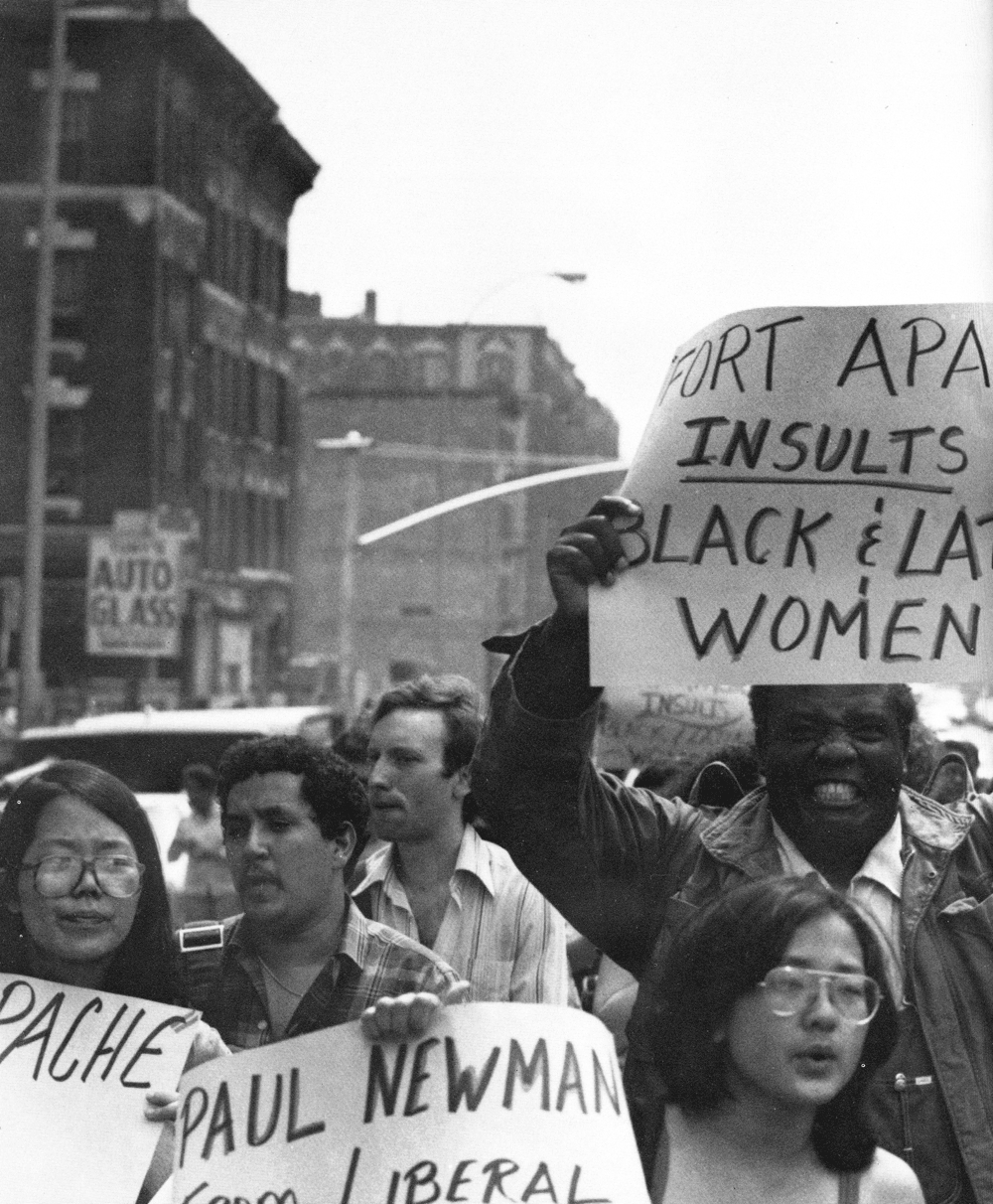
"Fort Apache the Bronx"

Thirty-three years after it first came out, the movie "Fort Apache the Bronx" brought itself into my mind yesterday. I wondered how it would hold up over time, this tale of a police precinct, its problems, its corruptions, its cruelties and kindnesses. So I watched a bit and thought that in its way, it was more convincing and on-target than the latter-day approaches to racism and poverty with their sometimes oozing understandings.
The movie is woven with "niggers" and "spics" and bits of random despair and death that seem explicable and yet the neatness of a blog or caring analyst fall flat ... just like real life. The movie was roundly criticized in its time.

Making nice about what is palpably not nice seems to add one more layer of not-niceness to an honestly not-nice mix. Where survival in a racist setting is the game, how helpful is it to wail, "Oh lawsy, lawsy! Racism is on the loose!"

Cops getting by in a cruel environment. Hard-pressed and largely poor residents getting by on the scraps their society made available. When everyone is corrupt by necessity, what happens to the meaning of "corruption?"

The movie may be a bit brittle around the edges, but it also has some gut-level honesty that feels refreshing ... if "refreshing" is exactly the right word.

Sunday, September 7, 2014

"distinguished colleagues"


Distinguished colleagues.

The luminous mind cannot be called luminous and therefore we are foregathered today to cast our shadows.

From the shadows we cast our light, imbue the universe and, without putting too fine a point on it, screw the pooch.

This raises the question, to what extent, if any, can shadow and light inform and fulfill the empty places of the heart? If this is some sort of cosmic joke, then who is laughing? And where laughter is absent, what presence fulfills its promise?

It is not just what casts the shadow that is or might be of interest or importance. There is also the matter of the surface against which luminosity -- the essential essence -- could reveal itself. Library shelves and monastic cubby holes are filled and yet when they are emptied, who can say what shadow that will cast? The layman bangs his thumb; the wise man whines.

Coming from near and far, we foregather.

Is that really what light and shadow had in mind?

I know you will figure it out ... that is the nature of being distinguished.

"frenemies" near and far

Odds and ends of journalistic effort crossed my stage this morning. Somehow they seem to connect, yet precisely how is beyond both my expertise and/or my willingness to argue for their connectedness.
-- Swedish director Roy Andersson's comedy A Pigeon Sat on a Branch Reflecting on Existence won the Golden Lion award for best film at the Venice Film Festival.
The offbeat movie was hailed by critics for its moving exploration of what it means to be  human.
Is there any end to the number of ways in which human beings can find means to explain what they already are?

--  The United Nations World Health Organization has designated suicide a "public health problem" that is shrouded in taboo and urged countries without them to come up with public policy approaches. A suicide occurs every 40 seconds, WHO said.

-- Small hospitals are under the financial gun to close up shop in the U.S. Is this a part of the U.S. public policy as regards suicide?

-- The "endless war" lobby got a needed boost today: "U.S. warplanes launched four air strikes against Islamic State militants threatening western Iraq's Haditha Dam early on Sunday, witnesses and senior officials said, broadening Washington's campaign against the fighters." Iraq and Afghanistan were, for a brief spell, places from which the U.S. had allegedly planned to disengage militarily.

-- As a means of winkling out who, precisely, is worthy of American "killed" or "wounded" or "considering suicide," Reuters has run an opinion piece on how to detect our "frenemies" around the world. "Frenemies" -- it's not just for policy wonks any more. Anyone needing a primer in this arena may get some help from the U.S. president, Barack Obama, who will give a a speech on Wednesday regarding the waxing villainy of the Islamic State, the guys and gals likely to keep the endless-war scenario fresh as a daisy. As if playing into Obama's scenario, "Islamic State pamphlets and flags have appeared in parts of Pakistan and India, alongside signs that the ultra-radical group is inspiring militants even in the strongholds of the Taliban and al Qaeda."

-- In El Salvador, a gang truce is holding. The result is ... stronger gangs.
For some reason, that seems relevant to the fact that water shortages in India have helped to nourish a mafia-like business in the commodity: Only the crooks seem capable of delivering. 

And that is what the Islamic State -- even if it doesn't want to -- is dragged into the American scenario of friction and danger. It's like kids laying out the plot-line of a game ... "OK, this time you be the bad guys and I'll be the good guys." We need you, you need us ... and everyone get their game face on!

What would happen, if only briefly, there simply were no enemies left? Talk about scary shit!

Let's stick with the Canadians and just send a few troops in .... it's only prudent and Vietnam is ancient history.

And as a less galling footnote to an eventful time:

Saturday, September 6, 2014

silly, I guess

A couple of sillies -- one more seriously silly than the other -- were called to my attention today. The first comes from comedian George Carlin:

1. George Carlin: The English Plurals

We'll begin with a box, and the plural is boxes,
But the plural of ox becomes oxen, not oxes;
One fowl is a goose, but two are called geese,
Yet the plural of moose should never be meese;
You may find a lone mouse or a nest full of mice,
Yet the plural of house is houses, not hice.

If the plural of man is always called men,
Why shouldn't the plural of pan be called pen ?
If I speak of my foot and show you my feet,
And I give you a boot, would a pair be called beet ?
If one is a tooth and a whole set are teeth,
Why shouldn't the plural of booth be called beeth ?

Then one may be that, & three would be those,
Yet hat in the plural would never be hose;
And the plural of cat is cats, not cose.
We speak of a brother & also of brethren,
But though we say mother, we never say methren.
Then the masculine pronouns are he, his & him,
But imagine the feminine: she, shis & shim !

Let's face it - English is a crazy language.
There is no egg in eggplant nor ham in hamburger;
Neither apple nor pine in pineapple.
English muffins weren't invented in England.

We take English for granted,
But if we explore its paradoxes,
We find that quicksand can work slowly,
Boxing rings are square;
A guinea pig is neither from Guinea nor is it a pig.
Why is it that writers write, but fingers don't fing,
Grocers don't groce & hammers don't ham ?

Doesn't it seem crazy that ...
You can make amends but not one amend ?
If you have a bunch of odds and ends ...
And get rid of all but one of them,
What do you call it ?

If teachers taught, why didn't preachers praught ?
If a vegetarian eats vegetables,
What does a humanitarian eat ?

Sometimes I think all people who speak English
Should be in an asylum for the verbally insane.
In what other language do people recite at a play,
And play at a recital ?

We ship by truck but send cargo by ship ...
We have noses that run & feet that smell;
We park in a driveway & drive in a parkway.
And how can a slim chance & a fat chance be the same,
While a wise man & a wise guy are opposites ?

You have to marvel at the unique lunacy of a language
In which your house can burn up as it burns down;
In which you fill in a form by filling it out,
& in which an alarm goes off by going on.
And in closing .....

If Father is Pop .....
How come Mother's not Mop ? ? ? ?

2. The other, not-quite-so-whimsical silly was to wonder if there were a rational person anywhere who would dispute the assertion that "no one can know the future."

Don't be too quick to answer. Think it over. Check it out in real-time experience: No one can know the future. Gather up all your exceptions and excuses and then consider the assertion: No one can know the future. It's not all that serious, I suppose, but it has some confounding implications ... as for example, why do individuals agree with the assertion and yet insist on collecting a collating information that will do its best to prove the opposite? But not only do they collect and collate, they also can believe their own rhetoric... and then be disappointed when the results only prove the original assertion -- no one can know the future.

And far from becoming humbler in the face of their own failed projections, the ill-fated will redouble their efforts to do better next time. Take the Department of Homeland Security, for example.....

Friday, September 5, 2014

really stupid, really smart

Sitting down with a nurse whose job it was to take a drop of blood from my finger, I commented on the newly-acquired suntan/burn on her face. We're chums in the sense that I check in with her from time to time, so a little personal banter goes with the medical proceeding.

"It was stupid!" she said emphatically. "I fell asleep in the sun. Really stupid!"

Her face, especially below the eyes, looked painful. But her insistence on chastising herself struck me as extreme.

"If that's the stupidest thing you've ever done, Anne, you're miles ahead of the other guys," I commented lightly, hoping to alleviate some of the acid criticism she was heaping on her own head.

My verbal nostrum had minimal effect: She made several other comments to indicate how disappointed she was by her "stupidity."

When I was a kid, I had a deep devotion to cap pistols. They were the top-drawer possession in my cowboys-and-Indians imagination. Today, of course, I look back on that affection with an indulgent nod: What was smart and credible at one time had lost its luster. Now, perhaps, it had an element of "stupid" ... but how different was "stupid" from its shadow "smart?"

Twenty-twenty hindsight is pretty easy. Everyone has got a laundry list of things that were adored/despised but now no longer have the same impact.

But the ease with which the past is viewed and assessed is not so easy when applied to present gods and demons. What might it be like, for example, if today's affections and beliefs were assessed with the same ease as cap pistols and sun burns?

Later in the day, I was chatting with an old chum who had likewise done some pretty serious Zen Buddhist training. In the course of assessing a letter written by a one-time Zen teacher, we were brought up short by an assertion that there was a deep karmic connection the between the writer and two other teachers who happened to have been born in the same year.

"Can you believe there was a time when we believed that shit?" I asked my friend. "Yeah ... hook, line and sinker," he chuckled in response. Both of us had "been there and done that," and in hindsight we had been "stupid" about what once had been "smart."

I guess it is wise to use the template of "sun burns" or "cap pistols" to assess current enthusiasms. Sure, it's important. Sure it deserves care. Sure it may be "transformative," though it's a little hard to name something that is not transformative.

Just a gentle question: To what extent does this devotion partake of what is bound to become a cap pistol or sun burn? It's no good to simply dismiss it ... but is that a reason for adoring it? Sure, it may be bullshit, but is there a way to know bullshit without walking the bullshit walk?

Is there something better than bullshit for making the flowers grow?

Is "really stupid" really stupid ... or "really smart" really smart?


organizing the sky

A devotee daubed in coloured powder prays as she takes part in the immersion of the idols of the Hindu god Ganesh, the deity of prosperity on the fifth day of the ten-day-long Ganesh Chaturthi festival in Mumbai, September 2, 2014.
REUTERS/Danish Siddiqui
  
One of the two-edged delight/horrors of spiritual endeavor is that, like the sky, spiritual life cannot be organized. As a result, there are vast libraries and wise men galore: Where intellect and emotion simply cannot tell a credible or satisfying tale, what a relief to enter a land where paltry bureaucracies and explanations fall flat.

Organization passing as understanding is ... so tiring, even if it makes socially-acceptable sense. Organize the sky? What nitwit made that stuff up?

Yes, it's a relief to stop organizing the sky.

But that doesn't mean it can't piss people off something fierce.


Thursday, September 4, 2014

murdered poodle

Locally, a 12-year-old toy poodle was found bludgeoned to death at the bottom of the cellar stairs belonging to an elderly couple who were not at home during a daylight break-in on Tuesday.

A veterinarian made the cause-of-death determination, according to Easthampton police.

The story was given a lead role on the front of today's newspaper.

Internationally, the recent beheading of two American freelance journalists covering conflicts in the Middle East remains a lingering horror ... even politicians are interested.

It's hardly a new observation to recall the quote attributed to the one-time Soviet dictator Joseph Stalin: "One death is a tragedy. The death of millions is a statistic."

The mind recoils at the notion of a very particular brutality: It is insanely cruel that the viscerally-innocent should suffer... children, animals, mothers, fathers, brothers and sisters: Taken one at a time, this is a horror.

I wonder what number turns tragedy into statistic. Is its basis sheer laziness or simple incapacity? Whatever it is, I think it is worth admitting -- weeping has its limitations and its excuses. Just because something is forgiven does not necessarily imply that it is forgiveable.

Or anyway, that's my guess.

Wednesday, September 3, 2014

the pleasant truth?

Posted elsewhere, but thought I would post here as well:

As a side-note, perhaps -- it is interesting to notice how what is considered positive or pleasant is embraced while what is negative and painful is shunned.

If something is pleasant, does that make it true?
If something is unpleasant, does that make it untrue?

How much effort is expended on behalf of what is pleasant as distinct from what is true?
Just thinking out loud.

a real tomato

The juice oozed down my chin, just as it should.

The flavor was delicious, just as it should be.

It was a go-to-hell-wonderful experience more compelling than the solstice.

The other day, my son bought some farm-stand tomatoes and this morning I had one on a tortilla with a little mayonnaise.

A real tomato, not the supermarket pretense with its long shelf-life and no flavor ... the money-maker.

I guess everyone has his or her luxuries, his or her touchstones, his or her swoon.

This was mine.

God-DAMN!!!!!

the halitosis of hallelujah

Death has a way of sand-papering the juicy and jagged and nuanced bits of anyone's life. As a focal point, reporting a death is a little like reporting on sports or religion ... the news is frequently cushioned by soft-ball recollections because, well, sports, religion and death are delicate matters, so shading the truth is often acceptable. Jesus and Babe Ruth and whoever all else may represent a totem ... well, somehow it's understandable to make nice ... they're dead after all.

On page 1 of the local paper today, the death of 89-year-old  Francis Dresser was reported. Dresser saw action during World War II, came home and became the Fire Chief in Goshen, a small community in the hills not far from here. To judge by the article, he was a nice and caring man of whom the reporter wrote that Dresser was "a man of little words who got a lot done." Dresser was instrumental in a number of emergency-services initiatives.

As praise goes, I like to think that Dresser was indeed a man who did more and spoke less. It's not a recollection anyone is likely to put on my gravestone. But just knowing there may have been such a man or woman -- especially with mid-term elections in the offing -- is a pleasure.

Doing disappears and yet remains.

Words just remain ... the stale stuff; the softball stuff; the 'important' stuff... the halitosis of hallelujah.

A nice bit of praise even if it is not entirely accurate -- spoke less, did more.

Monday, September 1, 2014

moose/deer vs. cars

A news filler warns drivers to be
cautious in September, the month when
deer and moose are likely to breed.

Given the quality of today's cars, the
friskiness-alert may be taken more seriously,
I think.

yesterday is soon enough

At about 5:15 a.m., I heard the newspaper slap up against the front stoop. It was a morning ritual I hadn't really expected on Labor Day, yet here it was, fresh as a daisy ... brand-spanky new: Yesterday's news. And the first thought into my head was, "Yesterday is soon enough."

Suggesting that anyone consider his or her own presumptions about time often leads to beard-stroking ruminations and sundry other profound observations. Time is so woven into everything that ... well, you can understand why anyone would say "fuck it."

But, with a light touch, I think time is worth considering.

And always it strikes me as true: "Yesterday is soon enough." Time invariably means time-past at the very moment when anyone might be asserting time-present. It's a disconnect hunkered down in the DNA. (I'm not interested in T.S. Eliot here ... it's the personal stuff that catches my eye.)

When I was a kid, there was snailmail and no email. Letters arrived two or three days after they were posted. The news they contained was old according to the sender, but became new with the opening of the envelope.

And when I was not even a twinkle in my daddy's eye, written communication might take weeks or months to arrive ... and be old even as they became brand new.

Internet users might sneer at such antiquities, but there is the same (if shorter) disconnect in the processing exercised by the Twitter-savvy. Yesterday is soon enough.

On the one hand, 'we' communicate in the present. On the other hand, and simultaneously, 'our' present is just a version of the past. Those who are 'living in the present' would be wise to consider their satisfaction. The price for not considering it is endless doubt ... I claim to be in the present by asserting the past. So, is the present nothing but past and if it is, then what is the past? I would like to repeat a past that was pleasant and avoid a past that was unpleasant. I would like -- or say I would -- to stop living in the past and live in what is plainly the present.

Oh well ... the tendrils reach out: Believe in the present and live in the past; disbelieve the present and receive the same result. How, I wonder, can anyone live in the present when they are already living in the present....

Or past....

Or whatever it's called?

Sunday, August 31, 2014

hot air on Labor Day

Missing as yet from the Labor Day Weekend skies are the hot-air balloons that take off from a jam-packed fairgrounds perhaps half a mile away and then float, hissing and silent, over my neighborhood.

Wikipedia describes the Labor Day holiday in the United States as:
Labor Day in the United States is a holiday celebrated on the first Monday in September. It is a celebration of the American labor movement and is dedicated to the social and economic achievements of workers. It constitutes a yearly national tribute to the contributions workers have made to the strength, prosperity, and well-being of their country.
Given the economy, the definition has a kind of icy ridiculousness -- a holiday to keep the peasants happy since honoring its accomplishments ... well, those with hot-air balloons know the value of hot air.

Many people get Monday off by way of celebration. A long weekend is probably welcome to those whose "productivity" inflates the pocketbooks of others, if not their own.

Yesterday, two immaculate automobiles from the 1920's puttered by my house on the back road that leads to the fairgrounds. Boxy, buffed and utterly nifty. The fixed horse races that once marked to fairground celebrations have been done away with (gambling is so déclassé, dontcha know) so there are fewer drunks driving by my house: The fair these days is top-heavy with music and kiddie rides and farm animals... a small venue that resembles gatherings in Hollywood and Versailles -- a place to see and be seen.

But where are the balloons? The weather is good -- clear, with small breezes -- but the balloons have not yet appeared. In years past, they dotted the skies and there was something delightful and uplifting in it. Who knows -- maybe there is another new and improved rule that disallows them.

Or maybe it's like owning horses -- another mark of casual wealth: Ballooning is a fairly expensive hobby and in 'productive' times, even the wealthy feel the pinch: What would the peasants do with a balloon if they saw one? It's more pricey than it's worth ... as, for example, to the Chinese middle class that is currently buying up Manhattan. Let's skip the balloons and add another bathroom. Wealth trickles down, right? Fried dough and Pepsi are enough.

The hot air has gone out of the hot air that once inspired the 'productive.' Or anyway, that's how it currently seems. Whatever the case, I do miss the balloons: They have no concrete meaning and from that perspective take on a meaning of some delightful kind.

Hot air and colorful floating. Hot air and labor gets a pat on the back. Hot air ....

Saturday, August 30, 2014

where did I come from?

My neighbor Joe and I slowed down a little yesterday and met in the street that separates our houses. Our meetings are never deliberate, but when they happen, they are pleasant enough.

Joe said he was just back from a couple of vacation months in Canada. He was packing the car to return for a couple of more months after which he and his wife were headed to Sicily and a trip that would help Joe fill in some of the blanks in his lineage.

Joe sounded enthusiastic about the small villages near Palermo that he had already researched: Relatives reaching back in time had lived there. Imagine that! Imagine knowing where you came from, who your forbears were, and possible common threads of interest or profession might exist! In his retirement, Joe seemed to have found direction and purpose, partly in a lineage investigation and partly in an eventual plan to move -- perhaps to Kenya -- where he could put his Christian convictions to work helping the poor.

Mostly our conversation centered on lineage and Joe's gathering of information. Joe obviously took it seriously. I had a hard time being quite so enthusiastic. As I said to Joe, I had done similar research in the past and invariably ran into a brick wall: To know where or when someone lived and to know what they did for a living and the offspring they sired ... well, it's interesting up to a point, but then I always get stuck wondering what a person's favorite color might have been; what cheese excited his/her palate; whether they ever tried bigamy or robbed a bank; what made them angry or sad; what a best friend did for a living; what vanity was most appealing ... you know, the human stuff.

I can sympathize with a clinging to lineage, but in the end, I am not interested. If you knew where you came from, what, precisely, would you know?

This is not so suggest that lineage be ignored. It is merely to suggest it does not hold much water when adored.

Yes indeed -- mother, father, sister, brother and on an on into the unfathomable past ... and the toilet bowl still leaks whether the king or scoundrel provides a backdrop. Intellectually, this is fun, perhaps. But I am interested in the personal seriousness anyone might be willing to apply.

Friday, August 29, 2014

police department upgrades

Passed along in email was this reminder to local police departments ... yes, you can upgrade.

skunk perfume

Sashaying through the crisp light of dawn today, a local skunk unwittingly tints the neighborhood silence with her scent.

It's not as if s/he cared or as if s/he didn't. Like the rest of us, s/he may carry the responsibility, but paying attention to every jot and tittle of import and impact is wasteful in the end: A skunk smells -- get used to it; what is vast importance to one is not all that important to another.

The desperate search for something of cemented importance may be desperate indeed. Check the human landscape. Check the bathroom mirror. Things refuse to stand still, the little fuckers!

Imagine the horror of World War II's D-Day landing in Europe. Imagine the horror of the Holocaust. Imagine the pain of a splinter or the sweetness of a kiss. The impact, the importance, the value of -- of anything at all ... it's no damned joke and yet it may as easily be a joke: Who, for example, can slip on the shoes of the poor soul shot dead on a Normadie beach -- cast casually aside after mother, father, sisters and brothers so lovingly raised him up and loved him and helped to instill the love-ability that raised the horror to its screaming status.... or know the sigh within that tiptoes behind a sainted kiss?

It sounds so wise and yet smacks of silliness: "He knows the cost of everything and the value of nothing." Don't be ridiculous! Skunks smell. The most far-reaching god or saint or notion of importance ... it doesn't work everywhere and always, no matter how desperate the search for cemented importance. And yet the longing is there and the insistence can be worthy of bloodshed.

Today, for example, I considered the possibility of selling the Buddha statue that stands in the small zendo behind the house here. The statue is about two feet tall, is made of African Wonder Stone, and
was an unimaginable gift from a woman with whose son I am friends. I imagine it weighs 50 pounds. It has been with me for years and weaves in and out of my gratitude glands ... Jesus! what a present! Jesus! What an impact! Jesus! The importance! I cannot begin to compass its cemented meaning ... and yet ...

The roof on the zendo needs fixing. I am getting old and will die and would like to think my family might get some use out of what does not interest them in the way it interests me. The statue's cemented importance -- like the cemented importance of all household gods -- is strictly skunk aroma on a crispy dawn.

This is not a bid for sympathy. Whether I find something vastly valuable or dismissively ordinary is simply something I, or anyone else, has to cope with. Still, the idea of selling the statue came as a bit of a surprise. The present was such a blessing in its time... full of implication and love and friendship.

Now, a little at a time, it is rock.

A bit like skunk perfume.

A D-Day landing.

I haven't quite learned to laugh at myself yet.


Thursday, August 28, 2014

shaping a best-seller

I was talking on the phone with my sister (actually, half-sister, but she's my favorite relative whatever the designation) a couple of evenings back and we rambled through recent family and personal happenings before settling like a couple of bumble bees on "the organ recital."

At 68, my sister is six years my junior, but that doesn't mean she too isn't feeling the pinch that older people feel. She was telling me a story about going out to dinner with a bunch of similarly-aged people and how the conversation, somehow inevitably, sank like a flat-car in quick sand into a recitation of various aches, pains, doctors, hospitals, exercise and other fixer-upper activities which young people find boring, even when they are willing to imagine the same may at some point afflict them.

My sister and I agreed: The older you get, the more likely the organ recital is likely to insert itself in the conversation. My sister and I laughed ruefully -- we too had found ourselves sucked into that maw of physiological frailty.

But another thing we agreed on was this: Not only was the topic likely to bore the socks off anyone else participating in the conversation; it also bored the socks off the one making the conversation. My aches and pains bore me. I would far rather talk about something more imaginative or funny or socially relevant ... and yet here I am, writing about the organ recital. Shiiieeeet!

We laughed about it, my sister and I, and yet when I said there might be a pretty good self-help book in how to avoid or sidestep the organ-recital earth, my sister said immediately, "So write it!"

Or, if not write it, at least think it through. Those unwilling to play the kidney or liver game might write/talk about something else. The trouble is that the something else is too often a regurgitation of someone else's analyses and the speaker is left either being a bore or a pimp. Originality seems to have flown the coop together with youthful energies and there are all sorts of socially-acceptable issues to keen about, but original thinking -- the emphasis and care it once commanded -- has lost its oomph. There is the pretense of 'caring' but the caring is largely on vacation.

I really do think there is a best-seller in this arena -- and not just from some do-good 40-something who uses the word "we" without a second thought -- but I can't think of the hook, the alternative, or the area of relief.

The organ recital is boring.

The second-hand social observation is, well, second-hand.

Perhaps candy bars really are the answer.

Wednesday, August 27, 2014

whistling

What is death but openness?

What is music but openness?

Why is music sometimes so heartening and sometimes so sad?

You can sort of see why those intent on war always bring music to bear, striving to open in others what no heartened soul prefers.

Wide open.

Perhaps this is why some take up whistling..... or something similar.

musical miasma