Passed along in email: A Thai commercial ...
Monday, September 16, 2013


please
I don't generally ask others to give to causes I think of as worthy, but I am willing to break with tradition on behalf of the Buddhist monk, Weera "Tony" Chulsuwan, a 66-year-old from Spencer, Oklahoma, who stepped out of his front door a week ago Friday and was beaten, literally, within an inch of his life by two boys, 14 and 15 -- kids whom Chulsuwan had known until that moment as neighbors.
The teenagers had come to rob Chulsuwan, a man who makes $350 a month and spends his time and energy taking care of animals that others can't or won't take care of themselves. The Oklahoma press rounded up an almost universal opinion that "Tony the Monk" was a good guy -- a guy who would give you the shirt off his back unasked.
The teenagers beat him with a steel pipe and a logging chain (apparently taunting him as they did so), stole various items from the house and then fled. Chulsuwan lay on the porch for 24 hours before he gained enough consciousness and energy to crawl to the telephone and call 911.
I will leave the sputtering adjectives that course through my mind for others to apply. All I hope is that each of us will take a few minutes, forgo a couple of containers of bottled water, empty a casually- filled penny jar, buy a stamp and address an envelope to:
Mr. Weera "Tony" Chulsuwan
c/o The Engaged Zen Foundation
P.O. Box 213
Sedgwick, Maine 04676
A PayPal donation site is also up and running.
My sense is that this guy was living on a shoestring even before the incident and now he has medical bills into the bargain.
The teenagers had come to rob Chulsuwan, a man who makes $350 a month and spends his time and energy taking care of animals that others can't or won't take care of themselves. The Oklahoma press rounded up an almost universal opinion that "Tony the Monk" was a good guy -- a guy who would give you the shirt off his back unasked.
The teenagers beat him with a steel pipe and a logging chain (apparently taunting him as they did so), stole various items from the house and then fled. Chulsuwan lay on the porch for 24 hours before he gained enough consciousness and energy to crawl to the telephone and call 911.
I will leave the sputtering adjectives that course through my mind for others to apply. All I hope is that each of us will take a few minutes, forgo a couple of containers of bottled water, empty a casually- filled penny jar, buy a stamp and address an envelope to:
Mr. Weera "Tony" Chulsuwan
c/o The Engaged Zen Foundation
P.O. Box 213
Sedgwick, Maine 04676
A PayPal donation site is also up and running.
My sense is that this guy was living on a shoestring even before the incident and now he has medical bills into the bargain.
news ... where's the rest of the story?
Making me wonder what the rest of the news story was ...
-- South Korean soldiers shot dead a man who was attempting to swim a river to North Korea.
-- In Seattle, an English professor was stabbed to death and his female partner was taken to the hospital in critical condition following a soccer game.
-- In Boston, a homeless man who found a backpack containing $2,400 in cash and $40,000 worth of traveler's checks turned the backpack over to police.
-- In Alaska, a Fairbanks man punched a grizzly bear that was apparently attempting to enter the tent where he and his girlfriend were sleeping.
-- "Police say Delaware is facing an epidemic of heroin use because it's cheap, easy to find and pure enough to snort, while the cost of prescription drugs has tripled due to close monitoring."
Perhaps news editors are being laid off as a cost-cutting measure.
-- South Korean soldiers shot dead a man who was attempting to swim a river to North Korea.
-- In Seattle, an English professor was stabbed to death and his female partner was taken to the hospital in critical condition following a soccer game.
-- In Boston, a homeless man who found a backpack containing $2,400 in cash and $40,000 worth of traveler's checks turned the backpack over to police.
-- In Alaska, a Fairbanks man punched a grizzly bear that was apparently attempting to enter the tent where he and his girlfriend were sleeping.
-- "Police say Delaware is facing an epidemic of heroin use because it's cheap, easy to find and pure enough to snort, while the cost of prescription drugs has tripled due to close monitoring."
Perhaps news editors are being laid off as a cost-cutting measure.
it's not something else

Mind you, zazen seemed to have some salutary effect and I kept after it in my own sincere and insincere ways. I could call it "good" or "profound" or "subtle" or "compassionate" or whatever. I could make a linkage between zazen and the unsatisfactory edginess that anyone (by which, of course, I meant me) might use as a springboard for a disciplined practice.
I could praise zazen. I could encourage others to give it a try. Over the years, I got pretty good at the meaning and importance of it all. But if I had been really comfortable, really assured, really complete, why would I need all these excuses about Gautama exercising his great compassion and 'spreading the Dharma?' Something was not yet complete for me.
Yesterday, after about an hour's worth of zazen, there was a small, relaxed, warm bathtub that seemed to envelope things. Zen training, Zen meditation, even Zen bullshit -- although it could not for a moment be called "good" -- reached the far corners of things because it addressed the long-standing and unconvincing conviction that things were or could be something else... that meaning and belief and praise and blame and love and anger and wisdom and ignorance could somehow employ what is as a means of getting by in life.
Yesterday, cozy as a cat around bare feet, the usefulness of zazen asserted itself with a relaxed assurance. It was simple: It is not something else.
It is not something else. There is a need to bone up on that recognition because the ordinary way is incomplete and edgy-making. Using intellect or emotion or spiritual life or bank robberies or altruism or self-centeredness to capture and control and bring peace ... it may be habitual and understandable, but it doesn't work. Zazen practice, like anything else, is not something else and this lesson was worth learning ... even if I felt like a dumb ox for not getting it through my actualized head sooner.
Conversationally, a rock in the palm of the hand or an hour's worth of zazen is "a rock in the palm of the hand" or "an hour's worth of zazen." That's kool as far as it goes, but it starts to get uneasy when anyone asks, "what is it really?" Zazen strengthens the muscles for the obvious: It is not something else.
Of course saying "it's not something else" doesn't say what anything is any better than "zazen" or a "rock in the palm of the hand" does. As an intellectual or emotional construct it doesn't reach; it doesn't get to the heart of things.
But as a matter of quite ordinary, bred-in-the-bone fact, "it's not something else" and the enjoyable willingness to sink into that bathtub ... well, ain't it the truth? ... the truth no one would be dumb enough to call "the truth?"
Zazen is not something else, no matter how many people dress up or build temples or write blog posts. It's just not something else ... and that realization is a relief, not because knowing it somehow puts anyone in control, but because it's just a fact... just like all the other facts that are not called "zazen" or "a rock in the palm of the hand."
With or without the tinsel, a Christmas tree is just a Christmas tree. But beyond that, with or without tinsel, it's not something else.
Reading this post over, I want to 86 the whole thing. Another piece of drivel that can hardly make anyone's life easier. On the other hand, it was a small, compelling bit of relaxation yesterday ... the kind of thing, once described, that might allow others to know what kind of idiot they did not want to be.
I like it: It's not something else. I like it even if some dimwit is bound to intone, "it is what it is" or "things are not what they seem, nor are they otherwise."
Relax -- it's not something else.
Sunday, September 15, 2013
the law that can not be broken
It occurred to me this morning during zazen (yes, yes ... I know ... tut-tut!) that Judaism is founded on the law. The law forms the substrate of what later emerges, the subbasement of this particular skyscraper.
And in this regard, I wondered if a Jew -- or anyone else for that matter -- might be well served during this life by keeping an eye skinned for the law that can not be broken.
Just as a matter of curiosity, perhaps.
And in this regard, I wondered if a Jew -- or anyone else for that matter -- might be well served during this life by keeping an eye skinned for the law that can not be broken.
Just as a matter of curiosity, perhaps.
Janice Keihanaikukauakahihuliheekahaunaele

A US woman has won a battle to have her full name put on her driving licence.Janice "Lokelani" Keihanaikukauakahihuliheekahaunaele's name is so long - containing 36 letters and 19 syllables - that it would not fit on the documentation.
But she says her grievance has now been redressed.
observing the obvious
From sunrise to sunset,
From text to tapestry,
From blessing to curse,
From socializing to loneliness,
From wondrous subtlety to confounding yawn,
From tallest mountain to molecule of sand,
Spiritual discipline boils down to this:
Observing the obvious.
And if this is incorrect, obviously that would be a pretty good observation.
From text to tapestry,
From blessing to curse,
From socializing to loneliness,
From wondrous subtlety to confounding yawn,
From tallest mountain to molecule of sand,
Spiritual discipline boils down to this:
Observing the obvious.
And if this is incorrect, obviously that would be a pretty good observation.
Saturday, September 14, 2013
like a ...
Like children pretending to be leaves,
The sparrows skitter-skatter through a passing breeze,
Puffed and pushed above the trees below.
I wonder if, along branch and bow,
The leaves are jealous -- vowing darkly, perhaps,
To fly like birds when a deeper autumn releases them at last.
The sparrows skitter-skatter through a passing breeze,
Puffed and pushed above the trees below.
I wonder if, along branch and bow,
The leaves are jealous -- vowing darkly, perhaps,
To fly like birds when a deeper autumn releases them at last.
humane warfare
(Reuters) - Syrian warplanes struck rebel-held suburbs of the capital on Saturday and government forces clashed with insurgents on the frontlines, residents and opposition activists said.No reports of chemical weapons ... how humane!
order and disorder
Based on the nudging/needling suggestion of a friend, I watched the movie "My Talks with Dean Spanley" yesterday. The 2008 New-Zealand-made tale is set in Edwardian England and focuses on a small group of well-heeled and decorous people whose lives are variously revised by an interest in reincarnation. The story is somewhat contrived and occasionally tortured, but the actors are good and the presentation is quiet enough to be human and credible: If this is insane, it's the kind of insanity anyone might experience in a much-ordered and meaningful life.
And that's the thought the movie evoked in me: In anyone's life, isn't it so? -- Too much order and control and conclusive meaning, and the heart cries out piteously for disorder, for room to roam and dance; too much disorder and chaos and anguish, and the heart cries out piteously for a well-ordered peace, a sturdy and cohesive meaning, a place to rest at last.
 Tick-tock, the pendulum swings: The white-picket fences of the post-World-War-II 1950's seemed to assert an at-long-last and desperately-desired peace only to be torn down by the barrier-busting imagination of the 1960's which was sick to death of being fenced in.
Order to disorder to order to disorder. And all the time "meaning" was not the point any more than "lack of meaning" was.
Of course the armchair decorousness of a blog post or a psychological treatise or a spiritual text are no basis for peace. This is life, after all, not some movie. How could such picket-fence order ever compare to the joyful look on the newlyweds' faces or the beyond-horror, thousand-yard stare of a combat soldier?
 Christ! Get me out of here!
Christ! Give me peace!
Give me meaning ... but don't fence me in!
It would be inhumane not to see all this as human. Vast energies are brought to bear in the creation of order, whether in Edwardian England or elsewhere. Vast energies are brought to bear when tearing down the white picket fences once lovingly constructed. Vast energies ... human energies ... your energies and mine. Vast energies in pursuit of meaning. Vast energies whose blood courses hot and hopeful through the mind. Vast energies whose blood slips unremarked into the battlefield soil.
Too much order and the mind rebels. Too much disorder and the mind rebels. And "the middle way" is too often just another white picket fence begging some "tick" not to turn into yet another "tock." "Meaning," like "no meaning," is just one way to describe the anguish of white picket fences or the lack thereof.
The friend who suggested I watch "My Talks with Dean Shanley" was right: I like costume dramas peopled with decorous mores that then fall of their own weight on their own swords. But that's just life, isn't it -- or at any rate, the human expression of life? That's what makes good stories good. Where the king is enthroned, the rebel bangs loudly at the gate. Where the rebel asserts victory, the king petitions for audience.
Who would be stupid enough to ignore these touchingly-human, tick-tock characteristics?
On the other hand, who would be stupid enough to believe them?
And that's the thought the movie evoked in me: In anyone's life, isn't it so? -- Too much order and control and conclusive meaning, and the heart cries out piteously for disorder, for room to roam and dance; too much disorder and chaos and anguish, and the heart cries out piteously for a well-ordered peace, a sturdy and cohesive meaning, a place to rest at last.
Tick-tock, the pendulum swings: The white-picket fences of the post-World-War-II 1950's seemed to assert an at-long-last and desperately-desired peace only to be torn down by the barrier-busting imagination of the 1960's which was sick to death of being fenced in.Order to disorder to order to disorder. And all the time "meaning" was not the point any more than "lack of meaning" was.
Of course the armchair decorousness of a blog post or a psychological treatise or a spiritual text are no basis for peace. This is life, after all, not some movie. How could such picket-fence order ever compare to the joyful look on the newlyweds' faces or the beyond-horror, thousand-yard stare of a combat soldier?
Christ! Get me out of here!Christ! Give me peace!
Give me meaning ... but don't fence me in!
It would be inhumane not to see all this as human. Vast energies are brought to bear in the creation of order, whether in Edwardian England or elsewhere. Vast energies are brought to bear when tearing down the white picket fences once lovingly constructed. Vast energies ... human energies ... your energies and mine. Vast energies in pursuit of meaning. Vast energies whose blood courses hot and hopeful through the mind. Vast energies whose blood slips unremarked into the battlefield soil.
Too much order and the mind rebels. Too much disorder and the mind rebels. And "the middle way" is too often just another white picket fence begging some "tick" not to turn into yet another "tock." "Meaning," like "no meaning," is just one way to describe the anguish of white picket fences or the lack thereof.
The friend who suggested I watch "My Talks with Dean Shanley" was right: I like costume dramas peopled with decorous mores that then fall of their own weight on their own swords. But that's just life, isn't it -- or at any rate, the human expression of life? That's what makes good stories good. Where the king is enthroned, the rebel bangs loudly at the gate. Where the rebel asserts victory, the king petitions for audience.
Who would be stupid enough to ignore these touchingly-human, tick-tock characteristics?
On the other hand, who would be stupid enough to believe them?
Friday, September 13, 2013
and who pays the price? one guess
Five years on from the bankruptcy of Lehman Brothers, the debate over how to hold senior bank bosses to account for failures is far from over, but legal sanctions for top executives remain a largely remote threat....Former U.S. President Harry S. Truman had a plaque on his desk that read, "The buck stops here." Banks and other institutions that own the U.S. government all seem to have acquired plaques reading, "The buck stops there."
In the United States, home to Lehman Brothers, no top executives at large Wall Street or commercial banks have been convicted of criminal charges relating to the 2008 crisis.
Sometimes I wish I were a banker, but if I were, I'm not sure I would have the nerve to look in the bathroom mirror.
trans-Atlantic balloon effort tabled
 |
| "A US man has been forced to abandon his bid to cross the Atlantic in a lifeboat suspended by some 370 helium balloons because of technical problems." |
precisely right
Even just for fun, did it ever occur to you ...?
You are precisely right.
Always precisely right.
Even when you're wrong, still you are precisely right.
Any corrective action is precisely right.
Any failure to exercise corrective action is precisely right.
There are consequences, of course, and they too are precisely right ... just like you.
Relax -- you are precisely right.
And it has nothing to do with "right" or "wrong."
You are precisely right.
Always precisely right.
Even when you're wrong, still you are precisely right.
Any corrective action is precisely right.
Any failure to exercise corrective action is precisely right.
There are consequences, of course, and they too are precisely right ... just like you.
Relax -- you are precisely right.
And it has nothing to do with "right" or "wrong."
handling the truth
Dialing back on the vitriol of the exchange, it occurred to me this morning that the denouement scene in the movie "A Few Good Men" is a pretty good stand-in for the relationship between (wo)man's heart-felt and sometimes fiery yearning for the ineffable and the spiritual exercises s/he might employ in the course of that search. In this particular courtroom scene, B-actor Tom Cruise attempts to elicit the truth from A-actor Jack Nicholson:
N: You want answers?Spiritual disciplines may have their uses, but I doubt that they have any honest capacity to handle the truth.
C: I think I'm entitled ...
N: You want answers?!
C: I want the truth!
N: You can't handle the truth!

cog wheels in nature
Just about the time human beings snuggle down in the cozy assumption that they are without doubt the inventive pinnacle of the animal kingdom, Nature provides a fly in the self-aggrandizing ointment.

Anyone feeling unduly deflated by this discovery may want to consider that there was no mention in the research announcement of whether the Issus could shoot rubber bands or pick its nose.
Previously believed to be only human-made, a natural example of a functioning gear mechanism has been discovered in a common insect -- showing that evolution developed interlocking cogs long before we did.British researchers announced their discovery after studying the juvenile Issus, "a plant-hopping insect found in gardens across Europe." That discovery: Cog wheels connecting the hind legs of the insect that had not previously been credited with a mechanical engineering degree.
Anyone feeling unduly deflated by this discovery may want to consider that there was no mention in the research announcement of whether the Issus could shoot rubber bands or pick its nose.
Thursday, September 12, 2013
speaking ill of the dead

Nestling in my mind in the wake of an email I received: Does death confer beatification? Are the dead absolved?
The Reno (Nevada) Gazette Journal recently pulled an online version of a Sept. 10 obituary that excoriated a woman who was recently deceased. The print version remains for perusal.
Marianne Theresa Johnson-Reddick born Jan 4, 1935 and died alone on Sept. 30, 2013. She is survived by her 6 of 8 children whom she spent her lifetime torturing in every way possible. While she neglected and abused her small children, she refused to allow anyone else to care or show compassion towards them. When they became adults she stalked and tortured anyone they dared to love. Everyone she met, adult or child was tortured by her cruelty and exposure to violence, criminal activity, vulgarity, and hatred of the gentle or kind human spirit.It was not immediately clear who submitted the obituary or whether it was legitimate. Whatever its somewhat vague and certainly angry assertions, it sounds true to me... and vague in ways that could indicate the pain that might be incurred if more specific information were adduced. Short and sweet: Gotcha, bitch!
Only of course there is no "gotcha" that can erase the harm allegedly done. "Closure" is for people who can't come to terms with the fact that closure is a myth. Human beings aren't sentences to which periods can be affixed. There are wounds. Sometimes there is a bit of healing. Sometimes not.
Reactions to the obituary included the outrage that anyone could place such vitriol in a space that 'should' be reserved for more glowing and sepulchral tones. But...
-- Sometimes the wounded have every right to scream. Sometimes it is utterly practical and salutary. Sometimes you gotta scream before a little peaceful silence can take root.
-- Does "never speak ill of the dead" equate with "always speak well of the dead?"
-- The best argument I can think of for not speaking ill of the dead is that it invariably adds to the burden of the one doing the speaking. The same might be said for speaking well of the dead, but that's another story. Dead is dead and speaking is the business of the living. It's not a matter of whether something is socially naughty or nice, it's a matter of what is, in the end, most useful.
-- One thing's for sure -- the dead don't give a shit ... or at least not that I know of.
I haven't got an answer for all of this. I'm just chewing my cud.
the sissy factor
A friend of mine insists on sending me email with links to gruesome, grisly movies ... stuff about zombies or slice-and-dice fantasies. He does it, I am convinced, in part so that he can razz me as a "sissy" and worse for not watching them.
And it's true -- I am a sissy. I comfort myself in the excuse that "there's enough real-life cruelty available; why should I add to the unpleasant load with fictionalized mayhem?"
I really don't like cruelty.
But I do like movies and any decent movie is bound to include some uphill battle, sometimes in the form of cruelty. For example, "King of Devil's Island" depicts a fictionalized version of events at a notorious Norwegian island prison for boys. Cruelty is one of the threads woven in its cloth and yet I watched it more than once and consider it a good movie. And even such light-hearted fantasies as "Matilda" rests in a hay loft containing stabbing truths.
So where is the line between sissy and willing?
I don't honestly know, but I do know that zombie movies are off my charts.
And it's true -- I am a sissy. I comfort myself in the excuse that "there's enough real-life cruelty available; why should I add to the unpleasant load with fictionalized mayhem?"
I really don't like cruelty.
But I do like movies and any decent movie is bound to include some uphill battle, sometimes in the form of cruelty. For example, "King of Devil's Island" depicts a fictionalized version of events at a notorious Norwegian island prison for boys. Cruelty is one of the threads woven in its cloth and yet I watched it more than once and consider it a good movie. And even such light-hearted fantasies as "Matilda" rests in a hay loft containing stabbing truths.
So where is the line between sissy and willing?
I don't honestly know, but I do know that zombie movies are off my charts.
heart-throb ugly
 |
| The blobfish has been voted world’s ugliest animal, according to the Ugly Animal Preservation Society, which announced the results Thursday at the British Science Festival. (Story here) |
it's free ... for a price

The discovery of an enormous fresh-water aquifer in Kenya, an often arid land in which the unblinking eyes and bloated bellies of small children are common, fuels hope and joy in the heart. How wonderful if those forced to rely on quonset huts stuffed with donated food stuffs were able to grow their own, not to mention drink without caution.
Researchers say there is enough water in the aquifer to supply the country for 70 years ... and this in a country where a little less than half of the 40 million Kenyans lack access to fresh, clean and life-giving water.
The land is thirsty. The people are thirsty. From my cosseted distance, I cannot pretend to know the decimation of such thirst. And yet here is an answer, a response, a salvation ... and it's for free. Freely given from beneath the dry, dry soil. Free. I am glibly glad that those who have borne so much might now bear a little less ... for free.
But this morning I have a couple of questions: In the course of human events, is or was there ever anything free that did not immediately inspire the installation of a toll booth? And, by association, was there ever anything offered for free for which those desiring what was free didn't demand a toll booth?
In the case of Kenya and surrounding arid lands, it is not entirely cynical to imagine that it will take expensive technology to release and employ what is, in the moment of discovery, free. It is not entirely cynical to wonder how much of what is free will trickle down to those in dire need. Someone -- drillers, government officials and who knows who else -- will have to get paid and there are always people willing to say, "that someone is me."
So what is or was "free" will be diluted. There will be some measure of relief ... after those in need go through the toll booth. And in consequence there will rise up a moaning contingent that is horrified by the prices demanded: "Greed!" they will intone from a reproving and careful distance ... as if that solved anything.
OK ... it does take a toll to reach what is free. And OK, there will always be a faction -- in government or in the heart -- that elevates the price to their own advantage. Both at once ... all as a result of what is "free."

The conflict:
Why should they pony up for what is for free? And from there, the conversation can go on and on and on: There are charlatans fleecing the unwary; there are spiritual-center bills to be paid ... etc. etc.
But I once heard that a Zen teacher (Yasutani, maybe?) was asked why students had to pay so much for retreats and other teachings. Wasn't this out of synch with the freely-available nature of the subject at hand? He laughed and said seriously, "Oh yes! Charge them a lot! That way they will think they are getting something."
And this is the conflict: I don't want to pay what is for free -- buying snow and ice at the North Pole -- but by what other gauge can I know that I have gotten anything worth having?
I may allege that I want what I call "priceless" and "free," but what is the first thing I do when it's offered? I put a price on it, I value it and I praise it. In short, I set up the very toll booth I claim to find onerous. This is a pretty good indicator that I haven't yet got a clue as to what "free" means, no matter how many refined words I may wrap it in.
About 200 yards from my house, my neighbor Giles teaches martial arts. Giles is serious about his practice -- which is to say he does not see it as a mere adjunct to his life. This is life. His dojo is set up in a barn behind his house and as a result he is in a position to offer instruction for free. If my memory does not fail me, Giles initially offered his training for free. When students failed to appear, he upped the ante to something like $30 a month, a pittance compared with other martial arts centers. And even then, he once told me, he was missing out on students who were deeply skeptical: How good could his training possibly be if he only charged $30? ... I don't want some junker! I want a Rolls Royce!
I want what is free.
I don't want to pay a price for it.
I or others set up a toll booth.
Is "free" a myth or is it just my mind that is flummoxed?
Wednesday, September 11, 2013
the starting point
I don't know anyone who wouldn't be willing to say, "I want to be happy." It's a no-brainer, right?
And in pursuit of that hope, anyone might ingest the formulas that others are always willing to provide ... go for a walk, be a Christian, get a job, have some kids, move to the country or city, rob a bank, love well, drink green tea, shoot heroin, meditate ... the formulas are all out there, waiting to be plucked like ripe apples.
But of course one person's formula is not another person's answer. Some formulas work and some don't, some appeal and some don't. Whatever the reaction, the hope remains the same: "I want to be happy."
I wonder if it's true within all of this: To be happy, you've got to start by being serious. This is not as easy as it sounds. There are any number of things about which a person might imagine s/he is serious, but it is a seriousness that relies on a group-consensus sort of seriousness: If lots of other people say it's serious and I say it's serious, then it is serious.
Or is it?
Happiness may be a lot of things, but it does not rely on consensus. You are happy ... that's it -- end of story. No support mechanisms or applause necessary. Woo-hoo is your woo-hoo.
And if this is true, then the sort of seriousness anyone might start with will likewise be devoid of consensus requirements.
So what does anyone take seriously -- really seriously? Is it chocolate chip cookies, one spiritual pursuit or another, working hard on a particular project, singing ... what is personally and irreducibly serious?
Whatever it is, I have a hunch that the recognition and acknowledgment of something serious -- anything at all -- is the starting point for an honestly happy life.
It's just a hunch.
And in pursuit of that hope, anyone might ingest the formulas that others are always willing to provide ... go for a walk, be a Christian, get a job, have some kids, move to the country or city, rob a bank, love well, drink green tea, shoot heroin, meditate ... the formulas are all out there, waiting to be plucked like ripe apples.
But of course one person's formula is not another person's answer. Some formulas work and some don't, some appeal and some don't. Whatever the reaction, the hope remains the same: "I want to be happy."
I wonder if it's true within all of this: To be happy, you've got to start by being serious. This is not as easy as it sounds. There are any number of things about which a person might imagine s/he is serious, but it is a seriousness that relies on a group-consensus sort of seriousness: If lots of other people say it's serious and I say it's serious, then it is serious.
Or is it?
Happiness may be a lot of things, but it does not rely on consensus. You are happy ... that's it -- end of story. No support mechanisms or applause necessary. Woo-hoo is your woo-hoo.
And if this is true, then the sort of seriousness anyone might start with will likewise be devoid of consensus requirements.
So what does anyone take seriously -- really seriously? Is it chocolate chip cookies, one spiritual pursuit or another, working hard on a particular project, singing ... what is personally and irreducibly serious?
Whatever it is, I have a hunch that the recognition and acknowledgment of something serious -- anything at all -- is the starting point for an honestly happy life.
It's just a hunch.
war is not heinous
President Barack Obama's willingness to refrain from an immediate attack on Syria based on its recent alleged use of chemical weapons shows a lot of things.
It shows (sort of) the the U.S. is not trigger-happy. It shows that the American public is war-weary and skeptical after the no-win wars in Iraq and Afghanistan. It shows that American influence is draining from the Middle East and elsewhere. And there are a lot of other things it shows ...
Among them: That it is OK to prosecute a civil war that has already created two million refugees and untold suffering ... as long as there are no chemical weapons in play. War is OK, but there are limits, dontcha know.
Chemical weapons are heinous, but war is not heinous.
The U.S. is in a damned-if-you-do-and-damned-if-you-don't position. Attack and risk what would almost certainly be a wider war, one consuming not just Syria, but also its neighbors ... and, courtesy of George W. Bush, Americans at home and abroad. Fail to act and risk an uptick in the number of radicalized combatants who might rightfully see the U.S. as long on talk and short on action ... a fork-tongued Judas if ever there was one, from their point of view.
And here it is the anniversary of Sept. 11, 2001, the date on which the World Trade Center towers were demolished ... an act that is now so routinely ('terrorist") linked to the American war in Afghanistan that suggesting a more careful investigation is considered conspiracy-theory claptrap ... despite the physical and other scientific evidence.
As the Anglican theologian and writer Charles Williams once wrote, "People believe what they want to believe."
It shows (sort of) the the U.S. is not trigger-happy. It shows that the American public is war-weary and skeptical after the no-win wars in Iraq and Afghanistan. It shows that American influence is draining from the Middle East and elsewhere. And there are a lot of other things it shows ...
Among them: That it is OK to prosecute a civil war that has already created two million refugees and untold suffering ... as long as there are no chemical weapons in play. War is OK, but there are limits, dontcha know.
Chemical weapons are heinous, but war is not heinous.
The U.S. is in a damned-if-you-do-and-damned-if-you-don't position. Attack and risk what would almost certainly be a wider war, one consuming not just Syria, but also its neighbors ... and, courtesy of George W. Bush, Americans at home and abroad. Fail to act and risk an uptick in the number of radicalized combatants who might rightfully see the U.S. as long on talk and short on action ... a fork-tongued Judas if ever there was one, from their point of view.
And here it is the anniversary of Sept. 11, 2001, the date on which the World Trade Center towers were demolished ... an act that is now so routinely ('terrorist") linked to the American war in Afghanistan that suggesting a more careful investigation is considered conspiracy-theory claptrap ... despite the physical and other scientific evidence.
As the Anglican theologian and writer Charles Williams once wrote, "People believe what they want to believe."
testaments
-- Yesterday, my neighbor Joe crossed the street with his typical, bright, good-to-see-you smile stuck on his face. Was he back in the academic groove, I asked before he had reached the curb in front of my house? Joe is in his 60's and is taking college courses that will allow him, with a certificate, to counsel elderly people, an activity he already does as part of his church's outreach programs.
 Brightly and ruefully, Joe described the course load he was taking this semester. Five courses -- three by day, one by night and one online. He had to read something like 50 pages a day of academic wisdom -- the viscous stuff that is full of things like semicolons. "I'm reading 50 pages a day!" he said emphatically and with a Jesus-H-Christ look on his face. And the teachers were frequently young and full of sincere pronouncements that lacked evidential support: Sincerity was enough for them ... they were right because they were sincere ... and Joe was not amused. "Am I going to have trouble with you?" one teacher asked him. And the answer that hung in the air without being spoken was, probably yes: People who have been around the block are less likely to sit still for 'important,' sincere, unsubstantiated, bushy-tailed generalizations.
Joe gave me all of this information and the conversation meandered here and there until, almost as an aside, he said, " ... and I found out I have leukemia." He was OK with it, he said -- found out about a month ago and the doctors were trying to determine if the disease were fast-moving or slow-going. Three important people in his life had died in recent times, so, in some sense, Joe said he felt "prepared." Well, sometimes it's true and sometimes its not, I suggested. Sometimes my death is as easy as a lima bean and sometimes it is heavy as smog. I didn't get to ask the questions that presented themselves in my mind because at that point in our conversation, Pat, Joe's wife, yelled out the door: She wanted something done and whatever she wanted done was more important than a couple of old farts gabbing in the street.
-- Later in the night, I was flipping idly around the TV channels and came upon "Frontline," my favorite news program. "Frontline" doesn't always address subjects that interest me, but whatever the topic is, it is generally addressed with some seriousness and some willingness to do the research. I hated finding "Frontline" because I knew that once I started watching, I would be up past my bedtime. Last night was no exception. The program had been dislodged, in part, by President Barack Obama's address to the nation: For the moment, the U.S. would not attack Syria. The rescheduling of "Frontline" meant I would get to bed even later than usual... and the Syrian refugees would continue to pile up and suffer still more.
 Last night's "Frontline" was an encore presentation entitled, "The Suicide Plan."
In one sense, the show was exactly what anyone might expect -- a detailing of organizations that gave those wishing to die concrete information and mental support. Since doctors and society at large withheld the medications that might make the process easier (sedatives like Nembutal), these organizations had come to the conclusion that helium, which anyone might purchase at a party store, was most humane... a plastic bag over the head; helium introduced; sleep; death. There was something grotesque and unkind about a social outlook that required the acquisition of such gizmos and gadgets. One man who was interviewed described the whole arena as "the next civil rights issue."
Watching the program, several small thoughts rose up: A. getting old or becoming painfully infirm is filled with one loss after another, a sense of losing whatever was controlled in the past. Physically and mentally, there is loss. This life does not fall into that category. It is empirically your business or mine. Spiritual or ethical caterwauling is for others to indulge in. Many if not most of the people contemplating suicide have made enough mistakes in life to know that making a mistake -- if suicide turns out to be one -- is not the end of the world. B. "rights" are social functions and, although a person wishing to commit suicide may recognize the social implications of his or her act (everyone saddles others with their actions), still the choice to commit suicide has nothing to do with rights: Clearly this is something anyone might do and whether they do it or not is entirely their business. C. there is something profoundly whopper-jawed about a social convention that finds some stigma or discomfort in the topic of death, whether willful or otherwise. Sure, there can be a great fear of what is called the unknown, but the overwhelming preponderance of empirical evidence suggests that what is born dies. In what way does it make sense to stigmatize or shy from the blueness of the sky? Oh well, one thing's for sure: We'll never talk the topic to death.
-- Associatively, I was in email contact with a chum and Zen monk, Brian Victoria yesterday. Brian had sent along something he had written and wanted feedback on. I gave it. Brian rewrote the piece and suggested I read the rewrite. I declined as politely as I could: Brian's meticulous academic research and clear writing only reach so far relative to my energy levels. I care about the miscues and misrepresentations of Zen Buddhism but much of it is tilting at windmills that are very well entrenched and unlikely to be swayed. I appreciate that anyone might want to tilt at such windmills and think it's important, but such tilting ... well, I run out of steam.
Brian heard me out and then wrote: "Thus, as you suggest, I'll just 'keep on tilting' for a while yet! And although we don't yet know each other that well, Adam, I do get the feeling that I am dealing, somewhere deep down, with a fellow 'tilter,' no?"
Joe gave me all of this information and the conversation meandered here and there until, almost as an aside, he said, " ... and I found out I have leukemia." He was OK with it, he said -- found out about a month ago and the doctors were trying to determine if the disease were fast-moving or slow-going. Three important people in his life had died in recent times, so, in some sense, Joe said he felt "prepared." Well, sometimes it's true and sometimes its not, I suggested. Sometimes my death is as easy as a lima bean and sometimes it is heavy as smog. I didn't get to ask the questions that presented themselves in my mind because at that point in our conversation, Pat, Joe's wife, yelled out the door: She wanted something done and whatever she wanted done was more important than a couple of old farts gabbing in the street.
-- Later in the night, I was flipping idly around the TV channels and came upon "Frontline," my favorite news program. "Frontline" doesn't always address subjects that interest me, but whatever the topic is, it is generally addressed with some seriousness and some willingness to do the research. I hated finding "Frontline" because I knew that once I started watching, I would be up past my bedtime. Last night was no exception. The program had been dislodged, in part, by President Barack Obama's address to the nation: For the moment, the U.S. would not attack Syria. The rescheduling of "Frontline" meant I would get to bed even later than usual... and the Syrian refugees would continue to pile up and suffer still more.
In one sense, the show was exactly what anyone might expect -- a detailing of organizations that gave those wishing to die concrete information and mental support. Since doctors and society at large withheld the medications that might make the process easier (sedatives like Nembutal), these organizations had come to the conclusion that helium, which anyone might purchase at a party store, was most humane... a plastic bag over the head; helium introduced; sleep; death. There was something grotesque and unkind about a social outlook that required the acquisition of such gizmos and gadgets. One man who was interviewed described the whole arena as "the next civil rights issue."
Watching the program, several small thoughts rose up: A. getting old or becoming painfully infirm is filled with one loss after another, a sense of losing whatever was controlled in the past. Physically and mentally, there is loss. This life does not fall into that category. It is empirically your business or mine. Spiritual or ethical caterwauling is for others to indulge in. Many if not most of the people contemplating suicide have made enough mistakes in life to know that making a mistake -- if suicide turns out to be one -- is not the end of the world. B. "rights" are social functions and, although a person wishing to commit suicide may recognize the social implications of his or her act (everyone saddles others with their actions), still the choice to commit suicide has nothing to do with rights: Clearly this is something anyone might do and whether they do it or not is entirely their business. C. there is something profoundly whopper-jawed about a social convention that finds some stigma or discomfort in the topic of death, whether willful or otherwise. Sure, there can be a great fear of what is called the unknown, but the overwhelming preponderance of empirical evidence suggests that what is born dies. In what way does it make sense to stigmatize or shy from the blueness of the sky? Oh well, one thing's for sure: We'll never talk the topic to death.
-- Associatively, I was in email contact with a chum and Zen monk, Brian Victoria yesterday. Brian had sent along something he had written and wanted feedback on. I gave it. Brian rewrote the piece and suggested I read the rewrite. I declined as politely as I could: Brian's meticulous academic research and clear writing only reach so far relative to my energy levels. I care about the miscues and misrepresentations of Zen Buddhism but much of it is tilting at windmills that are very well entrenched and unlikely to be swayed. I appreciate that anyone might want to tilt at such windmills and think it's important, but such tilting ... well, I run out of steam.
Brian heard me out and then wrote: "Thus, as you suggest, I'll just 'keep on tilting' for a while yet! And although we don't yet know each other that well, Adam, I do get the feeling that I am dealing, somewhere deep down, with a fellow 'tilter,' no?"
I felt mildly pinioned by the remark. Yes, I was a 'tilter' -- no point in being diffident or coy. But in what way, I wasn't entirely sure. Still, without much thought, I wrote back to him something that strikes me as close enough for folk singing:
As the Zen Buddhist teacher Shunryu Suzuki once said when asked how important zazen or seated meditation was:Brian -- At my age, I guess I have to lie down and spread my legs for the moniker "writer." Writers are creators of conflict and if this is so, I guess I qualify as a fellow tilter. If I had to verbalize it, I guess I would say my tilt is on behalf of that bare-naked yearning/longing/knowing within ... the one that goes begging without discipline and yet, simultaneously, knows that no discipline or format can ever hope to touch what is yearned for, longed for and known. It's a windmill of some proportions. :)
Or maybe, despite a world I find incredibly touching and worthy of care, I just like flapping my tongue.
Don't forget to send me part two, in which, I'm assuming, the dragons and windmills will be somewhat more flagrant.adam
It's important, but it's not that important.
Tuesday, September 10, 2013
dancing without the stars
| Helena Modjeska |
Modjeska stood out, stood tall, broke barriers, had vision, put her ass on the line, was generous and had a series of other definable characteristics, all as a woman in an era that was almost as constricted and stylized as sharia law when it came to women. She reminded me of another strong woman of about the same era: Annie Oakley.
Each may have had a quite self-serving agenda woven into their lives, but each had the courage to fend off and break through not just those who disagreed with them, but also those who agreed. Where the linguistic Puritans do not smother the scene, I would say both had balls.
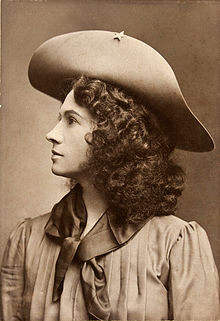 |
| Annie Oakley |
And all of this mental cud-munchimg makes me wonder if there isn't an important difference between admiration and adulation. The line between the two may be thinner than an anorexic, but still, I wonder if a bit of tortured reasoning isn't in order ... separating what, for all I know, is inseparable.
This blog post may serve as a perfect example. Here I sit, mentioning a couple of famous women, women I admire, women I might adulate -- straight, strong, and no doubt conflicted ... human beings. However badly informed I may be, still I am grateful to them. They help to paint an admirable picture in my mind ... exhibiting and exercising traits I too might like to exhibit or exercise.
But simultaneously ... how many people do you know who mention the stars in the literary or spiritual or academic or athletic firmament merely as a means of assuring their own luster? If I talk enough about spiritual or athletic hot shots, does some of that luster rub off on me and elevate me in your eyes? It's a cheap-date technique, no doubt, but that doesn't mean it's not common.
 From the couch-potato watching his favorite team play -- and cheering like a bandit -- to the utterly devoted spiritual apprentice who humbles himself before some authentic cross or liturgy or ritual or panoply of saints ... how much of it is admiration and how much of it is a means of activating some wider applause-meter ... the I-can-name-the-stars-therefore-you-might-wish-to-treat-me-as-a-star stuff... the devotee whose ability to get up off the couch is dubious at best... the sincere one resting on the laurels of sincerity?
I guess it's a human trait, getting caught up thinking that admiration should or could become adulation and that adulation is enough for an honest peaceful life. God knows I've been there and may yet again. But these days, I feel a bit more comfortable, as for example in Buddhism: Gautama is just another Helena Modjeska, another Annie Oakley, another example of something I admire, another instructor I find credible. Whether my own star is burnished in the mentioning of other stars is, in the end, useless, no matter how applause-worthy. No matter how I adulate or hug or praise such people, still I am stuck with the only farm I've got. Admiration strikes me as useful. Adulation does not.
What counts is the balls ... not dancing with the stars, just dancing.
Monday, September 9, 2013
the myth/tale of Israel
"Born and raised in Jerusalem in 1961, [Miko] Peled grew up in a prominent Zionist family; his grandfather signed Israel’s Declaration of Independence. His father, Mattiyahu Peled,
fought in the 1948 war and served as a general in the war of 1967;
later, after the Israeli cabinet ignored his investigation of a brutal
1967 Israeli war crime, he became a peace activist and leading proponent
of an Israeli dialogue with the PLO." -- More from Wikipedia

take your great teaching and stick it...
I am sick today. Sick and weak and I don't like it. Sick enough to think about seeing a doctor and I don't want to do that either. Not as sick as yesterday, it seems, but still nagged and weakened and wishing it would all go away.
Sick enough to be irascible -- if this is such a 'great teaching,' let those who mewl about 'great teachings' get taught!
I wonder who invented the word "shit!?"
"Shit" is such a wonderful word and even if words don't cure sickness, still they can be marvelous and mildly-soothing companions.
I think I'll stick with that:
Shit!
Sick enough to be irascible -- if this is such a 'great teaching,' let those who mewl about 'great teachings' get taught!
I wonder who invented the word "shit!?"
"Shit" is such a wonderful word and even if words don't cure sickness, still they can be marvelous and mildly-soothing companions.
I think I'll stick with that:
Shit!
victory without a W
Painted and powerful and handsome, Serena Williams, 31, beat lanky and fluid and intense Victoria Azarenka, 24, in the U.S. Open tennis championship yesterday. Top dog from America defeated top dog from Belarus.
 It was fierce to watch, even on TV. Even from an electronic safe distance, the intensity, the focus, and the unwillingness to fall prey to either despair or delight seemed palpable. This was no time for victory or defeat: Victory and defeat belong to the defeated ... this was serious. Each player made bad shots and good ones, but this was no time for "good" and "bad:" "Good" and "bad" would have dulled the blade necessary for this serious matter. This was serious. This was everything.
After the match, trophy in hand, Williams was quoted as saying, "I'm already thinking about what I could have done better. I think I'm a little crazy in that (way), like something must not be right because I don't even relish the moment enough." (Italics added.) She was also quoted as remembering how and why she got into tennis in the first place: True, her father had pressed her to do it, perhaps for the money, but she never thought about the money, she said, she just thought, "I want to win."
On the face of it, the situation was laden with victory and defeat. Thousands of fans sat in the sunshine in Arthur Ashe Stadium in Flushing, N.Y., to applaud and bask and be excited by a W (win). And the players too came to win a trophy and bragging rights and a lot of money. To win, to lose, to emerge victorious or defeated ... that's how games are played; that's how goals are formatted ... and in one sense, it's all true enough.
But what of the sense that "I don't even relish the moment enough?" What about the sense that the format of victory falls short of honesty? Sure, the majority of onlookers and the majority of the mind may accede to the format of victory ... but why is there a disconnect between the wildly-cheering victory and the sense that victory simply cannot put a period on the sentence? Why does a W fail to put its promised period on the sentence?
In the midst of any serious endeavor -- in the very middle of the thoughts, words and deeds required; in the place where gain and loss simply cannot be allowed to enter -- isn't it pretty much the same for anyone? It doesn't have to be some athletic contest -- any endeavor will do ... the kind of endeavor where 'why' and 'because' don't fill the bill and in fact get in the way; where the effort is whole-hearted and there is no time for extras: This is my life and it is so much my life that to say it's my life would be superfluous and, worse, gum up the effort. This is this ... everything and nothing all at once.
And later, later when the trophies are handed out and the crowd applauds and even I think I ought to be applauding ... later it is gone ... poof! What had been the blood of my precious blood in the moment is now ... well now it devolves into victory or defeat, a poor man's arena that cannot begin to describe or enter the whole-life that was expended in the attaining of it.
Has anyone not been to this seemingly strange land -- the one in which they are no longer doing something 'in order to' achieve something? The one in which relish and despair are not the point? The one in which "I do what I do because I do it ..." but the "I" is no longer a factor? The one that is filled with imperative and yet the imperative cannot be named.
I'm not so sure that it is a strange land. In the world of applause meters, perhaps it sounds screw-ball or scary and simply to express aliveness -- to let life live -- sounds too distant and lonely and contrary to all up-bringing. And yet who has not been there and later wondered why, somehow, s/he did not "relish" the victory enough?
Is it any wonder that military Medal of Honor winners feel embarrassed and confused and somewhat less than honorable?
Does life claim victory over life? I doubt it, but to acknowledge this land without victory strikes me as a potential W. It may not fit in the trophy case, but it does provide a savory relish.
It was fierce to watch, even on TV. Even from an electronic safe distance, the intensity, the focus, and the unwillingness to fall prey to either despair or delight seemed palpable. This was no time for victory or defeat: Victory and defeat belong to the defeated ... this was serious. Each player made bad shots and good ones, but this was no time for "good" and "bad:" "Good" and "bad" would have dulled the blade necessary for this serious matter. This was serious. This was everything.After the match, trophy in hand, Williams was quoted as saying, "I'm already thinking about what I could have done better. I think I'm a little crazy in that (way), like something must not be right because I don't even relish the moment enough." (Italics added.) She was also quoted as remembering how and why she got into tennis in the first place: True, her father had pressed her to do it, perhaps for the money, but she never thought about the money, she said, she just thought, "I want to win."
On the face of it, the situation was laden with victory and defeat. Thousands of fans sat in the sunshine in Arthur Ashe Stadium in Flushing, N.Y., to applaud and bask and be excited by a W (win). And the players too came to win a trophy and bragging rights and a lot of money. To win, to lose, to emerge victorious or defeated ... that's how games are played; that's how goals are formatted ... and in one sense, it's all true enough.
But what of the sense that "I don't even relish the moment enough?" What about the sense that the format of victory falls short of honesty? Sure, the majority of onlookers and the majority of the mind may accede to the format of victory ... but why is there a disconnect between the wildly-cheering victory and the sense that victory simply cannot put a period on the sentence? Why does a W fail to put its promised period on the sentence?
In the midst of any serious endeavor -- in the very middle of the thoughts, words and deeds required; in the place where gain and loss simply cannot be allowed to enter -- isn't it pretty much the same for anyone? It doesn't have to be some athletic contest -- any endeavor will do ... the kind of endeavor where 'why' and 'because' don't fill the bill and in fact get in the way; where the effort is whole-hearted and there is no time for extras: This is my life and it is so much my life that to say it's my life would be superfluous and, worse, gum up the effort. This is this ... everything and nothing all at once.
And later, later when the trophies are handed out and the crowd applauds and even I think I ought to be applauding ... later it is gone ... poof! What had been the blood of my precious blood in the moment is now ... well now it devolves into victory or defeat, a poor man's arena that cannot begin to describe or enter the whole-life that was expended in the attaining of it.
Has anyone not been to this seemingly strange land -- the one in which they are no longer doing something 'in order to' achieve something? The one in which relish and despair are not the point? The one in which "I do what I do because I do it ..." but the "I" is no longer a factor? The one that is filled with imperative and yet the imperative cannot be named.
I'm not so sure that it is a strange land. In the world of applause meters, perhaps it sounds screw-ball or scary and simply to express aliveness -- to let life live -- sounds too distant and lonely and contrary to all up-bringing. And yet who has not been there and later wondered why, somehow, s/he did not "relish" the victory enough?
Is it any wonder that military Medal of Honor winners feel embarrassed and confused and somewhat less than honorable?
Does life claim victory over life? I doubt it, but to acknowledge this land without victory strikes me as a potential W. It may not fit in the trophy case, but it does provide a savory relish.
Sunday, September 8, 2013
Subscribe to:
Posts (Atom)