Wednesday, January 8, 2014

in the halls of rebellion

This is too damned long by half ... give it a bye.

Just because you raise hell does not mean you are somehow exempted from it.

Or anyway, that's what I think this morning.

I say this out loud in part because I too have raised a little hell in my time and been caught in the honey trap of imagining that the hell-raising assured my place in some more well-appointed heaven.

Mind you, I like hell-raising and hell-raisers. These are the guys and gals who gird up their loins and point out that the emperor is not wearing any clothes; who amass the facts and come to contrary conclusions; who speak to "the better angels of our nature;" and who refuse to be cowed. They are the ones who challenge the prevailing, comforting, group-hug tide. Where hypocrisy and unkindness are blithely adorned, they show a willingness and courage that lesser (wo)men fail to summon. They pay prices for which others lack the purse.

Yes, I like and admire them ... AND ...

John Dear
Yesterday, I got an email from a rebellious Roman Catholic priest friend. In the email, Emmett passed along the tale of a Jesuit who had, to all intents and purposes, been tossed out of the Society of Jesus (the Jesuits). Reading between the lines, it seemed that peace activist and priest John Dear had pissed off one too many of his superiors ... that his anti-militarism (and willingness to get arrested for it) rocked the church-state boat a little too much... so they kicked his ass out.

Here is Dear's lead paragraph in a column announcing his departure from the Jesuits:
This week, with a heavy heart, I am officially leaving the Jesuits after 32 years. After three years of discernment, I'm leaving because the Society of Jesus in the U.S. has changed so much since I entered in 1982 and because my Jesuit superiors have tried so hard over the decades to stop my work for peace -- most recently, when my provincial ordered me to Baltimore but gave me no assignment and, I felt, encouraged me to leave, as many other superiors have done in the past.
OK -- you get the drift: Rapscallion hell-raiser challenges the establishment to which he belongs. He challenges that establishment to live up to its stated principles and does so in very public and pronounced ways. The establishment gets tired of this gnat on its brow and finally brings down the fly-swatter. The concrete particulars of the Dear case are not entirely in evidence, but the broad outlines have been seen before and will be seen again ... it's one thing to talk a good game (be for peace and justice and all) and quite another to put those principles front-and-center. The liar-liar-pants-on-fire implications for the establishment become annoying to an establishment that wants to think well of itself.

There is one more aspect to the email that I received yesterday from Emmett. There is a possibility that Pope Francis, himself a Jesuit and a man who has received a lot of good press for pointing the Catholic Church back towards its roots of helping the poor instead of counting up its theological and literal treasure, will sign off on Dear's ouster. Not for sure, but it is possible the pope will give his support to the ouster. And even the suggestion that the pope might sign off on it led Emmett to conclude that all of the warm-fuzzy press about the pope was off the mark: This was a business-as-usual, mortar-the-establishment walls, brook-little-dissent pope. Same shit, different day. Given his years as a priest, and my own ignorance, I was willing to accept Emmett's assessment.

But that assessment brought to mind the fact that religion, of whatever ilk, is invariably dependent on the state where it sets up shop. Religion cannot flourish where there is no stability. The state -- good, bad and indifferent -- provides that stability. Religion is locked in a love-dance with a state that, among other things, embraces the use of force ... of militarism. Religion may speak the speech of peace, but its own systemic format puts it in a position where it supports war. Purists may holler "hypocrite!" but the facts remain unmoved. Supporting what you claim to abhor is just part of the package.

And it is here that the fly in the ointment of rebellion makes itself felt. Hell-raising is really a pretty good thing, but believing that that hell-raising is capable of purifying the establishment against which it rebels is largely a myth: Where the system is locked in a love-dance with what it claims to abhor, purification becomes a relative matter. Can we do better? You bet. Can we, in doing better, actually do best? No.

Conformists and establishment members may dance in glee at this observation. Their beloved realms are saved from the rebels. But this is just the delight of the lazy who can do no better than agree with others and imagine themselves "right."

But do the rebels have some of the same problem? I think so. Being "right" is so magnetic. Hell-raising is often tinged with the unspoken understanding that peace and justice would certainly flourish within a given establishment if only that establishment would change gears and revise its emphases. But when the establishment the rebels seek to purify is ipso facto a supporter of war and injustice ... how well do the rebellious hopes and actions pan out?

The rebels of the Catholic Church seek to preserve the church and its religious priciples. The rebels of Zen Buddhism seek to preserve Zen Buddhism ... without the nastiness that can evolve. By changing course, by acknowledging the naked emperor, things will be better, more ethical, and more in tune with original intentions. And I think perhaps they will, but ...

When the established format carries within it the very toxin anyone might seek to excise or reform, then I think it is time for responsibility. Not lip-synch, talk-the-virtuous-talk responsibility, but in-your-face, bathroom-mirror responsibility.

The military chaplain, for example, needs to know that whereas his or her actions may succor soldiers in need, still those soldiers would not be in need without the support religion gives to the activities of war. The military chaplain swears fealty to the state; the state makes war; the chaplain is a responsible enabler of war.

Does all of this endless argument suggest that rebellion should be set aside? I don't think so. I love the rebels who dig and delve and attempt to make things better, often by making them worse. But I think the potential for blind-spot virtue is a danger. There is something to be said for banking the fires of hell while recognizing that the fires of hell are a personal, no-joke responsibility: I am the establishment; I am the rebel. Improvements are possible and hell-raising is a good idea.

Not good enough or flawless enough to be called "good" or "unflawed," mind you. But pretty good.

My own take: Whether lackadaisical company man or firebrand rebel, don't be lazy; don't be irresponsible.

Tuesday, January 7, 2014

U.S. weather spoof ... sort of

Warning for those in need: There are some naughty words:


1971 break-in at the FBI

Passed along in email:

On March 8, 1971, anti-Vietnam-war activists broke into a Federal Bureau of Investigation field office in Media, Pa. What they came away with in a heist that was never solved were suitcases full of documents proving that the FBI had overstepped its mandate and used lies, blackmail, and illegal mail interception among other tactics in its self-anointed quest to keep America pure, clean, safe ... you know, all the same stuff NSA and its supporters claim today in the face of Edward Snowden's and Bradley/Chelsea Manning's revelations.

The 1971 story seems incredibly antiquated in retrospect and yet one thing remains utterly clear -- what takes courage today took the same courage yesterday, and how lucky the rest of us are that such courage exists and is implemented.


Here is the NYTimes story.

thank you

When I was a teenager, I was invited to some sort of dinner party for a friend. There were a bunch of us gathered around the supper table where turkey was served.

And in the midst of the cheerful chatter that bubbled and floated in the room, I realized that I thought the turkey was very good. Turkey is not an easy thing to cook well -- it's drier and less flavorful than chicken, for example -- and so, when I had the opportunity, I told my friend's mother that I thought she had done a spectacular job on the turkey.

The woman looked pleased, but admitted candidly that she had not cooked it. The cook had.

And so I walked out to the kitchen and told the cook she had done a spectacular job.

She too looked pleased.

The farmer who raised the turkey was not immediately available for thanks, but I think there is something to be said for thanking the source... whatever it may be.

comme il faut

The British television serial "Downton Abbey" continues to rack up viewers here in the United States. Set in the late 19th and flowing into the early 20th century, the serial follows the lush adventures of an aristocratic family on a fictional estate in England.

Visually, the show is like eating chocolate mousse: Everyone and everything is perfectly appointed, from the place settings at the dinner table to the paintings on the walls, to the scrupulously scrubbed and trained servants. The estate is vast and manicured and conversation is invariably well-turned, if dutifully opaque (it's England, dontcha know ... although blaming the English is not quite fair: Rich people everywhere have a distanced way of approaching all those they imagine might deprive them of what they have and, sotto voce, deserve).

I'm not in a position to say with certainty why "Downton Abbey" should arouse a growing television following, but I can guess. And part of my guess is that the well-gardened certainties of aristocratic life can seem wonderfully delicious from the point of view of a world suffering from economic rawness, corruption, war and a sense that the unending up-to-date bruises and wounds provide no promise of surcease: Getting kicked in the ass is not so bad if there is some sense that up ahead there is a place where life will stop kicking you in the ass ... perhaps in a realm that, while not as posh as Downton Abbey, at least provides a bit of peaceful respite... a place of format and social agreement and ... things are just comme il faut. Where there are rules and regs, you can relax a little and let the rules and regs bear the burden.

Here in the United States, there was a time when businesses of a certain size would create a "personnel" department -- an agency that would vet incoming employees and cope with the problems those employees might encounter. But they were also, I suspect, the agency that would rebrand itself as "the department of human resources," or "HR" for short. "Personnel" was an adequate description but "human resources" sounded more caring and thoughtful and, well, human.

And the same quiet and caring legerdemain found a home for what was "the War Department" during World War II. Now it's "the Defense Department." "Life insurance" was never, as far as I know, called "death insurance" although its usefulness was contingent on the policy holder's dropping dead. Every realm seems to have its "Downton Abbey" parameters -- its rules and regs that smooth and soothe and make things work better.

And what is sauce for the world of commerce and politics is likewise sauce for the world of spiritual endeavor. Religious persuasions all draw up visions that are as nicely-appointed and well-spoken as the world of "Downton Abbey." There are as many versions of heavens and hells, rights and wrongs, threats and promises as there are place settings and proper forks at the aristocratic dinner table. Here are the rules and regs and the participant can rest easy: When things are comme il faut, the participant can be reassured and rest easy and make assured progress within stated and unstated boundaries.

It all can work pretty well. And it's certainly better than the chaotic barbarism that might ensue without rules.

But what is true for the TV series "Downton Abbey" is likewise true for other well-appointed rule books, whether institutional or personal. Life comes calling. At "Downton Abbey," the Industrial Revolution, World War I, the telephone, electricity, and a host of very human needs and longings and demands all chip away at a perfectly perfected world. Rules work ... right up to the moment when they don't work.

Suddenly, in the face of some event or situation, life asserts its wider potential. Comme il faut, "As IT should be," is suddenly seen for what it is: "what I WANT it to be." The overarching and impersonal IT displays its true colors and the Department of Defense becomes the Department of War; life insurance becomes death insurance. There are no rules outside the rules I impose or agree to and this responsibility is worth shouldering, however reluctantly. What the department of Human Resources deems "unacceptable" when it chastises an employee is not unacceptable from some rock-solid and ethereal and impersonal perspective (think "God"), but rather it is a personal choice made for personal, rule-book reasons. And those rules may in fact steady the course of events.

Who has not learned incalculably-useful lessons from the Downton Abbeys of this mind? How could baseball be played or houses erected or space shuttles built without the comme il faut of the realm? How could spiritual aspirants gain experience without entering into a world that is carefully coiffed?

But at some juncture as well, doesn't it need to be conceded that the rules that once informed are not necessarily the rules that work? To remain mired in the comme-il-faut's is to defeat the purpose of the exercise itself. Doggedly clutching the rule book to the breast ... does that really compute or is it rather a fear of living life whole?

Teenagers and other confused souls may think that fuck-the-rules is the way to go. The problem, of course, is that that approach simply concocts another rule book, another comme il faut.

Just something to consider, I guess: The delicious humming birds' tongues on the Downton Abbey plate all come to a toilet-flushing end. It's not good or bad or better or worse, but it is what happens and it's probably a good idea to make peace with what actually happens and release the reins of what should happen. If you doubt this, just check out the stale and sometimes barbarous activities of those who cannot or will not loosen those reins... as, for example, in the Downton Abbey of this mind.

Monday, January 6, 2014

Fukushima -- don't worry, be happy

Passed along in email today was this Dec. 31, 2013, article about a former MSNBC host, Cenk Uygur,
who was urged to tone down his critique of the Fukushima Daiichi nuclear disaster of March 11, 2011.

As a commentator, Uygur has said in politer terms, "Get the fuck out of there!"

But his alarms must have been overstated (right?) because "the official [Japanese] government position is that it’s safe." And Washington too was not amused by criticism of those who issued reassuring statements.

Now the fallout is slowly making itself felt in the western United States.

An April 15, 2012, article in The European Union Times addresses the issue of Japan's plan to evacuate 40 million people if things at Fukushima go from bad to worse.

If we ignore it, maybe it will just go away ... or we will.

Cup Song in Gaelic

Passed along in email:


apology form

Passed along in email (click to enlarge):


training wheels ... again

When I was a kid, training wheels for bicycles did not exist, or, if they did, I never saw or was aware of them. Training wheels are meant to give the cyclist in training a period to practice pedaling from here to there without collapsing on the pavement. They allow the novice some time to get a sense of the vehicle s/he hopes to master.

Anyway, they didn't exist when I was a kid. This meant that support mechanisms had to be replaced with determination. Sure, mom or dad might hold the bike steady now and then, but mom or dad couldn't be there all the time and any would-be bicyclist yearned for the the freedom and independent action that came from knowing how to ride a bike just like the other bike-riding kids in the neighborhood.

I really, really wanted to know how to ride a bike and that meant practicing on my own ... and falling off over and over again.

And even if there had been training wheels when I was young, still, there would have come a time when the training wheels that once acted as an assistant would have become, instead, a deterrent: No one can make a fast, sharp, banking turn with training wheels; the full range of possibilities and delights would be constrained by what once had been a very helping hand.

I learned the old-fashioned way: Fall on your ass and pick yourself up. Scrapes and bruises and tears ... maybe training wheels would have helped, but I doubt it: With or without training wheels, the goal is the same -- to ride unimpeded along the delicate line between joy and sorrow ... yes, maybe I'd fall, but in the meantime, I was soaring. Once, I believed I could ride and was determined to do so. Now, I could ride.

I guess it is the mundane nature of riding a bike that makes people reluctant to agree with me: Bike riding, with all its joys and sorrows, is a precise metaphor when it comes to spiritual endeavor. Precise, exact, no need for exceptions.

Training wheels or not, mom and dad or not ... precisely the same. The texts and temples, teachers and helpers, hopes and fears, determination and dismay, bumps and bruises, incense and chanting, long history and new discovery, seriousness and solemnity ... I cannot think of a particular in one realm that does not find correspondence in the other.

Does anyone hope to ride a bike with training wheels forever? Doesn't anyone who rides a bike say thank-you to mom and dad and training wheels and then ... just ride? Seriousness and solemnity are as unnecessary now as they were once necessary. Childish dreams of "never falling off" (some static-state bliss) are set aside: Riding is falling off; falling off is riding. When you need training wheels, use 'em. When that time has passed, don't. What is useful today turns into a barrier tomorrow. Why make life any harder than it has to be?

Oh well ... I just got off on a training-wheels thought train this morning.


Sunday, January 5, 2014

drug drawbacks acknowledged too late

Passed along in email: "7 Drugs Whose Dangerous Risks Emerged Only After Big Pharma Made Its Money."

"Wake Up" video-song

Passed along, unsolicited, in email. I enjoyed the voice more than the video, but I can imagine others feeling differently. The email arrived with a backstory that included, "The song is sung by a young Chinese girl who now lives in London.  Emily Wang Garbo was born in Beijing in 1999 and is now living in London, England. Emily was raised in the beginning by her Grandmother who was a devout Buddhist. Emily’s early childhood was often spent with her grandmother in Chinese Buddhist monasteries."


cold day

A cold morning inspires the furnace to kick in today.

Up ahead in a couple of hours, there will be some time to spend in the zendo I did not adequately insulate when I built it.

As a result, I will dress myself plump as the insufferably cute Pillsbury doughboy and pay my penalties for an hour or so.

Oh well, freezing my ass off beats some swooning and wise discussion of 'karma.'

no self, so to speak

Strange to think that no one in their right mind would ask a blue jay to be a robin and yet, for those who concern themselves in this way, a person who has lived a whole life with something called "self," might struggle mightily to rearrange his or her feathers.

For those concerned, it's really an enormous, wracking effort. Imagine: A whole life infused and circumscribed and wounded and ecstatic and ... filled to the brim with self and then, upon self-ish investigation, this self is encouraged to change gears because crediting the self leads to so much discomfort and sorrow and inaccuracy.

Great dollops of spiritual observation are brought to bear: Attachment and compassion and clarity and emptiness and selflessness and ... well, fill in your own blanks. Years and years and years of practice. Years of encouragement. Years of falling down and getting up. Moments of brightness and moments of blackness. Swooning and despairing and all the other times and places and conditions ... Jesus! what an effort. It's all as heroic in some eyes as it is idiotic in others.

But when you stop to think about it, what else could there be besides this blue jay self. Isn't self the nature of all things? A blue jay is a blue-jay self; a maple tree is a maple-tree self; a spiritual aspirant is a spiritual aspirant self. It's the nature of the beast -- no big deal. Why would a jelly bean strain to be a lollipop? That would be silly, wouldn't it?

So maybe it's an easier point of entry -- taking this self that has been around in every second of a whole life and stop picking your nose about it. Stop fretting and fidgeting. Yup ... this self is all there is. Relax. Correct mistakes. Get on with it. Enjoy.

There is nothing but self.

The only trick to it is that there is no self.

And anyone who claims that there is no self has missed the mark by a mile.

Saturday, January 4, 2014

"people are awesome"

Passed along in email:


at play

Grey seals play underwater by the Farne Islands off the Northumberland coast, near Seahouses, northern England, November 17 2013.
REUTERS/Nigel Roddis

Phil Everly dies at 74


US musician Phil Everly, one half of the Everly Brothers, has died, aged 74, in California, his family says.
Everly died in the Los Angeles suburb of Burbank of complications from lung disease, his wife, Patti, told the Los Angeles Times....
Phil Everly and his brother Don made up the Everly Brothers, one of the biggest pop acts of the 1950s and early 1960s.
They had a string of close-harmony hits including Wake Up Little Suzie, Cathy's Clown, Bye Bye Love, and All I Have To Do Is Dream.

fear pays off for Boeing

Unions whose forbears suffered enormous casualties in pursuit of  the 40-hour work week, the minimum wage and other improved conditions suffered another body blow last night when aircraft-maker Boeing's workers agreed to financial give-backs as the price for keeping the work in Washington state. Workers voted by 51% to accept the company offer.
"I think people that voted for it were scared," [Hazel] Powers said. "The pressure from the politicians and the community - people are scared about not having good-paying Boeing jobs."
I have a hunch that the 21st century laborer may have to refight 20th century battles. And as in the past, the cops and military (made up of working stiffs for the most part) will be at the beck and call of management/politicians. Downton Abby has its requirements.

breaking the Jell-O molds

Setting aside the acidic arrogance of the satirist for a moment, is it true or am I only imagining it ....

Give a man a good idea and he will turn it into a bureaucracy.

Give a man a heavenly dream and he will turn it into a hellish nightmare.

Give a man a bit of common sense and he will twist its neck into a ruthless senselessness.

Is there something woven intractably into the human DNA that allows onlookers to observe with considerable accuracy, "He'd fuck up a wet dream?"

-- Safety is quite an appealing idea, for example. The Department of Homeland Security and its waxing stature with street-corner cameras, the tapping of personal communications, the use of drones and an unwillingness to examine "terror" root and branch takes an appealing idea and codifies nothing so much as its horror.

-- Education is a good idea in the sense that it can provide a wider view of the possibilities in life and thus increases the chances for individual happiness. But is there any educated person who hasn't run up against the educator whose smug abilities leave others stupider than they were in the first place ... as for example in this wonderful, spoofing bit of gibberish passed along in email today:


-- The format may vary, but reflecting and perhaps repenting of errors is a probably a good idea. Aside from anything else, it can help instill the determination not to make the same mistake twice. But this morning, for reasons that escape me, I woke up thinking of "auto-da-fé," a term whose exact meaning and application escaped me. So I looked it up.

The Portuguese term "auto-da-fé" literally means "act of faith." It was "the ritual of public penance of condemned heretics and apostates" during the Portuguese or Spanish Inquisition, an inquisition that got its bureaucratic legs in the 15th century when King Ferdinand and Queen Isabella "received permission from Pope Sixtus IV to name inquisitors throughout their domain to protect Catholicism as the one true faith." Not everyone accused of heresy or apostasy was necessarily burned alive, but a lot were.

1683 painting of auto-da-fé in Madrid
Talk about a nightmare growing out of an idea that has some merit!
Anyone who was guilty or knew of someone who was guilty was urged to confess. If they were approached and charged they were then presumed guilty. Since the suspects were not allowed to look at the evidence against them, they could only assume the worst. A defendant at the trial did not know what witnesses would be called against him....
The ceremony of public penitence then began with a procession of prisoners, who bore elaborate visual symbols on their garments and bodies. These symbols were called sanbenito, and were made of yellow sackcloth. They served to identify the specific acts of treason of the accused, whose identities were kept secret until the very last moment. In addition, the prisoners usually had no idea what the outcome of their trial had been or their sentencing. The prisoners were taken outside the city walls to a place called the quemadero or burning place. There the sentences were read. Prisoners who were acquitted or whose sentence was suspended would fall on their knees in thanksgiving, but the condemned would be punished. [italics added]
Although I have criticized the Roman Catholic Church in the past, that is not my intention here. The Inquisition and its attendant rituals simply serve as what I think is a good example of what happens when a reasonable and often good idea is poured into the Jell-O mold of governing policy... the kind of policy that can afflict both societies and individuals.

Heavenly idea, hellish application -- how many have not made that mistake? I certainly know that I have.

And worse than the mistake itself is the realization that undoing the error is a hell of a lot harder than committing the error in the first place.

Imagine trying to undo the Department of Homeland Security, an institution that employs thousands, has thousands more in an applauding audience, and is top-heavy with tax dollars. Imagine how hard it might be for an academic to learn convoluted and self-serving gibberish and then attempt to backtrack into a world of salutary straightforwardness. Imagine a spiritual institution or belief system top-heavy with Jell-O molds of right and wrong rethinking its mission. So much power and so much treasure are already invested ... personally or institutionally, sometimes it is just easier to support and advance the well-established error than it is to forswear the Jell-O molds.

All I can think is ... your/my life, your/my choice.

And too, the wry observation, "No one ever lay on his death bed saying, 'Gee! I wish I had spent more time at the office.'"

uncompromising applause

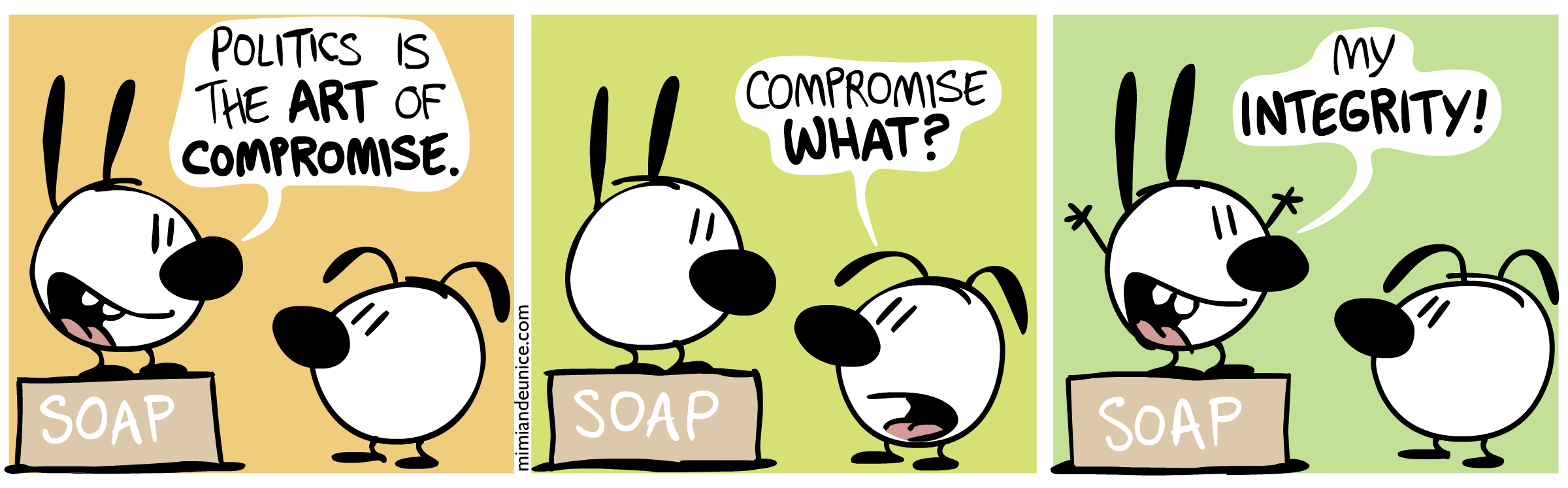
Among the Internet dictionary definitions of the verb "compromise" are these:
-- to solve a problem or end an argument by accepting that you cannot have everything that you want
--to risk harming or losing something important
Whether personally or socially, no one has to look very far to see that compromise can be a wise and peaceful activity without which there are sometimes chaotic and sometimes brutal results. From politics to marriage to ecumenism to baseball, if participants run around proclaiming that only their individual philosophy or belief will do ... well, not only is there less chance of a wider accomplishment, but also there is a lot of anguish. From this vantage point, compromise comes in for a lot of well-deserved praise. Look how much we can do together, in concert, in harmony ... or anyway something like harmony!

But then there is the other edge of the sword called "compromise" --  the risk posed by going-along-to-get-along. If every situation means accepting that you cannot have everything you want, at what point do you get what you may want very badly ... something you will not compromise because that poses an unacceptable risk of harming or losing what is important?

If everyone always agrees, it may produce an outward serenity. It may also produce an insufferable mediocrity in which no (wo)man is ever really called on to do his or her best from his or her point of view. Somehow, to compromise may be wonderful and productive and it may be bland and demeaning.

Beethoven did not create a symphony by committee. The greatness of Tolstoy can hardly be imagined as arising out of some earnest round-table discussion. No more is it easy to imagine that Gautama or Jesus or Mohammad were willing to "risk harming or losing something important."

Jesuitical thinkers and hug fanatics may argue that to compromise without compromising is the way to go, or that circumstances dictate where to "hold 'em" and where to "fold 'em," but for the individual I imagine  verbal legerdemain lacks much savor. 
On the one hand, no one can do whatever s/he wants without repercussions, but, on the other, not-doing-whatever-s/he-wants can feel sluggish, second-hand, and cowardly... and as if something important has been harmed or lost.

This sketchy appreciation can go on and on, but what crosses my mental bow at the moment is the extent to which anyone's spiritual life may be a compromise of socially-agreeable comfort and to what extent it refuses to "risk harming or losing something important."

In order to "risk harming or losing something important" in spiritual life, it seems to me that the individual would have to know precisely what it is that is "important." Knowing this from the get-go is unlikely: If someone knew precisely what was important, there would be no need to embark on a spiritual adventure in the first place.

Perhaps, then, there is just a bit of hope, a bit of belief and a hunch to begin with. And it is in the world of compromise, of going along and getting along, of curtailing personal leanings in favor of some peaceable spiritual kingdom, that the adventure can begin ... a realm that has a history and has expositors and has costumes and has buildings and has various sorts of magic and practices. And when someone of stature says, "This is the right way," the initiate answers, "Amen!" This is a sanctified union of hearts and voices and it is capable of generating its own warming and generous praise.

When I was younger, I went to several folk-music concerts given by Pete Seeger, the old socialist rabble-rouser who was both pointed and a lot of fun. And at each concert, Seeger would play some song that the audience was invited to join. Since the audiences were often large, the sound was enormous. It was enthralling. It was delicious ... and when the song was done, the audience would applaud Seeger loudly ... a swoon of cheers. It was delicious in the way that a post-orgasmic rest period can be delicious ... emptied out, warm, together ... Jeeeeesus! What a magician Seeger was ....
as magical, perhaps, as a spiritual congregation.

And then, of course, the thought will not be denied: Was the audience applauding Seeger or were they applauding themselves? Their voices filled the auditorium just like their applause. Whether led or not led, this individual voice was just that -- individual ... individual and uncompromising and uncompromised. This observation is not to denigrate the current magician or circumstance of life -- Seeger or any other individual or setting. It is just to notice.
 This voice, whether in field or mountains or auditorium, is utterly itself. It does not compare or contrast or elevate or denigrate ... it just is ... uncompromised and uncompromising. It is inescapable. It requires no assent or debate. It is not better because it rises in harmony and not worse if dissonance is what it can muster.

It cannot be lost and it cannot be harmed, but knowing its importance strikes me as worth knowing in a world of compromise.

Friday, January 3, 2014

how to land on Mars

Passed along in email:


mixed messages in China

(Reuters) - China's police chief wrote on Friday that his officers must uphold the leadership of the Communist Party and be loyal to it, as the government targets the domestic security apparatus in a crackdown on corruption....
Zhou had expanded his role into one of the most powerful, and controversial, fiefdoms in the one-party government, and under his stewardship the domestic security budget exceeded that of the military [emphasis added]....
Xi confounded expectations he may loosen up upon his appointment as president last year, and has instead overseen a sweeping crackdown on dissent, a theme Guo implied would continue in the interests of national development.
"Only if there is social stability can reform and development continue to proceed," he wrote.

Let me see if I've got this straight: Police must back a central authority whose track record for honesty is under suspicion.

And I wonder if the U.S. and other western countries take see a lesson in China's corruption/centralized power. I doubt that the Department of Homeland Security has yet attained a budget that equals or exceeds the military, but nothing happens overnight.

snapshot of an imagined future


WASHINGTON (AP) - Ask people to imagine American life in 2050, and you'll get some dreary visions.
Whether they foresee runaway technology or runaway government, rampant poverty or vanishing morality, a majority of Americans predict a future worse than today.

the weather, death and stuff

The cold is bitter in the predawn hours today, but the snowfall that had everyone closing up shop before the event is minor ... maybe four to six inches. It's worse in other parts of Massachusetts, the state where I live. A friend emailed an advisory picture that summed things up minus the solemnity:

Based on a look out the window, the advisory seems to be accurate. I'm in the "no-big-deal" neighborhood.

Yesterday evening, Gideon, the man who lives in New York and manages my aging mother's affairs with a kindness I appreciate, called to say that he couldn't put his finger on it, but he thought my mother would die soon. She is 98. On Gideon's latest visit, my mother recognized him and smiled, but was unwilling to make the effort to talk. Gideon wanted to line up the bureaucratic ducks (the will and other arrangements), but encouraged me not to come down to New York if I was feeling fragile, which, generally speaking, I guess I am. I thought it was kind of him to think of that. I don't like whining, but appreciate it when someone recognizes that I might want to.

Today, I have to go to the hospital for an "upper endoscopy" -- a video camera shoved down my throat to see if there is some biological cause for an on-again-off-again stomach discomfort. Ah, the Organ Recital ... part of the music of getting older. As much as I dislike discommoding others, my daughter will drive me to and fro ... the drugs and the hospital insurance company, no doubt, suggest that driving myself is not in the cards.

Over the last couple of days, I have had two emails from people -- one a Roman Catholic priest -- who have found an interest in Buddhism. I like Tom -- the priest -- quite a lot based on earlier emails about non-Buddhist topics. Of course there is no knowing on what basis or with what degree of what seriousness anyone conceives such an interest, but I always like to hear that people have taken an interest in something I too have taken, I guess, seriously. I like it partly, I suppose, for the club-house feeling of group activity, but mostly I like it because I am happy for anyone who even thinks about the possibility of investigating their own lives: The odds of straightening things out and being happier are improved ... even for the wand-wavers. Belief, while useful on a tentative basis, really can't cut it in the end and it makes me happy to think someone might take those reins in hand.

Thursday, January 2, 2014

photos (Reuters)

Ultra-Orthodox Jewish men attend a protest against plans to enlist men from their community into the military, in the Mea Shearim neighbourhood of Jerusalem January 1, 2014. Ultra-Orthodox Jews protested in Jerusalem on Wednesday against plans to enlist men from their community into the military, a proposal supported by the secular majority pushing for a more equal share of the burden on Israeli society.
REUTERS/Ronen Zvulun
People offer prayers on the first day of the new year at Meiji Shrine in Tokyo January 1, 2014. Many people from across Japan visit shrines and temples to make new year wishes as they pray for the safety of the household, good relationships and success in business on the first day of the New Year.
REUTERS/Yuya Shino
A man jumps into a hole cut in the ice on the Ottawa River during the annual Great Canadian Chill polar bear dip in Ottawa January 1, 2014.
REUTERS/Chris Wattie
Pope Francis kisses a baby Jesus statue as he leads a mass at Saint Peter's Basilica at the Vatican January 1, 2014.
REUTERS/Giampiero Sposito

winter storm

It's only a tickle at the moment, but I can imagine that news outlets that were never too keen on more-expensive-and-substantive news-gathering in the first place are delighted that the first major snowstorm of the season is about to land on the Northeast here in the U.S.

It's not here yet, but the local newspaper leads its page 1 with the storm. Television outlets have let loose their already over-utilized forecasters.

Think how much money can be saved:

"It's coming."

"It came."

"It needs to be cleaned up."

Days and days of Mother Nature. The number of barbecues that will be up-ended is positively outrageous, don't you agree? Looking out the window is hardly enough: We need to know more and more and more about what the window can elucidate in an instant. A heatwave in Argentina is of no importance.

It's here and it's now and it's not going to end any time soon.

farewell incandescent light bulbs

As of Jan. 1, 2014, incandescent light bulbs, left, have been banned. Here is an assessment of the ban and its fallout.

carelessness

It may be sexist, but it floats up into my male thoughts as a reminder nonetheless -- Vito Corleone's observation in "The Godfather:"
It's an old habit. I spent my life trying not to be careless. Women and children can be careless, but not men.
"Trying" is not necessarily "succeeding," but it is "trying" and carelessness can exact some sharp-edged prices. In the world of 'the Godfather' and organized crime, the price is sometimes death, a price many, if not most, people would prefer not to pay. But there are less all-consuming prices as well and everyone has paid them, I imagine.

Carelessness is an attribute best observed in the rear-view mirror. Only after one particular effort or another can the yardstick be applied with any credible meaning. Before that effort, planning is brought to bear, sometimes with earlier bits of carelessness in mind. Sometimes things work out. Sometimes "the best-laid plans of mice and men do oft times go awry."

No matter how much care is brought to bear, still, it seems, carelessness raises its head on later examination. No one can see into the future and yet trying not to be careless is the only game in town for those wishing to succeed ... or attempting to lead a responsible life.

Employment, marriage, stock-car racing, academic research, eating chocolate cake, spiritual endeavor, war --  pick a realm and each is up to its ears in the need for care and the dangers of carelessness. And no matter how careful, still the fallout can feel distinctly careless. And if this is true, the question can arise, "why be careful in the first place?" or "why seek to avoid what is unavoidable?"

The fictional character Vito Corleone spent his life "trying not to be careless." In the novel, he won some and lost some. But the point is that he "tried." Why? Because the alternative was more painful and less potentially beneficial than not trying. He did not feign trying ... he tried. He did not imagine that "I deserve it" ... he tried. He did not waste too much time measuring his capacities against the capacities of others ... he tried.

Somewhere or other, Gautama (the man referred to as "the Buddha" in Buddhism) was asked to sum up his teachings succinctly. In the text I can remember but not cite, it said that Gautama paused and then, "summoning all of his powers," he replied, "It's not intellectual."

With all of his powers, Gautama tried not to be careless.

Or at any rate, I am inclined to think he tried.

I am inclined to think he really tried.

I am inclined to think that he reached down into his core, summoning honesty and love, with his eyes open to the necessity for care and the sorrows of carelessness, with every fiber of his being, using all things at his command ... and tried.

No one needs a holy text or sage to know how well that worked.

Wednesday, January 1, 2014

the best-dressed man

Just a turn of phrase that appeals to me vis-a-vis spiritual adventures:

"The best-dressed man in a nudist colony."

I guess I'd better check the bathroom mirror.

the George Orwell effect

I awoke strangely late (9:00) on this new year's day and for some reason found myself thinking about George Orwell.

"George Orwell"
In my memory banks, Orwell is simply a bright light and a bulwark of sorts -- a vaguely amorphous yet also powerful touchstone whose very specific socialist-leaning and anti-totalitarian essays and novels do not stand out in their academic, sound-intelligent particulars.

Yes, "1984" and "Animal Farm" and "Down and Out in Paris and London" and "Homage to Catalonia" and "Killing the Elephant" are all in there somewhere, but their particulars are long gone and I would flunk a high-school essay exam if forced to write one. Orwell is more like a beautiful woman who has left the room but her scent remains.

Orwell: The hell-raiser who grew up honing intellectual skills in an environment he would later dissect and excoriate with such effect. Without the educational and economic blessing, would his view of the curse been so bang-on? Without the social and cultural lickspittles, how could his fiery fulminations have found so popular a purchase?

How surprising is the light bulb without the darkness?

How informative is what works without the myriad failures of what does not?

How heroic is the hero without the backdrop of cowardice and mediocrity?

Didn't Buddha and Jesus and Ikkyu and Mohammed and all the other pick-your-poison bright lights have vast debts to acknowledge? The wondrous rapscallions are in debt in the mind that elevates them and sooner or later those debts must be acknowledged and paid off. Wallowing among the lickspittles -- seeking out a life based on the agreement of others -- is as suffocating as it is comforting and yet the blazing light that shows the way out requires examination as well: Disagreement is just agreement in other clothes.... the sort of conundrum faced by the second-class atheist who constantly posits God as a means of denying him/her/it.

Lickspittle mediocrity and carelessness is tedious, yes. But anyone who imagines that putting on a white hat can eradicate what is black-hatted is stuck with the farm: It's just another hat. This is just goodness that posits and thus encourages what is seen as -- and what actually may be -- bad. The light bulb is not wondrous of itself but only in concert with the darkness it dispels. It's a trap that is hardly peaceful, however stenciled with "peace" it may be.

Limits point to limitlessness.

Limitlessness points to limits.

For this reason, I suspect it is good to sleep late from time to time.

new year

Suddenly, it is not then.

Here's wishing everyone a

                       HAPPY NEW YEAR! 

May the times be as peaceful as they are fleeting.