Thursday, April 18, 2013

consumed by passion

Listening absently to the car radio yesterday, a somewhat breathless and adoring public radio host was interviewing an African musician, Hugh Masekela, who apparently is on tour here in the United States. I don't care much for jazz and had never heard of Masekela, but I enjoyed his bits and snippets that entered my mind as I drove ... a man who began drinking at 13 and quit at 58; a man now 74 who spoke highly of Miriam Makeba, whose work I admired and to whom Masekela had apparently been tumultuously married; and most of all, a man with a passion -- a passion he described as a "demon" -- for music... any music ... all music ... a passion!

On the radio, his voice was as seasoned and sound as the host's adoration was flimsy and panting. Masekela answered the questions with an even-tempered good grace that seemed to arise out of experience -- some good, some bad, but it seemed to be his and he sounded whole and devoted and blessedly wry.

And when at last the interview wound down, the host asked Masekela what advice he would give to aspiring musicians. The question made my mind cringe. It was one of those go-to questions that interviewers might escape criticism for asking, but I cringed: How do you ask someone about something that consumes them, subsumes them and for which they are literally willing to die ... the passionate demon/god that others might dance around, crooning tunes like, "I believe!"

Where I cringed, Masekela did not: "Well, I think the best advice you can give to anybody is that if they love something and they want to be involved with it, the first thing they have to do is be honest with themselves: How much do they like this thing ... do they have a passion for it? And second, they have to be honest about ... have they been told that they seem to be very talented in this field ... because whatever you go into, you have to go there to be the best. There's no formulas. It's all about passion and honesty and hard work. It may look glamorous, but it takes hard work. The blessing with the arts is that you can do it forever, until you drop dead. That's the blessing. I'm 74 and I feel that I am just beginning."

"The first thing they have to do is be honest with themselves."

Not critical.

Just honest.

In this way it is possible to distinguish puppy love from the heavenly hell-fires that can reduce anyone to a cinder.

Wednesday, April 17, 2013

magnetic putty ... who knew?


cleaning the zendo

Today is splendiferously bright and sunny, with blue sky from horizon to horizon. Today, I have promised myself to clean the zendo. I am delaying that effort by writing this blog entry ... fucking off, to put it bluntly.

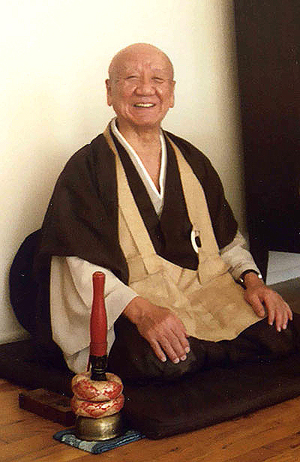
My Zen teacher, Kyudo Nakagawa Roshi, once complained that his students in New York did not clean the zendo and that he had to do it.

He meant, in part, that he was getting old and the effort was in many ways beyond his means. This is something any Zen student would be wise to consider: What happens to your energetic and much-convinced and perhaps years-long practice when cleaning the zendo is physically beyond your means or when doing zazen is physically out of the question? Never mind the cutsey answers about Zen having to do with "mind." Literally ... when you can no longer do it, what value or usefulness remains? And if an answer to that question is elusive, what were all those years of hard work about?

I think -- and mind you this is just what I think -- Kyudo had something else in mind as well with his complaints about inattentive and lazy students.

Coming to a zendo from the outside can have the feel of going to a movie or a baseball game ... visitors are visiting; they come for the enjoyment or awe or spiritual fireworks or wise gurus or whatever other out-there fulfillment ... and management is responsible for upkeep of the arena because, what the hell, that's the lifestyle they chose! There will always be a stable boy to muck out the stall so that missy can ride a well-groomed mare.

But I don't think Kyudo's irritation was entirely based on the inattentive laziness of the students who left him holding the bag. I think his disappointment may have been as much with himself -- that he had not managed to instill the understanding that the zendo belonged to those students, that the zendo had no meaning without their presence, and that to take care of the zendo was literally a way of taking care of and being responsible for themselves ... a cornerstone of Zen practice. How is Zen practice ever to bear fruit if you can't wash the floor?! Zen practice is not some Vatican positing a glistening and free-standing "Mother Church."

True, lazy and arrogant Zen instructors might take advantage of good-natured students, but still...

This point of view is not something one man can tell another. People learn it or they don't. But I can imagine that Kyudo, as a man who had chosen the stable-boy pastime of Zen instructor, might still feel as if he had somehow failed.

And as an adjunct benefit, he was stuck with the cleaning.

OK, OK ... I'll get off the computer now. Since the aches and pains and weakness of age will assert themselves in any event, I might as well put them to some use.

Make a promise, keep a promise.

You gotta die of something.

responsibility, Charles-Monroe-style

Responsibility probably has as many definitions as there are people willing to define it, but it does seem to play a key role in a happy life no matter what the definition.

I don't generally like letting others do my lifting for me, but over many years I have enjoyed the words of Charles Monroe, who was described in a 1939 interview as "not a man of wealth or education," but was, at about 50, considered a leading citizen of New Marlborough, Mass., where he was a mail clerk. I keep the interview as a link on this blog because, I guess, everyone likes to remember what makes their hearts sing.

Today, instead of being responsible, I offer, as I have in the past, an excerpt from Charles Monroe's ranging views on small town living, Christianity, song, forgiveness and other aspects of his life:
I try to be a good citizen by performing certain public and personal duties which most of my friends would throw up their hands at if I suggested they perform along with me. In my opinion there's too much 'passing the buck' going on today. I don't like many of our laws - capital punishment, for instance - but since I'm a voter and a sustainer of our form of government, I of course automatically make myself as responsible as any other individual in the upholding of our laws. As a sort of an 'accessory to the fact' I once forced myself to attend an execution down in Sing Sing prison where my brother-in-law holds a good job. It was an ugly business. One witness fainted and another vomited, and it was a big relief to get out of there. I felt like the executioner myself, as I was partly, for the fact that we do not press the button or cut the rope doesn't let any of us off.
But if I can't convince you that I was a killer in that instance, you'll have to grant that I'm a killer of pigs and cattle, for I've often helped farmers butcher their live stock. I've done this to satisfy my own conscience, for I'm a meat eater, and being a meat-eater, why shouldn't I assist with the dirty work? You smile!
Not all of the interview is as indelicately in-your face as the above, but I cite it because life has a way of getting in your face no matter how delicate anyone might be.


Life Rules 24, 13, and 35


No. 24: Be your own kind of crazy so others can be their own kind of sane.

No. 13: Don't be lazy: Get used to yourself.

No. 35: Just because something is simple does not mean it is easy.

Tuesday, April 16, 2013

"abhorrent and intolerable"

In a 577-page report, an 11-person independent task force issued a scathing assessment today, not only of the torture techniques applied there, but also of the very existence of the Guantanamo Bay detention
center in Cuba, home to 166 prisoners who have been held indefinitely without trial.
[By the end of 2014] the 166 Guantanamo prisoners should be tried in civilian or military courts, repatriated or transferred to countries that would not torture them, or moved to U.S. jails, the task force's majority recommended.
As a slow-poke old fart, I am still waiting for anyone to define the word "terrorist" as meaning something or someone other than what the accuser dislikes and would like to eradicate.

The word "terrorist" has terrorist implications in my mind.

invasion of the snails

They're big, they're voracious and they're eating Florida.

Giant African land snails have left environmentalists in a serious dither. The snails consume up to 500 species of plant life and eat plaster walls as a means of augmenting their shells.

With the rainy season due in a little less than two months, the population of snails is expected to explode. A typical snail can produce 1,200 eggs a year.

All this and people pay good money to see science fiction movies?!

earthquake in Iran


A 7.8 magnitude earthquake struck southeastern Iran today ... the strongest quake in 40 years. Pakistan, India and the Middle East felt the tremors. Communications have been disrupted. The dead have not been tallied.

Perhaps I should not concern myself. After all, the newspaper was delivered on time here.

twinkle, twinkle

Yesterday was an amalgam of sorts ... a little like walking on a sandy beach on a sunny day, tiny bits and pieces of mica glistening and twinkling for no particular reason, come and gone in an instant, miraculous and boring-as-oatmeal mundane before anyone could say a single word ...

The old man at 4
Out of nowhere, a Spanish publisher requested the use of several photographs of Carson McCullers that my mother took in 1944. As we exchanged several emails, I dug out the tattered album in which the pictures were saved and scanned them against the time when I expected to send them along. The pictures were take at Yaddo, an artists' colony in upstate New York. And there, in the same time frame as McCullers, I was ... four years old in 1944 ... sixty-nine years ago: Was I really that old?! How did anyone get to be old enough to look back 69 years? What had happened in the meantime, the time between then and now? The thoughts were more surprised than sad ... seriously, how did that happen? What had I thought, at 4, of all those imaginative people at Yaddo? Driven, serious, wonderfully artistic ... I imagine I thought they were weirdly weird ... but powerful, like all grown-ups. What did I know then ... or now either, come to that? The thoughts as spelled out are leaden on the page: In fact they came and went like mica glistening on the beach ...

Just as I was wrapping up my scanning efforts, Bill knocked at the front door. Bill is my always-immaculately-scrubbed financial hand-holder. He is invariably pleasant in a way that seems to camouflage his honest decency. Bill wanted me to sign some papers, which I did, and then, as in the past, we got to gabbing. "What do you think of the new pope?" he asked. The question caught me a bit off guard until I remembered that Bill counted himself as a Roman Catholic -- a topic we had discussed in other times. Bill found reason to hope in the ascension of the lately-appointed Jesuit, Francis, whose early activities seem to point to a Vatican less buried in ritual and riches. I said I agreed that Francis was a change from rigid potatoes but wondered how well he would fare when the systemic trip-stones of a Catholic hierarchy came more into play. I wished the pope well but had serious doubts. Institutions are institutions ... offering guidance on the one hand, shutting off the blood-flow on the other.

Bill was bright-eyed with optimism. Of course, he explained, he wasn't concerned too much with the machinations of the institution: His relationship with God was "direct" -- a "vertical" relationship in which his communion was outside the boundaries and vagaries of any institution. "But if you have a direct connection with God," I asked, "why bother being a Catholic?" Bill nimbly segued into free will Pascal's wager and the hope that at "the end of the trail," he would be greeted with the words, "well done, my good and faithful servant." I am sure Bill felt that he had answered my question. For my part, it reminded me of one-time Yankees manager Casey Stengel's malapropism that made perfect sense: "If the fans won't come out to the ball park, you can't stop them" It also reminded me of the Zen teacher Rinzai's observation to his monks, "Your whole problem is that you do not trust yourselves enough." If I were a Christian, I would pray for Bill and others like him. But since I am not, I will take responsibility for a small sense of sorrow. Who the hell do I think I am, being sad?! I let the subject drop and soon enough he was out the door and back to work, a flicker of mica come and gone.
and the human propensity to fuck up. His outlook seemed to be based as much as anything on

After Bill left, I wrapped up the scanning and drove over to the local convenience store to buy cigarettes. I vaguely recognized the man ahead of me in line, the one who was busy turning in a winning lottery ticket and then buying 10 or 15 new ones. His hair was grey, his face wrinkled and his seriousness apparent as he chose from the vast array of tickets for sale.

From the convenience store, I stopped off to see my bodhisattva car mechanic Jose, a man I trust to be the man he is. I explained that the battery cable on my son's car was loose after a cleaning I gave it. It made me nervous. Jose gave me a smile and a small washer with which to tighten the space between the cable clasp and the battery post.

Driving home, I listened absently to a description of the Boston Marathon on the radio ... an Ethiopian man had won with a Kenyan woman claiming similar laurels ... both covered the 26.2 miles in something over two hours and ten minutes. Impossibly fast in my mind.  The bombs had not yet gone off. Twinkle, twinkle.

By the time I got up from a nap, the bombs had gone off. Three people were dead. Some people had had limbs sheared off. 140 were otherwise wounded. An unthinkable horror made all the more horrific by the fact that it was so plainly thinkable. Spread the mental, explanatory arms as wide as you like and such an event cannot be laid to rest. It twinkles and gnaws ... wide as the wind ... edges always out of reach.

And then there was a letter from my son who is undergoing military basic training. In his microscopic but neat hand, he quoted from one of the few books he was allowed to read while undergoing his training -- something called "The Warriors Ethos." He loved the quote that was written with reference to the Spartans:
In other words, the lessons we learn are not wasted. The virtues we acquire during our time in the warrior archetype we can use when we mature into the husband and father, the mentor, the king. We get to keep these -- and profit from them -- our whole lives.
In another context, I would not have been affected. But the context I was reading in was the context of my son and I was conflicted. On the one hand, there is nothing like disciplined experience to shape and guide in nourishing ways. On the other hand, there is no such thing as an utterly good event or person or persuasion: What is nourishing can be likewise toxic. But no man can tell this to another, however much I might want to tell it convincingly to my son.

Christ, how compelling uncertainty can be!

A direct connection to God.
Well done, my good and faithful servant.
Lottery tickets that will....
A bomb blast on an ebullient and sunny day.
A loose cable which, when tightened, might provide some driving certainty.
An encouragement that asserts kinship and expertise and a certainty of agreement.

What is it that is so hateful about uncertainty? Anyone can look at his or her own life and bear witness -- experiential witness -- to an array, a horde, a tsunami of uncertainties, little and large. Things never turn out precisely as predicted and yet the attempt to beat back the facts seems to be nourished rather than extinguished by the plain-as-the-nose-on-your-face facts. Why must uncertainty be so galling, so purely anathema, so pleading and cajoling ... pleasepleaseplease give me certainty! Please let me be at peace in something -- anything! Knee-jerk responses like, "no one wants to die" may be true enough, but what about the rest of the panorama, the other parts of life in which certainty is the desire even as uncertainty is the fact? What, precisely, is the matter with uncertainty? (OK, OK, for those positively frothing at the mouth to say so we can be diverted by "ego" or "attachment" ... but still...) What is so hard about turning things around and acknowledging without hesitation this fiendish foe?

I was no different ... yearning as I did to beat back the uncertainty of what my son was learning and what he loved. I wanted to protect him from the factual fallout of life ... of espousing a good thing that is never faultlessly good, whatever its promise and delight. I did not want to turn him into some knee-jerk cynic ... but just ... but just ... well, I didn't want him to be hurt and yet knew in my heart of hearts there was no damned way in hell to prevent it. I too hated uncertainty. I too scurried for the protection of certainty. I too neglected the facts and elevated the fancies. Twinkle, twinkle.

In the evening, I watched a CBS video segment that James Ford put on his blog without remark. Entitled "Religion & Spirituality in a Changing Society," I watched it in the same way a high-school student might memorize foreign-language verb tenses... it's homework, however sparkless it may be. But I did watch all of it, wading through the advertising that dotted the documentary. Sincere and sometimes intelligent people shaped the video. It appeared serious. Those interviewed, particularly expositors of the spiritual aspects of life, smiled a lot. I watched because I think it is both discourteous and stupid not to take some measure of an environment in which I find myself. So I watched. And came away feeling strangely lonely and unfed -- as if I had ordered a plateful of chicken wings and was vainly seeking some bit of meat on an already-cleaned bone. The meat of uncertainty, perhaps... not just some smiling, intellectually-astute appreciation, but the up-close-and-personal, ravening nature of uncertainty ... the no-bones-about-it, wracking bomb blast in Boston. OK ... smiles are OK. I'm no fan of enforced and manipulated tears or the fires of some well-imagined hell, but some smiles are more delightful than others. I love to see people smile ... but I also wish them meat on their chicken wings.

Twinkle, twinkle.


Monday, April 15, 2013

bombs in Boston ... and Iraq


Three bombs went off during the Boston Marathon today, killing two, ripping limbs from several, and injuring scores more. Two of the relatively small bombs went off near the jam-packed finish line of the 26.2 mile annual event which was held on Patriots' Day. The third went off about three miles away. At the moment, information is sketchy.

BBC television devoted its entire 30-minute evening news broadcast to the terrifying and tragic event.

In Iraq, a string of apparently coordinated bombings claimed the lives of 55 people and injured an untold number of others, most civilians. The explosions seemed to be connected with the upcoming elections, the first since withdrawal of U.S. troops.

The BBC had consecrated its coverage to Boston. American public television spliced in perhaps one minute devoted to the tragic and terrifying events in Iraq.

Comparisons are odious and connecting the dots may or may not be warranted as a means of making 'sense' of things but it is hard not to ask...

Is the blood less red, the fear less searing, the tears less wet, the horror less consuming, the panic less compelling, the impotence less embracing, the loss less impaling, the humanity less human...?

No doubt it's too much to ask, but I can't help asking anyway ... couldn't we ask those questions before the fuses are so blithely lit? Fuck the solemnities and flags ... ASK and ANSWER!

seeds of decency, seeds of decay

In the news:

-- A Michigan judge who posted rules saying that people whose electronic devices disrupted court proceedings would be held in contempt has fined himself after his Smartphone went off during a case.

Raymond Voet said,
... if he can't live by the rules he enforces he has no business enforcing the rules.
Imagine what things might be like if more people applied that yardstick.

-- Other farmers may be facing tough times, but Afghan farmers are looking forward to a bumper crop in poppies, the building blocks of the opium/heroin trade. The crop yields have been rising steadily in areas where U.S. troops have withdrawn and the Taliban is regaining a foothold. How the religious rigidities of the Taliban are used to permit such activities -- however lucrative and thereby supportive of the rule the Taliban would like to assert -- I'm not quite sure.

completely incomplete

Is the point of painting to be a "painter?"
Is the point of skiing to be a "skier?"
Is the point of Buddhism to be a "Buddhist?"

My guess is no, but the longing for agreement and the longing to be right and the longing to be loved are all pretty strong things. Club-house reassurances have their uses and yet ...

Perhaps I am just airing my own dirty laundry, but I suspect that others who reflect may have come to similar conclusions: The central fly in the ointment of a happy life is to live cautiously ... to hold back a 5% in any effort, to create a safety net in case things go south, to maintain a bolt hole of skepticism or explanation or wisdom or something similar ... to keep a wary eye over the shoulder ... to doubt what anyone might claim to be so sure of.

The rug burn of this approach lies in the fact that this moment is inescapable and complete with or without anyone's approval or say-so. Buddhism, for one, addresses this  friction by encouraging "right" action, "right" thought, "right" meditation, etc. The word "right" is sometimes rendered as "complete" ... complete, as in this moment that could not be anything other than complete.

All of this may have a cozy, airy-fairy, philosophical, I-can-explain-it, dig-my-beliefs feel to it until there is some  experience that provides a concrete and in-your-face understanding of what it is to live a normal and complete life.

A sneeze, a kiss, an orgasm, a middle C and suddenly, perhaps, there is nothing else. Where did everything go? It feels bang-on and yet nothing is left and no applause can enter. It is lighter than a feather and more potent than a jackhammer. This ... is ... it -- right up until anyone says "this is it" and things swing back to the over-the-shoulder, 5%-withheld, safety-net world of agreement. Look Ma! -- I'm a Buddhist.

Once upon a time, I took a class in oriental calligraphy. It was sort of an associative adjunct to my then-pedal-to-the-metal interest in Zen Buddhist practice. Over and over again I screwed the pooch as I moved the brush across the paper. My 5% was in full swing. I wanted to get things right ... and missed the mark in very visible, very concrete ways. Still, I practiced ... and no matter how hard I tried, I couldn't escape the desire to be good at it. Until one day, as if by accident, I got it right. I knew it was right with an assurance that somehow left me out of the equation and wondrously flabbergasted. Being right or being a calligrapher or being a Buddhist had nothing to do with anything... all that was possible, but it was not necessary.

It was complete.

And then it was gone.

Just like any other moment.

Practice, practice, practice. Practicing to escape what cannot be escaped until what cannot be escaped claims the scene and, voila! -- there is no escape and escape is all there is, but there is no longer a five-percent-er barring the way. There is no five percent any more than there is a 95%.

Practice painting ... OK.
Practice skiing ... OK.
Practice Buddhism ... OK.

But let's not forget the wide-open wonders of a sneeze ...

Complete.

Completely incomplete.

Sunday, April 14, 2013

idle chatter

In Buddhism, there is a suggestion that students refrain from "idle chatter."

I guess that means, among other things, not gossiping about your friends, enemies or neighbors.

But I suppose it also means not gossiping about those who gossip about their friends, enemies and neighbors.

And perhaps that also means not gossiping about not gossiping about those who gossip about their friends, enemies and neighbors.

Following this particular Yellow Brick Road, you might think that silence would be the surest way to sidestep the fires of "idle chatter."

But those who are silent are frequently more profoundly -- if silently -- garrulous than Aunt Minnie.

Maybe the best way to refrain from "idle chatter" is to stop trying to be a Buddhist.

I dunno. I just work here.

turnabout

My son wrote from military basic training to ask if I could send him "The Godfather" in bits and pieces. The trainees are not allowed to have books, so perhaps I could sneak in something piecemeal.

I set about trying to implement this small conspiracy and then realized that the task would be too enormous. "The Godfather" is nearly 400 pages long with chapters that tended to be likewise long ... long and thus weighty in a first-class mail envelope. More than that, very fat envelopes are obvious and risked discovery by the powers that be. If you're going to be sneaky, it pays not to be too obviously sneaky.

No books, no cell phones, no computers, phone calls home granted as an occasional privilege ... these are some of the rules of my son's new environment. What he has taken for granted in the past -- what was ho-hum and possibly boring -- can no longer be taken for granted ... and as a result, acquires a new luster and importance.

It's a good lesson, I think -- a life that yanks your chain a reminds you to be a little more attentive. My son was never what I would call a reading fool, but now ... now reading would be a delight, or at least a change from hum-drum potatoes.

I did not want to let my son's request go unanswered, so I began thinking of what reading material I could send on the QT. At first I thought of digging out one or two short-short stories, but then I got hung up remembering "Turnabout,"  one of William Faulkner's very few tales that was not infused with stylistic murk ... just a straightforward story packed with World War II derring-do. It may be too murky for my son, but as action-adventure goes, I had always thought it was pretty good. So I risked it -- twenty pages stuffed into an envelope.

I have to admit to thinking that if the military life teaches my son a love of -- or even interest in -- reading, it will have done him a good service. That would be quite a turnabout from high school.

a sympathy of larks

Ambling into the mind this morning...

A herd of cows...
A gaggle of geese...
A pride of lions...

And, out of some imaginative left field,

A sympathy of larks.

I don't know what it means, but somehow I like it.

identification, please!

Curious to think how very, very hard anyone might work in this lifetime to gather and glue the bits of identity. I don't mean this in some self-serving, I'm-immune, dig-my-analysis way ... just that it seems to be true: So much very hard work: Employment, marital status, manufacturing skills, athletic ability, analytical strengths, joke-making capacity, love of animals, amassing money, wielding power, painting pictures, singing arias, dressing up, mathematical equations, shooting rifles, solving problems, making improvements, baptizing babies, medical breakthroughs, dealing drugs, speaking foreign languages, believing in God, skipping rope ....

It takes a lot of hard work -- sometimes really really hard work. And as often as not that effort is used as a means of identity -- all those bits and pieces, all that sweat, coalescing into an identity that informs others and, more important, perhaps, informs me.

If, without imposing judgment for a moment and without applying some sounds-good spirituality, this is more or less true...

Then it strikes me as sad somehow that all that hard work is not accompanied by a curiosity to find out or a willingness to examine who or what, precisely, is being identified. Without settling that matter, wouldn't life be infused with a sort of sub-rosa desperation or sense of dis-ease? Who or what am I identifying?

Maybe spiritual discipline can help in such matters, but I'm not inclined to think there's any necessity to shoehorn the question into some identifiable 'spiritual' cookie tin. The question is personal. Not good, not bad ... just, perhaps, sensible because not looking into it leaves a lingering, half-formed doubt and uncertainty ... the very elements that identity was used to fend off in the first place.

It's like a family secret: My identity collapses without you; your identity collapses without me. But "collapses" to where or what or who?

I don't think there's anything wrong with identity.

I do think there's something unsettling about not finding out who or what is identified.

Saturday, April 13, 2013

whether it's true or not

A reminder (and perhaps conundrum) I like comes from some dialogue in the 2003 movie "Secondhand Lions:"
If you're going to believe something, believe it because it's something good to believe in. Whether it's true or not makes no difference.

in the noodle parlor

Overnight, I found myself missing my Zen teacher, a man who once told me that if he were not the abbot of a monastery in Japan, he would like to run a noodle parlor ... the work was easy, customers left satisfied, and the mark-up on the ingredients guaranteed a good income.

Kyudo Nakagawa died at 80 in 2007 and I realized last night that the reason I missed him was that I missed my trust in him. Not necessarily that that trust was warranted in some overarching, impersonal sense, but just the fact that I trusted him ... credited him as a man of sand and substance. Trust, warranted or otherwise, is so delicious.

What set off this wispy sense of missing Kyudo was the matter of what might be called "spiritual breakthroughs." I wanted to hear his point of view, not as if it were some etched-in-stone tablet brought down from Mount Sinai, but simply as a matter of his experience ... something that might be true or untrue, but in any case was worth considering.

There is no doubt in my mind that spiritual breakthroughs or bright openings or shazzam moments exist for those who decide to take their spiritual lives seriously. Such moments are possible ... which is not the same as saying they are somehow necessary.

Imagine being a chick in an egg, peck-peck-pecking at the circumscribed world around you when all of a sudden, something lets go and through the resulting hole, the entire universe is revealed or announces itself. This is way beyond religious woo-hoo story telling. It is in your face and all over your being. It is your being and yet only a jackass would claim to own it. Well ... whatever else it may be, it's a surprise that has been described as joyful, though that strikes me as pretty self-centered. In the past, you might have struggled and strained and believed and hoped for such a moment, but all that is just eyewash when the shell is suddenly cracked open.

Eureka!

Surprise!


Kensho ... satori... blah-blah-blah.

Never mind all that! This is WOW!

Those who have never experienced such a thing may feel left out and bereft and second-class somehow: I can't be much of a Zen student if the bright-lights didn't go off for me. This, to my mind, is a mistake, but it's part-and-parcel of a believer's take on spiritual experience: How can I know that spiritual life is important if something important doesn't happen to me? All that effort, all those years of hard work and you can bet your bippy that I long to be as ecstatic as some damp young female waving her panties at an Elvis concert!

I wanted to talk to Kyudo about breakthroughs... those bright-brighter-brightest times when the world became new. I wanted to talk to him because I trusted him not to do some Zen Buddhist shuck-and-jive on the topic. The fact that his experience had a Zen Buddhist context was irrelevant... that's what I trusted about him. What did he think in a noodle-parlor context? Kyudo was not some Zen Buddhist coward, cinching his robes tightly about him, toeing some hemmed-in mark.

My own feeling is that where the brightness blazes and the joy consumes ... this is a time bearing both good tidings and a stern warning. The good tidings are that life is bigger than a breadbox. The warning is that excitement is extra. Yes, a eureka moment can change the world forever. But forever is just forever ... no need to make too much out of it.

I would be interested to hear what Kyudo thought. I never will, but I would like to hear in the same way a friend might like to hear about an acquaintance's recent vacation: It's the friendship that counts.

Friendship ... and perhaps a bowl of noodles.

Friday, April 12, 2013

like lightning

American comedian Jonathan Winters died Thursday in California at the age of 87.

He was probably the greatest comedian of the 20th century ... or anyway, he'd get my vote. You could always feel his insanity lurking at the edges of his routines, but it was impossible to stop watching: He was the sky in which other comedians might claim to be stars. His stuff was never contrived or subservient or cheap or memorized or self-important ... it came pure and new out of his enormous edgeless cosmos... non sequiturs that left you doubled up with laughter because they seemed so perfectly in tune with his subject matter... non sequiturs that made perfect sense and yet could not be called anything other than non sequiturs.

Like lightning and with empty hands, he delivered.

To say he was "like" is too mealy-mouthed by half.

I once saw him in tandem with Robin Williams, another comedian who could leave ordinary comedians in the dust and whose demons likewise lurked. To hear the two of them go at it was like being privy to the best of the best and yet beyond the best ... nanosecond-fast, bright as a supernova, and the likes of which were impossible to find elsewhere ... ever.

"Genius" is such a limp-wristed and inadequate word.

If I had to guess why he died, I think I'd imagine that Winters could not abide the notion that Margaret Thatcher (the former British PM who died Monday at 87) might hog the limelight in the afterlife. What a trove of material she might represent to him.

critical thinking

About a third of the 10th-grade students in an Albany, N.Y., English class refused to complete an assignment in which they were told to research Nazi thinking and then cite the reasons why Jews had been responsible for Germany's pre-World-War-II difficulties from a Nazi point of view.

When reported in a local newspaper, the furor was as pronounced as it was predictable:
Superintendent Marguerite Vanden Wyngaard was expected to personally apologize on Friday to families of Albany High School students who were given the writing assignment, said Ron Lesko, a spokesman for the district.
The unnamed teacher may be disciplined.

My question is this: How can critical thinking ever take root among our young people when the yardstick for that thinking is how many people agree or are offended?

my dirty laundry and yours

Russia has put the U.S. on warning: Do not publish a list of Russians banned from entering the U.S. on account of human rights abuses.
[T]he Russian foreign ministry has drawn up its own blacklist of US officials who are alleged to have committed human rights violations.
Sergei Magnitsky
....
The Magnitsky Act passed by Washington in 2012 blacklists Russian officials accused of involvement in his death. The names - which have up to now been kept secret - are due to be made public on Friday.
....
Mr Magnitsky had accused [Russian] officials of stealing $230m (£150m) from the state through fraudulent tax rebates. His family and rights groups say he was badly beaten and denied medical treatment in custody.
....
The posthumous trial of Mr Magnitsky - who died aged 37 in pre-trial detention after developing pancreatitis - opened in Moscow in March but was adjourned shortly afterwards.
If you don't mention my syphilis, I won't mention your gonorrhea.

where decorum and dismay collide

In England, an online campaign to push "Ding Dong! The Witch is Dead" to the top of the British song charts has left those who wish to honor former Prime Minister Margaret Thatcher in a tizzy. Thatcher died of a stroke on Monday. She was 87.

In her lifetime, Thatcher's economic and political priorities are seen in some quarters as having had positive results. But positive results for some are invariably attended by negative results for others ... as "The Wizard of Oz" song campaign makes clear.

Those who would extol the first female prime minister consider the musical onslaught to be in decidedly bad taste and "insensitive." But backers of the song campaign have ample fodder for their assault as well.

Why is it that those who believe we should "not speak ill of the dead" are so tone-deaf to their own principles? If speaking ill of the dead is insensitive and corrosive, why is speaking well of them any less calloused and corrupt?

skeleton key

How many prisoners lie manacled in this life ... the love or sorrow or prowess or belief or rage or wisdom or boredom or cruelty or meaning or smiles or importance or joy or hope or plain old baloney sandwiches? It may be a very well-kept and admirable lock-up, but still ... how many?

Where everything unlocks everything else, it's time to throw away the key.

Thursday, April 11, 2013

North Korean chic

Female North Korean soldiers patrol along the banks of Yalu River, near the North Korean town of Sinuiju, opposite the Chinese border city of Dandong, April 11, 2013.
REUTERS/Jacky Chen


In the midst of a lot of North Korean sabre-rattling, perhaps there is some reassurance to be had from ... what shall we call it? ... a sense of style?

strange imperative

It's like a mandate.

An imperative.

It has never weakened over the years ... even now, when times get weaker.

I hesitate to mention it for fear that someone might think it was "good," but it leaves me curious: Where the hell did that come from? I honestly don't know.

This morning I got one of those out-of-the-blue emails from a woman snooping the edges of Buddhism. For no particular reason (she didn't write anything unusual), I assumed she was a grown-up and not just a teenager who was down-hearted after breaking up with some special friend... someone who would forget about an interest in Buddhism as soon as a more immediate sense of relief  -- a TV show or A on a paper or some new friend -- entered her life.

But even if she had been someone looking for solve-all fairy dust, still it would have risen up, as sure as a case of farts after a plate of baked beans ... an imperative to answer, to help as best I might. It's not a matter of trying to convince anyone (yo! Buddhism is the first-est with the best-est!) ... it has something to do with humanity and seriousing up and this-is-important all wrapped in some not-quite-explicable ball within. When someone asks me personally, then, somehow, I must.

Where the hell did that come from?

Over time, I have tried to train myself away from the professional neurotics and I am mildly relieved that no one shows up to sit on Sundays and I can hear the spiritually- and psychologically-adroit sharpening their knives of explanation ... but still ....

Where the hell did that come from?

I honestly don't know.

But sure as God made little green apples, it's a fact.

luxury items

This morning, the wisps and tendrils of recollection insist ...

The daughter of an old Internet chum answered my request for an update on her father, a man who was  once full of wry humor and good common sense when it came to the practice of Buddhism.
My dad does nothing. He's only 63 which I don't think is that old really. He's just totally given up. He smokes and watches programmes about end of the world disasters mainly. He sleeps a lot too. No interest in Buddhism. Unable to read or wrote or use a computer. Not that he tries. He can converse to a small degree but gets frustrated when he can't say what he wants to as the words just won't come out so just tends to not say much. He won't do physio to improve his walking. He won't practice his speech therapy. I guess it's the brain damage I just would have hoped some of his fighting spirit would have shone through but alas nothing! It's not a burden to me as my mum does most of the work. But she also works full time so my brother helps out. He needs washing, he can feed himself but needs meals preparing etc (not that he ever cooked before mind lol!) He can just about hobble into the kitchen and make himself a tea with his one good arm. All things which could be improved if he were to do his exercises, practice his speech etc but there's no desire.
The email note made me wonder how many luxury items in anyone's life might be overlooked and ignored in favor of brighter and more elevated baubles.

Since nature is wanton in its profligacy and since man is part of nature, I guess there's no reason to complain about the wastefulness of human life ... or wonder whether wastefulness were ever truly wasteful.

Wednesday, April 10, 2013

getting naked

Spring, that warming time a Zen friend once indelicately but aptly described as "tit season," is coming.

In spring, everyone gets undressed and it is a relief somehow ... out from under the weights and coverings of an earlier time.

An ahhhh that will soon enough be the new normal -- nothing to write home about.

Sometimes I think spiritual endeavor amounts to little more than getting naked.

Wouldn't it be nice if getting naked were as easy as taking all your clothes off?

rock balancing

Received in email. Enjoy the pictures first ... an explanation from the email is below:


The  Art Of Rock Balancing   Michael Grab is an  artist that has been 'rock balancing' since 2008. Much of
his recent work  has been done around the Boulder, Colorado area. Grab---yes,
that's his  real name---finds the process both spiritual and therapeutic.

Grab  explains:

"The most fundamental element of balancing in a physical  sense is finding some
kind of 'tripod' for the rock to stand on. Every  rock is covered in a variety of tiny
to large indentations that can act as  a tripod for the rock to stand upright, or in
most orientations you can  think of with other rocks. By paying close attention to
the feeling of the  rocks, you will start to feel even the smallest clicks as the notches
of  the rocks in contact are moving over one another.

Parallel to the  physical element of finding tripods, the most fundamental
non-physical  element is harder to explain through words. In a nutshell, I am
referring  to meditation, or finding a zero point or silence within yourself.
Some  balances can apply significant pressure on your mind and your patience.
The  challenge is overcoming any doubt that may arise."

"Syria Behind the Lines"

When I was a kid and learning to write, my mother once observed, "If you want to write a story about boredom, you can't be boring."

Last night I watched a documentary entitled "Syria Behind the Lines." It was presented on "Frontline," one of the few television news programs that comes anywhere near to living up to the word "news" in my book. There is a thoughtfulness to its offerings. It is not in the sound-bite business. I didn't really want to watch "Syria Behind the Lines," but I couldn't stop watching.

To depict the war in Syria, a culture laced with a love of and devotion to family, Frontline picked an area divided by a river. On one side were tribal Alawites, a longtime ruling minority in the country; on the other were Sunnis -- a more populous group. Everyone looked pretty much the same ... nut-brown, with dark, serious eyes and a hodge-podge of clothing that included T-shirts emblazoned with peppy English slogans. I really had a hard time keeping the characters straight. Like people everywhere, those on either side of the river were sincere. They longed for peace and were in the inescapable business of killing each other. Seriously ... i-n-e-s-c-a-p-a-b-l-e.

A young man with a newly-grown beard explained with a bright and reasonable and far from fanatic tone that he hoped to become a martyr -- someone who died in an anointed cause. Later in the show, he (I think) would lie bloodied on a makeshift bed. He couldn't move one arm. There was shrapnel in his chest and head and "they can't get it out." Later still, he would return to the fighting.

No one complained or when they did complain, they were shushed, as for example a boy of about twelve who wailed inconsolably that his grandparents had just been buried in a house struck by a shell. The boy wailed and wailed. A young man cradled the boy's head against his chest. But still the boy kept wailing. Finally, a bearded man who seemed to be in his forties, turned his fury on the boy. Approximately he screamed, "Will someone shut that kid up?! Get him the fuck out of here!" The man was profoundly angry.

Every village street was on its way to becoming rubble ... bits and pieces of shelter dotting the mounds of rock and detritus all around. People who had fled the cities in hopes of safety in country villages moved on yet further. Mothers could not protect their children. People begged for bread. The fields were full of rotting food. Everyone listened for the jets or watched the rockets against a night sky ... rockets coming for them. Moment by moment they awaited death and yet were keenly alive. Which was more hellish -- the fact that they wept or the fact that they did not weep?

On a flatbed truck, a man of perhaps 40 hunkered down in the company of three dead bodies -- three of six family members who had been killed just minutes before. The man stared but did not weep. A close-up of one of the dead bodies showed that this man too was staring ... but the light had gone out.

How does anyone depict a scene that has no edges, where everything just is what it is and there is no escape? For my money, Frontline failed in that story-telling regard and in that failure succeeded beyond all story-telling dreams.

This was a world that lacked any other options, a world in which martyrdom made perfectly good sense, a world in which my tidy and cosseted moralities were shown for the juvenile bullshit they were. The liberal ain't-it-awful's or hope-springs-eternal ... "will someone shut that kid up?!" It was beyond the cozy distances of calling it "insane." It was a world in which "there is no god but god" and no one is so stupid or self-important as to name or circumscribe that god. No one wastes his breath saying "Fuck your morality! Fuck your beliefs! Fuck your philosophies! Fuck your stories!" There are no edges here ... there is no "here" here ... where once there were empty hands, there is no emptiness. Nothing is left to be "bereft" and since that is so, being "bereft" is just another luxury item for lackadaisical story tellers. Good and bad are cotton candy for not-terribly-bright kids.

I hated it -- watching this Frontline story that could not tell a coherent story because coherence would not only be untrue, it would be boring. My desire to understand and find meaning and put a seductive period on a conclusive sentence was utterly thwarted. My mewling moralities played no role. Take your "hell" and "heaven" and stick 'em where the sun don't shine!

About like any other moment of this life.

I will try to be as good as I can and pray to any gods there may be that I will never imagine it is good.

That would truly be boring.


Tuesday, April 9, 2013

verisimilitude

Strange to think that "The Passion of the Christ," a 2004 American movie into which director/actor Mel Gibson poured his heart and soul and $30 million of his own money, should have been offered entirely in reconstructed Aramaic and Latin with vernacular subtitles.

The only conclusion I can come up with for this verbal imposition is that the director was bound and determined to make the story as true to life as possible... that he had a sense that other depictions of Christian legend fell short of the actual-factual truth of what the Christian savior lived and died within. If this was the fire that filled Gibson's belly -- if verisimilitude was a driving force, then I wonder ....

Why was the man who played Jesus Christ so blatantly Caucasian?

True, it probably contributed to the $600 million the movie made, but if verisimilitude were important, where was the nut-brown man who is the odds-on favorite when it comes to reconstructing Christian history?

I guess verisimilitude varies according to who is depicting it....

A fact that seems to mock the notion of "verisimilitude."