Posted elsewhere, but I thought I would put it here as well:
In times past, there were vocabulary-building encouragements that
included such lines as "use a new word ten times in a day and it is
yours."
Today, I wonder if reversing the process might not also
have some benefits ... "erase one word from your vocabulary in a day and
see what happens."
It's just an experiment. What word would you choose, assuming you wanted to experiment?
My choice for the day is the word "because."
Friday, January 17, 2014


nothing and something
 On a day when a Pennsylvania couple is suffering the fallout from trying to sell their "slightly haunted" house and South Korean conscientious objectors, like CO's elsewhere, are jailed for stating what you might think the military would thank them for announcing (who wants an unwilling soldier on the front lines?) and a Japanese man who spent 29 years in the jungle because he did not believe World War II had ended has died at 91 and U.S. President Barack Obama is scheduled to announce revisions (and if you believe that one, I have a lovely bridge in Brooklyn to sell you) in the National Security Agency's invasive-but-dreadfully-'important' snooping capabilities ... and lots of other bits of news are floating around like bubbles in a shaken bottle of Pepsi ... well, in the face of all that and relatively speaking, "I've got nothing."
Nothing that seems to be something.
In the backyard, a couple of shingles fell off the zendo roof and I have called on roofer to get an estimate for how much it might cost to reshingle. It's not a big job and at another time I would have done it myself. I resent the fact that the "30-year-shingle" I bought and applied in 1998 has begun to crumble in about half the guaranteed time. I cringe at what I suppose will be the indignity of not being able to afford the work.
And, as if to add fuel to the flames, the "donate" organization I am linked to on this blog (WePay) sent me some sort of notification that I will have to revise my connection to them... hook up with some other donation organization in order to maintain my status. I dislike the bureaucracy, but more, I dislike being reminded that asking for donations is pretty uppity in the first place: What tangible service or goods do I offer that warrants such requests? I write and the zendo is open to the public ... but otherwise? There is food on my table and there are so many others who have more compelling cases. It's one of those aaaaarrrrrgh situations. Assuming the roofer does come with an estimate, I can imagine its costing about as much to reshingle what amounts to a large shed (16x12) as it cost me to build the whole structure in the first place ... $2,000 ... and it could hardly take more than a day to do the work. Groan and grumble under grey skies.
The best I can come up with this morning is to be thankful that the early fog is not possessed of sound. Talk about a noisy environment!
Talk about Totally Useless Information!
Thursday, January 16, 2014
"morally reprehensible"
"Morally reprehensible" is one of those nifty, thunderous expressions that requires the speaker to credit morality to some extent and to hope, in all probability, that s/he has or can create a loyal following. In other words, what is morally reprehensible requires that someone gives a shit. What is morally reprehensible is more often than not just what is repugnant.
No one with two brain cells to rub together would walk into a Mafia social club and discourse on the moral reprehensibility of killing other people. Killing is just the price of doing or protecting business. In a Mafia social club, finding excuses is not necessary.
Politicians and businessmen work a little harder to elude the lash of moral reprehensibility. Selling shoddy products works better when the products or programs are construed as worthy or good. A vocabulary of plausible deniability is kept handy for those times when the shoddy goods or programs fall apart or do inescapably-obvious harm to others.
All of this mental gum-chewing came to mind while trying to rein myself in this morning when reading about a meeting in Geneva between representatives of the United Nations and representatives of the Vatican in the matter of clerical abuse of children. It was "the first time the Vatican has had to publicly defend its record in what
amounted to a courtroom cross-examination where no limits were placed
on the questioning."
Monsignor Charles Scicluna spoke for the Vatican:
The sheer balls of the assertion is enough to leave me all but speechless.
And that's where the "morally reprehensible" gum-chewing began. Wasn't this like the teenager who loves the benefits of getting laid but is no where to be found when pregnancy evolves? The shamelessness and irresponsibility beggar belief ... it is morally reprehensible ... or rather, I guess ...
I find it repugnant.
In spades.
No one with two brain cells to rub together would walk into a Mafia social club and discourse on the moral reprehensibility of killing other people. Killing is just the price of doing or protecting business. In a Mafia social club, finding excuses is not necessary.
Politicians and businessmen work a little harder to elude the lash of moral reprehensibility. Selling shoddy products works better when the products or programs are construed as worthy or good. A vocabulary of plausible deniability is kept handy for those times when the shoddy goods or programs fall apart or do inescapably-obvious harm to others.
 |
| Msgr. Charles Scicluna |
Monsignor Charles Scicluna spoke for the Vatican:
He was responding to a grilling by the U.N. committee over the Holy See's failure to abide by terms of the U.N. Convention on the Rights of the Child which, among other things, calls for signatories to take all appropriate measures to keep children from harm. Critics allege the church enabled the rape of thousands of children by encouraging a culture of cover-up to defend its reputation....The Vatican can create and defrock priests, change assignments and duties, elevate and enshrine, lay claim to the pronouncements of God Almighty, dissect sin and salvation, cut off the pay of those who come into disfavor, send missionaries far and wide, open hospitals and schools ... and otherwise wield an enormous power, but nevertheless has "little jurisdiction to sanction pedophile priests?"
The Vatican insisted it had little jurisdiction to sanction pedophile priests around the globe, saying it was for local law enforcement to do so.
The sheer balls of the assertion is enough to leave me all but speechless.
And that's where the "morally reprehensible" gum-chewing began. Wasn't this like the teenager who loves the benefits of getting laid but is no where to be found when pregnancy evolves? The shamelessness and irresponsibility beggar belief ... it is morally reprehensible ... or rather, I guess ...
I find it repugnant.
In spades.
important/unimportant
Perhaps spiritual practice is not so different from anyone's ordinary life:
Just don't make the mistake of thinking you/it are important.
And don't make the mistake of thinking you/it are unimportant.
Just don't make the mistake of thinking you/it are important.
And don't make the mistake of thinking you/it are unimportant.
just for argument's sake

In the past, I have taken part in sometimes heated debates. Specifically, I am thinking of the sexual and fiduciary malfeasances in the world of Zen Buddhism and the pedophile scandals that rocked the Roman Catholic Church. It is not my interest this morning to revive the heart-felt particulars of those debates but rather to poke around a little in the argumentation itself. I will use the Catholic Church as an example not because I am anti-Catholic, but rather because it is easier to speak of one instance than it is to speak of many. What I wonder in the midst of it all is the extent to which the aspects of that instance offer some generalization. I really don't know.
Starting most recently in 2002, pedophilia within the Catholic Church gained some traction when The Boston Globe ran a series of articles. Child abuse within the church had been a hot topic for centuries, but the newspaper articles cast a public light on what had been kept imperiously private in the past. The power of the institution to adjudicate its own missteps was hardly questioned, even by those charged with public justice. The Globe articles opened the door to a questioning that lingers to this day: Two days ago, for example, a Guardian article noted that two Catholic orders had admitted -- during "the largest inquiry into institutional child abuse in UK legal history." -- that they had abused children in their care. And then there's today's story of the U.N. grilling the Vatican.
Church malfeasance may not be front-page news any longer, but the willingness to question and sometimes punish has entered where once the church had been above and beyond reproach because, to all intents and purposes, the church said so and had the ear of those in social power.
The visceral heinousness of child abuse can hardly be overstated and when an institution imbued with some vaguely-described good proves to be the perpetrator ... well it was a heady mix, and the critics went to work with a will, citing instance after heart-rending and infuriating instance of cover-up and lies and vile action. The laundry list seemed never to end.
But that laundry list -- endless as it might be -- did not dissuade those who were on board with the Catholic Church. Counter-arguments rose up with the fury of a gored ox: These were Catholic-haters who sought to bring down the church, for example. Or, for the more thoughtful of the faithful, yes, there may have been mistakes in the past, but let's not throw the baby out with the bath water; just because there were some rotten apples in the barrel did not mean the other apples were not sweet. We should not destroy the Holy Mother Church or its benevolence just because specific mistakes had been made.
And this is the point at which I find myself curious -- about the Catholic Church, yes, but also about other spiritual persuasions that find themselves in a negative spotlight:
Critics stand on comfortable soil in the sense that they can cite chapter and concrete verse of perfectly-obvious malfeasance. Defenders, on the other hand, may be able to adduce a laundry list of good deeds, of various kinds of benevolence within the human realm, but does this laundry list of decent and kindly action fully define the "baby" they hope will not be thrown out with the dirty bath water? I have a hunch it does not.
The "baby" is not just the schools built and the poverty alleviated and the shelter given: If this were the full extent of the counter-argument, then the church would be unnecessary since kindness and benevolence are simply part of the human repertoire: The kindness and benevolence of an atheist or a devil-worshiper is just as kind and benevolent as the kindness and benevolence of any true believer. The church or philosophy may inspire -- sometimes through promise, sometimes through threat -- benevolence and decency, but cannot be called imperative to that benevolence and decency.
Defenders of the faith are between a rock and a hard place. If a compiled list of decent activities is the best they can muster in defense of their faith, then what becomes of "God" or "enlightenment" or whatever other ineffable enormity is said to infuse that faith? If "God" or "enlightenment" is no more than a laundry list, that would limit "God" or "enlightenment" in ways that would be far too mundane.
My sense is that the critics are on terra firma: All they have to do is cite chapter and factual verse. But defenders are backed into a corner of their own devising: Yes, the "baby" can be seen in good works, perhaps, but the notion that good works are the only thing under threat from critics is not entirely complete or honest.
The defenders often assert, by implication of their defense, that spiritual life is more than just a laundry list of good works. But they are unwilling or incapable of saying precisely what constitutes that "more." This is a question I have repeatedly put to critics of various aspects of Zen Buddhism. Those critics are often unwilling to throw the baby out with the bathwater, but what constitutes that baby leaves them evasive and silent. And the moment they admit there is some "more" inherent in spiritual endeavor, they are trapped making another laundry list, another limitation to the ineffable something-or-other which they feel is worth upholding. Defenders and critics alike are hoist by their own petard.
I have agreed roundly with many of the criticisms of the past, but I do think it behooves a critic to examine the ground from which s/he springs. I am not here taking part in the defender's mealy-mouthed unwillingness to meet criticism head-on ... stuff like, "look to the mote in your own eye," cowardice passing as "noble silence" and the like. What I am interested in is the willingness to admit that even if someone cannot adequately depict the "baby" or the "more," still there is a value to fessing up.
And the best I can figure, that confession boils down to, "I love it" or "I choose it." My experience is such that I am willing to put in a good word, for example, for the practice of Zen Buddhism. No doubt there are Catholics who are willing to do the same. But to claim to be "defending the Dharma" or "protecting God" is really pretty arrogant ... not to mention unduly vague.
Laundry lists only reach so far. My choice, however insignificant or feeble, is just my choice. And it is a choice that hardly requires the struts and staging of an institution, whether noble or flawed. I may find usefulness in an institution or philosophy, but I also find usefulness in a hammer.
"More" is just my choice.
A little humility never hurt.
planning and panic
A bit too dismissive and yet apt as well, this snippet cut across my Internet prow the other day:
YOUR FAILURE TO PLAN DOES NOT CONSTITUTE
MY IMPERATIVE TO PANIC.
YOUR FAILURE TO PLAN DOES NOT CONSTITUTE
MY IMPERATIVE TO PANIC.
Wednesday, January 15, 2014
Christian school science quiz
Passed along in email was the following, which Snopes -- a site that seeks out bogus Internet claims -- seems to rate as "true:"


congressional millionaires
"[A]t a time when lawmakers are debating issues like
unemployment benefits, food stamps and the minimum wage ... as well as considering an overhaul of
the tax code,” the Center for Responsive Politics reports that "for the first time in history," a majority of American senators and representatives are millionaires.
I am sure there must be some conscientious and good-hearted millionaires out there somewhere, but the evidence I can quickly summon up suggests that the well-heeled are notably cavalier, whether intentionally or unintentionally, when it comes to those who have less or have needs that Neiman-Marcus can't be bothered with.
And sometimes what is merely cavalier can turn downright grudging. Anyone who has ever hung out with a well-to-do person may be familiar with a sense of protective distance that seems to emanate from that person. Honesty and openness -- even conversationally -- seems to take a back seat to the fear that someone might somehow wrongfully deprive them. It is like talking to someone living in a bubble.
The rich representing the un-rich... it's a curious notion even when it's not ludicrous.
Is this democracy? Is democracy a myth? I really don't know.
I am sure there must be some conscientious and good-hearted millionaires out there somewhere, but the evidence I can quickly summon up suggests that the well-heeled are notably cavalier, whether intentionally or unintentionally, when it comes to those who have less or have needs that Neiman-Marcus can't be bothered with.
And sometimes what is merely cavalier can turn downright grudging. Anyone who has ever hung out with a well-to-do person may be familiar with a sense of protective distance that seems to emanate from that person. Honesty and openness -- even conversationally -- seems to take a back seat to the fear that someone might somehow wrongfully deprive them. It is like talking to someone living in a bubble.
The rich representing the un-rich... it's a curious notion even when it's not ludicrous.
Is this democracy? Is democracy a myth? I really don't know.
life without liberation
I read it elsewhere and, although I don't know for sure that it is a real thing, I can certainly imagine that it might be:
The anguish of the world is no joke. It's pretty compelling stuff. You can see where "liberation" might offer a bit of light at the end of whatever gloomy tunnel there is. And it's not just businessmen who make a living from gloomy tunnels. Their customers are endless as well. Deep, profound, unexcelled, mystical, edgeless, unshakeable, unrivaled, unconditioned, empty, complete, perfect, unspeakable, peaceful, joyful ... you bet -- the anguish of the world is no joke.
But as a personal matter, once business matters begin to wear a bit thin and things settle down, wouldn't it be a little easier to set aside the liberation tatting and vacuum the living room rug?
Life without liberation -- how about them apples?
Nothing can be removed,I realize that it might put a lot of businessmen out of work, but as a personal matter, I wonder if there really doesn't come a time when "liberation" needs to be set aside. Nothing rough and tumble, nothing raucous or combative -- just set aside like an empty beer can ... it was good beer, but walking around with an empty can ...?
not the slightest thing is to be added.
Truly looking at truth, truth is seen.
When seen, this is complete liberation.
-- Uttaratantra Shastra
Nothing can be removed,As a nudge or encouragement, isn't that enough, assuming someone is in the market for nudges or encouragements?
not the slightest thing to be added.
The anguish of the world is no joke. It's pretty compelling stuff. You can see where "liberation" might offer a bit of light at the end of whatever gloomy tunnel there is. And it's not just businessmen who make a living from gloomy tunnels. Their customers are endless as well. Deep, profound, unexcelled, mystical, edgeless, unshakeable, unrivaled, unconditioned, empty, complete, perfect, unspeakable, peaceful, joyful ... you bet -- the anguish of the world is no joke.
But as a personal matter, once business matters begin to wear a bit thin and things settle down, wouldn't it be a little easier to set aside the liberation tatting and vacuum the living room rug?
Life without liberation -- how about them apples?
Tuesday, January 14, 2014
crabby day

And within this mildly-acid miasma, there floats the thought that the trouble with stupidity is not so much the self-referential delight at being able to cite an idiocy as it is the harm that stupidity is capable of inflicting.
"Everyone knows..." for example. How many are willing to find their certainty and peace of mind in the knowledge that others agree? No doubt it is part of the longing to belong, to be social, to be part of some social matrix.
But relying on the certainty of others is such a fragile touchstone. God, heaven, hell, goodness, politics, money, love, books, rituals, terrorism, nationalism ... it's not hard to find a setting in which "everyone knows" and, more, to rely on that knowledge for a personal peace of mind.
If lots and lots and lots of people agree with me, then I must be right. And since I am right, there is no need for me to examine whether I am right.
LaRochefoucauld once wrote, more or less, "the intelligence of the group is inversely proportionate to its number." True, he wrote from an aristocratic and probably arrogant station in life, but enter a group setting and it is hard to evade his thrust. Properly inspired, groups can prove themselves acutely stupid.
I can see nothing wrong with agreeing with others, but the notion that their agreement is the cornerstone of my own thoughts and beliefs strikes me as a step too far.
Others will probably see it differently.
suicidal sanity
No doubt there will be fussing and fluttering, but a New Mexico judge has ruled that competent patients have the right to ask for a doctor's help to end their lives.
Judge Nan Nash wrote:
Judge Nan Nash wrote:
"This court cannot envision a right more fundamental, more private or more integral to the liberty, safety and happiness of a New Mexican than the right of a competent, terminally ill patient to choose aid in dying," H[sic]ash wrote. "If decisions made in the shadow of one's imminent death regarding how they and their loved ones will face that death are not fundamental and at the core of these constitutional guarantees, then what decisions are?"A little sanity -- suicidal or otherwise -- is always welcome.
volcano in Indonesia
|

 |
| Mount Sinabung volcano spews ash during an
eruption, as seen from Berastepu village in Karo district, Indonesia's
North Sumatra province, January 10, 2014. REUTERS/Beawiharta |
 | ||
| A child wears a surgical mask to protect her
from ashes spewing from Mount Sinabung next to her mother, in Beras Tepu
village in Karo district, Indonesia's North Sumatra province, January
13, 2014. REUTERS/Beawiharta |
 |
| Chickens are seen in the midst of plants covered
by ash from Mount Sinabung near Sigarang-Garang village in Karo
district, Indonesia's North Sumatra province, January 12, 2014. REUTERS/Roni Bintang |
Monday, January 13, 2014
courage born of the AK-47

"I keep having the same unsolved question: if my rifle claimed people's lives, then can it be that I... a Christian and an Orthodox believer, was to blame for their deaths?" he asked.How many men or women have the courage to address their own responsibilities so boldly?
"The longer I live," he continued, "the more this question drills itself into my brain and the more I wonder why the Lord allowed man to have the devilish desires of envy, greed and aggression".
What a lovely bequest Kalashnikov left for the rest of us.
womb transplants
STOCKHOLM (AP) - Nine women in Sweden have successfully received transplanted wombs donated from relatives and will soon try to become pregnant, the doctor in charge of the pioneering project has revealed.
The women were born without a uterus or had it removed because of cervical cancer. Most are in their 30s and are part of the first major experiment to test whether it's possible to transplant wombs into women so they can give birth to their own children....
"This is a new kind of surgery," Dr. Mats Brannstrom told The Associated Press in an interview from Goteborg. "We have no textbook to look at."
planning the escape

When I was a kid, my father might occasionally say of someone he admired that the person had "no side." The meaning was not so much a description of a personal position or group affiliation, but rather of a guileless completeness: Right, wrong or indifferent, the person had no side -- there was nothing extra or feigned or secondary in his or her activity. S/he was not trying -- or at any rate did not seem to be trying -- to achieve something else.
And maybe that's what I liked (or felt beckoned to) about the football -- the knowledge that whatever the planning and whatever the goal, there came a moment when there was simply action. And any side -- any memory of planning or goal -- would impede the completeness and hence success of the action itself. This moment, this action was all there was and there was no side to it. (Or, in ick-speak, "it is what it is.") ... right...fucking...now! Men on a field in a single nanosecond just doing what they were doing. Doing something else was out of the question and thus the nanosecond was, so to speak, blessed.
Isn't that a magnetic matter for anyone -- the recognition that in whatever the action is, there is this moment in which all the palaver and all the training and all the side simply falls away. It falls away not because there is some religion or philosophy or hope or belief or goodness or evil. It falls away because that is the inescapable nature of all action ... all action all of the time. And perhaps there is some yearning to get on board with what is inescapable ... things are lighter and more attuned that way ... and what the hell, it's just the truth and there's no reason to get your knickers in a twist about it.
So maybe a couple of football teams make things easier to see ... or maybe changing a flat tire works or maybe a kiss or a war or adding the bleach to a laundry cycle. There can't be anything else and yet, this once, there is a moment in which anyone gets with the program ... no more side, no more cloying goals, no more something-else's, no more religio-philosophical psychobabble, no more of the extras that seem to suck a (wo)man down like quick sand, no more incalculable efforts, no more planning, no more goodness or evil... no more side. It may seem like death and it is a death, but just this once, it is alive.
Escaping the inescapable by -- ahhhh -- not escaping.
Curious how hard it is to do what is so palpably and in-your-face easy.
That's the nature of "side" I guess.
On Vulture Peak, Gautama the Buddha held up a single flower. Was he playing football or was he bullshitting? You tell me.
Sunday, January 12, 2014
healing the loss?
Whether it's the car keys, the reading glasses, or the disappearance of some beloved capacity or possession or person, loss can nag and natter and claw on what seems like a loop tape ... something that goes around and around playing the same mournful music... endlessly and without relief. There is no stopping it, no smarmy "closure" or "healing ... it just seems to go on and on until, with luck, it is forgotten or lingers like some rough-spot scar in the mind.
Perhaps the only healing investigation that counts for much when it comes to loss is an examination of why or how anyone came to imagine s/he owned something or 'had' it in the first place.
No threats, no gloom ... just an examination.
Perhaps the only healing investigation that counts for much when it comes to loss is an examination of why or how anyone came to imagine s/he owned something or 'had' it in the first place.
No threats, no gloom ... just an examination.
a little Ummon
It was the Zen teacher Ummon (862/864-949), I believe, who said approximately, "When you can't say it, it's there. When you don't say it, it's missing."
Was it also he -- I'm not sure ... I guess it doesn't matter much -- who said, "Having some understanding is the jackal's yelp. Having no understanding is the lion's roar?"
I guess everyone picks his/her own poison, but I like choking to death on Ummon.
Was it also he -- I'm not sure ... I guess it doesn't matter much -- who said, "Having some understanding is the jackal's yelp. Having no understanding is the lion's roar?"
I guess everyone picks his/her own poison, but I like choking to death on Ummon.
January thaw
The scientifically-inclined may pooh-pooh a "January thaw" and yet every year it seems to arrive -- not at any specific time, but sometime in January ... a warming trend that, as last night, confounds the extra blankets laid on the bed against frigid, star-lit temperatures.
Icy patches in the street are surrounded with melting waters this morning and what had kept me toasty in previous nights turned into a ratting-around burden of warmth ... kicking the covers off instead of drawing them close around the shoulders.
Every year, Mother Nature seems to provide this bait-and-switch in which, just about the time you think that spring might be right around the corner, well...
IT AIN'T!
Icy patches in the street are surrounded with melting waters this morning and what had kept me toasty in previous nights turned into a ratting-around burden of warmth ... kicking the covers off instead of drawing them close around the shoulders.
Every year, Mother Nature seems to provide this bait-and-switch in which, just about the time you think that spring might be right around the corner, well...
IT AIN'T!
'science' confirms what you always knew
'Science' proves what you knew all along....
New Report Confirms You Are Most Interesting, Most Important Individual On Earth
a nice little hymn
For the spiritually-formatted and church-going on a Sunday morning, I think this constitutes a nice little hymn:
Saturday, January 11, 2014


what is spiritual life
Perhaps spiritual life is just an invitation to stop
CREATING
and then
MERCHANDIZING
secrets.
CREATING
and then
MERCHANDIZING
secrets.
the price of water
No water. How expensive is that?
CHARLESTON, W.Va. (AP) - A company president apologized to West Virginia residents for a chemical leak that got into a public water treatment system, and a state agency ordered Freedom Industries to remove its remaining chemicals from the site.
About 300,000 people in nine counties entered their third day Saturday without being able to drink, bathe in, or wash dishes or clothes with their tap water. The only allowed use of the water was for flushing toilets.
Officials remain unclear when it might be safe again.
Friday, January 10, 2014
blemished and unblemished
Emailing this morning with a Zen Buddhist monk friend in Japan, it crossed my mind:
If someone supposed that because the practice of Zen Buddhism (or any other approach for that matter) was unblemished and that therefore the expositors of Zen Buddhism (or any other approach) were likewise, ipso facto, unblemished ... well, anyone with two brain cells to rub together would snicker.
But would the snickering be diminished if the proposition were turned around and someone supposed that because the expositors of Zen Buddhism (or any other) were blemished, then therefore Zen Buddhism itself was blemished?
I guess "blemished" and "unblemished" boil down to a willingness to shoulder personal responsibility and winkle out the truth. Either that, or endure the well-deserved snickers of others.
If someone supposed that because the practice of Zen Buddhism (or any other approach for that matter) was unblemished and that therefore the expositors of Zen Buddhism (or any other approach) were likewise, ipso facto, unblemished ... well, anyone with two brain cells to rub together would snicker.
But would the snickering be diminished if the proposition were turned around and someone supposed that because the expositors of Zen Buddhism (or any other) were blemished, then therefore Zen Buddhism itself was blemished?
I guess "blemished" and "unblemished" boil down to a willingness to shoulder personal responsibility and winkle out the truth. Either that, or endure the well-deserved snickers of others.
ice "boulders" in Lake Michigan
Passed along in email during this cold snap:
Visitors to the shores of Lake Michigan were greeted by an interesting sight this week, as waves lapped against hundreds of massive ice balls.No one seems to have offered a measurement and it's a bit hard to get perspective and the event is described as not all that unusual, but still ....
The balls, or boulders, as some have called them, are formed when water from the lake begins to freeze and is pushed ashore by wave action, according to AccuWeather.com Meteorologist Jim Andrews.
bridging the gap
Whatever other characteristics dreams may have, it seems to me that they lack the qualities of awe or pomposity or perspective.
In dreams, there is no second opinion.
Dreams are serious, not solemn.
From nightmare horror to wet-dream wonder, dreams dance without partners. They are clean and clear and uncluttered with sage overlays. Soaring with eagles or dissolving in despair, still there is nothing but soaring or dissolving. Laughter is just laughing.
Some say dreams represent what anyone might fear or long for but anyone who has dreamed long enough knows that distinguishing between those two is a fool's errand.
I don't dream well or at any rate remember what I do dream, but last night I dreamed a dream that I managed to remember.
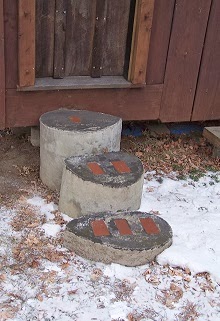 In the dream, I turned some corner on the property here and saw that someone had dug up the concrete steps leading into the zendo I built in the backyard more than a decade ago. The steps were laid out ... dug up and laid out and the important part was the knowledge that no one was going to put them back. Given all the effort that had gone into creating them and given their utility, it seemed too bad ... but there it was: It was over. I sure as hell didn't have what it took to recreate, reposition, or replace what had been undone.
In the dream, the steps -- three of them -- looked somewhat different from the reality, but the representation was close enough. What had showed above-ground (the steps themselves) had long footings that had been, as in reality, below the surface of the earth. Like a wisdom tooth or an iceberg, the serious aspects of the steps lay unseen below the surface.
Once the zendo was more or less complete in 1998, I needed to create some bridge between the earth and the building entrance, which lay perhaps 28-36 inches above the ground. I wasn't a good enough carpenter/mathematician to create wooden stairs on my own, but in any case disliked the staying power of wood, given the elements around here. So I went to my favorite junk yard -- a wondrous expanse of leftover windows and doors and toilets and sinks. I did find short bits of staircasing, but none fit the specifications I needed. And so I was thrown back on my own resources: If you want something done right, do it yourself. But how?
And then the idea of creating concrete pilings came to mind. The stairs would be round ... or anyway, that's what I imagined. But they needed a foundation -- something that would defy the capricious imperatives of a New England frost line. So first I dug a square -- perhaps two-by-five feet -- about a foot deep. The square would underpin the three stairs, each of them about 18 inches across. But this plate on which the stairs would rest also needed an underpinning: Frost lines usually reach 24 inches down. I needed something that would assure the stability of the stability I wanted for the steps. So I got a post digger and created a hole in the center of the space that would hold the stairs. The hole was three or four feet deep, thus creating a foundation that was below the frost line. Then I mixed the first batch of cement, laced it with bits and shards of New England rock and shoved in three lengths of rebar -- metal reinforcing rods used in construction. The rebar in the hole protruded above the cement and awaited the second addition of concrete -- a connective to the plate on which the stairs would sit. Into this second addition of cement, I added three pieces of rebar per step -- sticking up and creating a new connector.
Looking at the paragraph above, I realize how tedious it is. No one gives a shit how something was built. What they care about is that the shoes or forks or glasses or trousers in their lives work. But in the dream, all the tediousness and sweat was in my mind as I surveyed the extracted steps. And there was more to remember and factor in: As a means of creating the steps themselves, I got 36-inch roof flashing -- a thin metal sheathing -- and turned it into tubes by applying duct tape. Then I poured concrete into the tubes. One of the problems was that I hadn't thought of how much weight the concrete represented and how that weight might affect the perfect but thinly shaped circles I had created. But once I got to pouring cement, there was no going back and the perfect circles became whatever shape gravity insisted upon. The steps themselves -- the results -- are kind of wubba-wubba by shape ... but they worked... worked then, worked now, but no longer worked in the dream.
The bridge had been built, from earth to entry way. Using it, anyone could climb smoothly into the zendo. No special effort required. The earth has long since filled in around the base of the steps, so they seem to arise without effort out of the lawn ... like some volcanic-extrusion islands in the Pacific.
 But coming around the corner in my dream, there they lay, extracted from the earth to which they had been affixed. The smoothness from earth to destination had been undone and no one was going to resmooth the scene. The steps in their usefulness were gone and, with them, the effort that had once started as a dream.
Last night's dream was not sad or frustrated. Like all dreams, it was just factual. I wasn't quite sure how so much effort had come undone, but it had.
That's the way it is with important bridges, I guess -- so important in their time and effort and yet coming undone with the passage of dawns and dusks and with some evolving recognition of the imaginary gaps they span.
That's the way it is with dreams.
In dreams, there is no second opinion.
Dreams are serious, not solemn.
From nightmare horror to wet-dream wonder, dreams dance without partners. They are clean and clear and uncluttered with sage overlays. Soaring with eagles or dissolving in despair, still there is nothing but soaring or dissolving. Laughter is just laughing.
Some say dreams represent what anyone might fear or long for but anyone who has dreamed long enough knows that distinguishing between those two is a fool's errand.
I don't dream well or at any rate remember what I do dream, but last night I dreamed a dream that I managed to remember.
In the dream, I turned some corner on the property here and saw that someone had dug up the concrete steps leading into the zendo I built in the backyard more than a decade ago. The steps were laid out ... dug up and laid out and the important part was the knowledge that no one was going to put them back. Given all the effort that had gone into creating them and given their utility, it seemed too bad ... but there it was: It was over. I sure as hell didn't have what it took to recreate, reposition, or replace what had been undone.In the dream, the steps -- three of them -- looked somewhat different from the reality, but the representation was close enough. What had showed above-ground (the steps themselves) had long footings that had been, as in reality, below the surface of the earth. Like a wisdom tooth or an iceberg, the serious aspects of the steps lay unseen below the surface.
Once the zendo was more or less complete in 1998, I needed to create some bridge between the earth and the building entrance, which lay perhaps 28-36 inches above the ground. I wasn't a good enough carpenter/mathematician to create wooden stairs on my own, but in any case disliked the staying power of wood, given the elements around here. So I went to my favorite junk yard -- a wondrous expanse of leftover windows and doors and toilets and sinks. I did find short bits of staircasing, but none fit the specifications I needed. And so I was thrown back on my own resources: If you want something done right, do it yourself. But how?
And then the idea of creating concrete pilings came to mind. The stairs would be round ... or anyway, that's what I imagined. But they needed a foundation -- something that would defy the capricious imperatives of a New England frost line. So first I dug a square -- perhaps two-by-five feet -- about a foot deep. The square would underpin the three stairs, each of them about 18 inches across. But this plate on which the stairs would rest also needed an underpinning: Frost lines usually reach 24 inches down. I needed something that would assure the stability of the stability I wanted for the steps. So I got a post digger and created a hole in the center of the space that would hold the stairs. The hole was three or four feet deep, thus creating a foundation that was below the frost line. Then I mixed the first batch of cement, laced it with bits and shards of New England rock and shoved in three lengths of rebar -- metal reinforcing rods used in construction. The rebar in the hole protruded above the cement and awaited the second addition of concrete -- a connective to the plate on which the stairs would sit. Into this second addition of cement, I added three pieces of rebar per step -- sticking up and creating a new connector.
Looking at the paragraph above, I realize how tedious it is. No one gives a shit how something was built. What they care about is that the shoes or forks or glasses or trousers in their lives work. But in the dream, all the tediousness and sweat was in my mind as I surveyed the extracted steps. And there was more to remember and factor in: As a means of creating the steps themselves, I got 36-inch roof flashing -- a thin metal sheathing -- and turned it into tubes by applying duct tape. Then I poured concrete into the tubes. One of the problems was that I hadn't thought of how much weight the concrete represented and how that weight might affect the perfect but thinly shaped circles I had created. But once I got to pouring cement, there was no going back and the perfect circles became whatever shape gravity insisted upon. The steps themselves -- the results -- are kind of wubba-wubba by shape ... but they worked... worked then, worked now, but no longer worked in the dream.
The bridge had been built, from earth to entry way. Using it, anyone could climb smoothly into the zendo. No special effort required. The earth has long since filled in around the base of the steps, so they seem to arise without effort out of the lawn ... like some volcanic-extrusion islands in the Pacific.
Last night's dream was not sad or frustrated. Like all dreams, it was just factual. I wasn't quite sure how so much effort had come undone, but it had.
That's the way it is with important bridges, I guess -- so important in their time and effort and yet coming undone with the passage of dawns and dusks and with some evolving recognition of the imaginary gaps they span.
That's the way it is with dreams.
Thursday, January 9, 2014
mailing the kids
Received in email:

In 1913 it was legal to mail children. With stamps attached to their clothing, children rode trains to their destinations, accompanied by letter carriers. One newspaper reported it cost fifty-three cents for parents to mail their daughter to her grandparents for a family visit. As news stories and photos popped up around the country, it didn't take long to get a law on the books making it illegal to send children through the mail.Snopes.com, the investigator of wild and wooly Internet assertions, offers a more interesting back-story. Yes, it was legal for a while to ship kids, though the pictures above are most likely light-hearted representations of that truth. Kids were most often shipped, when they were, over short distances. They needed to weigh less than 11 pounds in compliance with Parcel Post regulations. When the kids were shipped long distances, it saved the money that might otherwise be spent on a rail ticket.
Vernon O. Lytle, mail carrier on rural routeNo. 5, is the first man to accept and deliver under parcel post conditions a live baby. The baby, a boy weighing 10-3/4 pounds, just within the11 pound weight limit, is the child of Mr. andMrs. Jesse Beagle of Glen Este. The boy was well wrapped and ready for "mailing" when the carrier received himto-day. Mr. Lytle delivered the boy safely at the address on the card attached, that of the boy's grandmother,Mrs. Louis Beagle, who lives about a mile distant. The postage was fifteen cents and the parcel was insured for $50. [New York Times]
ead more at http://www.snopes.com/photos/people/mailingchildren.asp#EF2LT2hmJv0vjgoK.99
In
1913 it was legal to mail children. With stamps attached to their
clothing, children rode trains to their destinations, accompanied by
letter carriers. One newspaper reported it cost fifty-three cents for
parents to mail their daughter to her grandparents for a family visit.
As news stories and photos popped up around the country, it didn't take
long to get a law on the books making it illegal to send children
through the mail.
Read more at http://www.snopes.com/photos/people/mailingchildren.asp#EF2LT2hmJv0vjgoK.99
Read more at http://www.snopes.com/photos/people/mailingchildren.asp#EF2LT2hmJv0vjgoK.99
Subscribe to:
Posts (Atom)