Thursday, June 19, 2014

public persona, private life

At about 6:15, what I took to be a young woman walked down the sidewalk across the street. I could see her from my perch on the porch, walking with the attentive slowness of a drug addict, a meditator or a crazy person. What caught my attention was her turquoise cap which sang cheerfully in the thick silence of the coming day.

Her progress led her from north to south. She stopped here and there to touch the bushes that separated one house from another. Pause, touch, move on; pause, touch, move on.

As she passed my position, I glanced once more at her receding figure. She looked anorexic/ballet dancer thin in her uninteresting-plaid jacket and the tight jeans that accentuated her thinness. Once she had gotten past, I could see her from the rear -- the rear where the replica Monarch butterfly wings -- 18-24 inches in length -- were strapped between her shoulder blades.

Slowly, slowly, slowly she passed from view.

I weighed calling the cops, not because she seemed a danger to anyone else but rather because I was not sure that whatever planet she was on was entirely friendly to her own life and limb. In the end, I did not call.

Why is it -- if it is -- that people's private lives are so much more interesting than their public personas? Hours and hours and hours of effort and shaping go into what is acceptable or socially adroit or offers an entree into this group or that ... and all the while there is a private panorama kept carefully hidden at the back of some mental sock drawer. It's not necessarily violent or mean, though it may be that, but it's there, like unused butterfly wings -- a contradiction, perhaps, of all that is socially or personally acceptable ... wearing a turquoise hat in the darkness.

Maybe the question that I like to ask secretly of others is this: Of what privacy is your public display an example? I suppose I might equally ask it of myself, but it's safer to ask it of others. Who knows what the hell is at the back of my sock drawer?

Maybe one day the woman in the turquoise hat will take her wings off and fly.

Maybe I will.

Wednesday, June 18, 2014

buy an iPad, poison a Chinaman

Passed along in email:


dog-eaters feast early

BEIJING (AP) — Residents in a southern Chinese city that has come under fire for an annual summer solstice festival in which thousands of dogs are slaughtered for food have held their feasts early to avoid attention....
The public uproar reflects the increasing affluence of ordinary Chinese, who keep pets, travel overseas and are changing attitudes toward traditions they may not have questioned before.

Australians for coal

Passed along in email:


where the prayers end, the peace begins

In the book "Swampland Flowers: The Letters and Lectures of Zen Master Ta Hui [1089-1163]," Ta Hui writes approximately (haven't got what it takes to look it up) to one of his students: "I have always taken a great vow that I would rather suffer the fires of hell for all eternity than to portray Zen as a human emotion."

The sentiment, to the extent anyone might be willing to examine it, runs counter to quite a lot of what passes for Buddhism in today's world of spiritual endeavor. Implicitly and explicitly, human emotion plays a pretty strong role, however camouflaged it may be. To my mind, it's no big deal, but it is worth noting that Ta Hui was right.

Another way of saying, "I have always taken a great vow that I would rather suffer the fires of hell for all eternity than to portray Zen as a human emotion" is this:

Where the prayers end, the peace begins.

One of the steps in spiritual endeavor, I think, is to notice what the problem is -- to get a bead on the attachments and delusions and whatever all else seems to stand in the way of some smooth sailing. And once having gotten a bead, there is also a natural tendency to want to take the newly-acquired spiritual discipline and stamp out or cut off these wily interlopers.

No one who took up a spiritual discipline did so because s/he was so damned happy and with this in mind it is natural to think that if the wiles of ego and attachment and delusion are cut off, something more like happiness will result.

With the recently-acquired and well-imagined weapons of "compassion" and "clarity" (lotsa different names here), the effort is put in motion. Anyone who has tried this over an extended period of time knows that it amounts to a game of Whac-a-Mole ... delusions are endless and wily and sly and the game goes on and on and on and the sub-rosa search for an emotionally-satisfying happiness recedes with each new success.

As I say, I don't think it's a big deal, but I do think it may be instructive.

There is a difference between fighting the emissaries of darkness and noticing them. Fighting always elevates and gives substance to the enemy. Fighting unkindness and selfishness and whatever all else means, first, giving substance and power to what is opposed, and second, deciding to battle it. Welcome to Whac-A-Mole.

But just because the battle cannot be won does not mean there are no enemies. It just means that defeating them may require a more effective strategy. Soo ...

Where taking up sword and shield against the foe tends to prolong the war, noticing and keeping an eye on what is inimical is different. To watch anything is to give it the opportunity to disappear and watching the gnawing capacities of human life is no different. Just watch. Just notice. No improvements. No prayers. Just watch ... and see what happens.

Spiritual discipline is largely the discipline of patience and outflanking the Whac-A-Mole approach requires patience -- patience and a certain determination not to be swept up in the swirling seas of emotional satisfaction.

What happens when you just watch? Seriously, what happens? Does it mean you turn into an emotional zombie? I don't think so, but watch and find out. Does it mean you get your picture on some holy Hallmark calendar, halo carefully adjusted? I doubt it, but watch and find out. Does it mean you have to give up the joys of playing Whac-A-Mole? I doubt it, but watch and find out. Does it mean others will bless your name and kiss your feet or ass? I doubt it, but watch and find out.

Just watching makes up in effectiveness for what it lacks in soap-opera drama.

Or anyway that's my guess.


June column


The VA’s standing around army of patients


Nationwide, there is a great deal of hand-wringing about the delayed or denied services offered to American veterans. The VA hospital in Leeds is one such medical provider.
 
A recent chart in the Daily Hampshire Gazette showed there were an average 72 days of wait time to see a primary care doctor in Leeds; a 67-day wait to see a specialist; and a 28-day wait for mental-health care. Staff turnover, recruiting difficulties and increased patient load were cited as some of the reasons for malfunction.

A Merritt Hawkins 2014 study found that American civilians wait an average of 18.5 days for a doctor’s appointment. In Boston, the average wait for a family physician was 66 days, while the average wait for various specialists was 45.4 days.

When I compare the VA statistics with my own medical care, I am appalled. Over the years living in Northampton, I have been treated by excellent, adequate and lackadaisical physicians. Through it all, I have been fortunate to have some insurance coverage. But the need for my care was rarely more compelling than the need for care that a veteran might experience. As an American, I am mortified by my good fortune.

And I’m more embarrassed still that my country’s delivery and outcomes in medical care of its civilian population lags behind a longish list of other countries that spend far less and provide a professionalism any American might envy.

In 2012, Forbes magazine reported that med school students graduated with an average of $140,000 in debt. Primary care doctors, while shouldering the lion’s share of American medical treatment, are the least well-paid at $189,000 on average. Primary care physicians at the VA average about $177,500.
In addition to the financial burden, primary care physicians miss out on the prestige that comes with specialization. An orthopedic surgeon’s $519,000 or a cardiologist’s $512, 000 or urologist’s $461,000 average base salary comes with ... what shall we call it ... a prestigious set of brass buttons, perhaps.

And so, at a minimum, income plays role in why primary care doctors might steer clear of the VA.
But I imagine there is another factor as well.

War is not appendicitis.

Appendicitis is a dysfunction of the body — one that a physician might successfully treat. Like anyone else, a doctor would like to think that his or her healing skills might generate success after the body malfunctions.

When Mr. or Mrs. Jones gets better, it makes that $140,000 in debt worthwhile.
War and its wounds are not inflicted by nature. And the frustration of treating what is clearly a man-made choice — a choice that might equally have been left unchosen — can be both compelling and draining.

The wacky world depicted on television’s long-running series M*A*S*H was pretty funny by way of Korean War zaniness, but not funny at all by way of the grueling, grinding substance of operating on one wounded teenager or 20-something after another. Even on a comedy show, futility took its toll.

War, of course, has its excuses, some of them quite compelling. But few of them are compelling enough to buy into the ballooning pretext of government-approved violence — the undocumented claims of “terrorism” or the “terrorists” who “might” attack us. And so, perhaps, futility and insanity create a one-two punch and an unremitting downer.

But as a means of focusing a more serious attention on war, military involvements and the medical shortages at the VA, here is a small and ridiculous proposal.

Each time a politician votes for military venture or war or any action likely to promote an uptick in the need for body bags and prosthetic limbs and suicides and wrecked families, a $100 co-pay per doctor visit will be added to that politician’s medical insurance. Two such votes will cost $200, etc.
This add-on will likewise apply to all staffers employed by the politician.

And the president and his staff would not be exempt.

The resulting income, while not enormous by comparison to the need, may allow the VA that is left to cope with the fallout of such votes to sweeten the medical pot at its facilities.

Of course, it’s a ridiculous proposal. When was the last time you saw anyone who gave the orders shouldering a straightforward responsibility for the unpleasant consequences?

Of course it’s a ridiculous proposal.

But is it really any more ridiculous than the treatment being received by our veterans?

Adam Fisher lives in Northampton. His column appears on the third Wednesday. He can be reached at genkakukigen@aol.com.

Tuesday, June 17, 2014

unlikely results

... And, in what may be thought of as the Pissing-Into-The-Wind Department:

-- Pope Francis has encouraged the super-rich and bankers to get some ethics.

-- "We Will Harass Men" is gaining a Twitter foothold in Egypt, a country, like many others in its neighborhood, that can treat women as chattel and worse. I particularly liked the suggestion that men were immoral for not wearing a veil.

missed your destination

Sometimes I think life's one, only-half-kidding instruction is this:
STOP!

GO BACK!

YOU MISSED YOUR DESTINATION!

Monday, June 16, 2014

fireflies

In the silence of the coming night,
There are fireflies to trumpet
And delight.
How noisy and magical!

university job opening draws swarm

The University of Alberta is seeking a new president. The job pays a minimum of $400,000 per year. With this in mind, a quasi-tongue-in-cheek group of four professors offered their collective services to fill the position. They noted that even if they split the president's salary four ways, each of them expected to receive a pay raise in academic times given to ballyhooing "austerity."

When I was growing up, this used to be called a "rat-fuck" -- a practical joke of considerable proportions. And yet, in this case, the professors are only partly giggling. The other part really wants to point out the bloat rampant in the upper levels of academia.

Here is both the application by the four professors and the university's solicitation for applicants.

Since the feisty four made their initial application, another 52 academics have joined the fray.

treasuring the enemy

Personally or socially, I wonder what things might be like if the habit were laid to rest, even if only for a little while -- treasuring our enemies.

Last night, I got around to watching the 2012 movie, "Zero Dark Thirty," the alleged tale of the search for and eventual assassination of Osama bin Laden, one-time front man for Al Qaida, an organization the United States has loved to hate. I watched it based pretty much based on the fact that I had enjoyed director Kathryn Bigelow's earlier gritty tale, "The Hurt Locker."

But whereas "The Hurt Locker" (2008) told a very focused and nuanced tale of bomb disposal teams after the U.S. invasion of Iraq, "Zero Dark Thirty" seemed to be all over the lot as it adduced the bits and pieces of effort and intelligence that led up to the storming of a compound in Abbottabad, Pakistan, where bin Laden was holed up. The movie's ending seemed to ask the question, "OK, you killed him. So what?"

But there was a lot of to-ing and fro-ing before the actual attack: Aside from anything else, it was interesting to see the differences in attire: On the one side were nut-brown Middle-Eastern men with facial hair and sometimes robes; on the other were mostly-pink CIA and other U.S. operatives whom it was hard not to think of as paupers in Armani suits. Each was harming the other in a variety of grisly and often fatal ways.

Overwhelming a stated enemy is no small matter, especially when torture and death are involved, and "Zero Dark Thirty" relied on its viewers to concede the point -- an enemy is an enemy and enemies are a serious business. But I think it is a short step from such seriousness to a recognition (with luck) that if he is an enemy long enough, he becomes a treasured and reliable friend, a part of the raison d'être scenery.

Who would I be without my friends? Who would I be without my enemies?

In the practice of Buddhism, conversation sometimes parks its car in the "enlightenment" garage. There are hundreds of ways of referring to this ineffable realm, but all of them, when put to the test, assert in little letters and large that "enlightenment" is a good thing, something worth aspiring to and even, in some cases, something to "attain." As I say, this is all for conversational purposes, purposes of the practicing Buddhist's mind. Enlightenment is, in one sense, a good and loving and healing friend.

A couple of questions cross my conversational mind when it comes to "enlightenment," as it is referred to conversationally. 

1. There are those who claim to be seeking enlightenment and to assert that they are not yet enlightened. But how could anyone know they were not enlightened if they didn't know it from an enlightened point of view? And if they were already in possession of an enlightened point of view, why on earth would they be seeking what they already had?

2. Anyone who has lowered himself into the pool of Buddhist practice knows the feeling of being confronted by a host of difficulties. Attachment, delusion, ego, greed, anger, folly ... in little and in large and in a very intimate life, there are difficulties to confront. And the deeper the practice, the sharper the barbs can feel. How is anyone to end "suffering" when there is so much fertile soil? It seems endless and daunting and ... oh, hey! wait a minute -- isn't that what enlightenment is supposed to wipe off the map?! Isn't that what makes enlightenment special and desirable and fulfilling? Isn't freedom from such enemies -- or, more politely put, seeing into the nature of such difficulties -- the point of all this hard, hard work?

The trouble is that anything that is special presupposes something that is not special -- something that might be downright inimical. Being enlightened is one thing, being deluded is another. But the question has to be asked: If the enlightenment anyone seeks differentiates what is special and what is not, what is friend and what is foe, what sort of enlightenment could that possibly be? Hell, with that sort of enlightenment, you might as well open a church and pass the collection plate.

Treasuring enlightenment; treasuring delusion -- the two locked together in some intimate concoction that passes for practice. Yup -- I know my friends. Yup -- I know my enemies. Yup -- they inspire and encourage me to practice hard-harder-hardest. And into the bargain, I may get some Armani robes. The old-timers were right -- Buddhism really is a special practice, even when I grovel and play the humble and compassionate game. I love to love what I love. I love to hate what I hate. I know my friends and I know my foes. And to ice the cake, I can say, conversationally, that neither love nor hate enters, that I am beyond friends and enemies.

OK, treasuring friends. OK, treasuring enemies. If that's what it takes at the moment, then give it a whirl. Enlightenment good; delusion bad. OK, give it a whirl, whether within or without.

But practice anyway. Practice until the treasuring aspect dissolves. Treasuring friends. Treasuring enemies. Treasuring me. 

Practice and dissolve.

Practice and dissolve.

If all of it were in any way special, how could it possibly be special or worth the effort?

Yes, I know -- the robes are kool. But come on!


Sunday, June 15, 2014

a designated preserve

As an instructor, discipline, koan, tombstone, or reminder, maybe it would be nice to create a small and serious preserve in this life, whether within or without, and add a little signage:


the sporting life...photos

England's Billy Twelvetrees (L) and New Zealand All Blacks Cory Jane the ball during their second rugby union test match at Forsyth Barr Stadium in Dunedin June 14, 2014.
REUTERS/Anthony Phelps
  
"Twelvetrees" -- where do people get these kool names? "Sixsmith," "Twelvetrees" -- I want one of those.

A participant runs in high-heels as she competes in the Stiletto Run in Bucharest June 14, 2014. The annual 50 metres race requires participants to wear high-heels that are at least 7cm tall.
REUTERS/Bogdan Cristel
Now that sounds like a dangerous sport!

Father's Day

It's Father's Day ... which leaves me a bit confused ... but I suppose I ought to have something to say about that.

My wife gave me a couple of nice chocolate bars and a card which said inside: "You are loved a lot!" The sentiment bowled me over, but it was part of the confusion. What for?

If anything, I have always felt pretty second-rate as a father ... although I admit I'm not exactly sure what a first-rate father might be ... just not me, I guess. I wish I had been better, but it's too late now. Wish I had done more, given more ... something better.

Based on my kids, whom I like as well as love, it was my wife who did the miraculous heavy lifting, so today, for me, is more a Mother's Day than a Father's Day. What a ballbuster! And she did it. I'm in the mix somewhere, but where, precisely, I'm not sure in ways I imagine a "better father" might be.

And I'm aware of my knee-jerk up-bringing that suggests 'measuring up' is not in the cards. It's neurotic crap, but it's the neurotic crap I'm stuck with. Now and then, I can out-smile it these days, but the low hum is there, making me wonder what in the world Father's Day might be or mean.

Someone knows, I imagine. It just doesn't happen to be me.

Saturday, June 14, 2014

Dwight David Eisenhower

With Memorial Day receding in the rear-view mirror together with the heart-felt remembrances of men and women who died in wartime, I thought it might be nice to tip a hat to Dwight David Eisenhower (1890-1969), 34th president of the United States and the Supreme Allied Commander of the "sacrificing" and "heroic" forces that routed Hitler's armies in Europe during World War II.

To the extent that anyone might remember its fallen veterans with words of praise and gratitude, I think the man who led them might also be due for some applause. Eisenhower made some tough decisions, but in the end, the allies won the war. Eisenhower deserves some laurels as a serious man.

And yet that same serious man would one day say/pray:
I don't want people who have a financial stake in crisis and tensions to have a voice in national policy.
Compare that with the lay of the much-manipulated congressional landscape today and it's hard not to think that Eisenhower is lucky to be dead.

when democracy gets out of hand

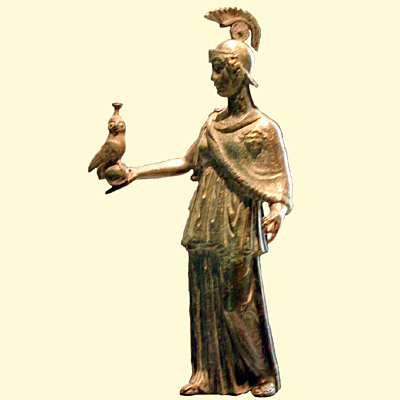
Minerva, "the Roman goddess of wisdom and sponsor
of arts, trade, and strategy."

 If you haven't had your cup of "depressing" today, Nafeez Ahmed's blog depiction of the "Minerva Research Initiative" in The Guardian should replenish your stock.


Launched in 2008 – the year of the global banking crisis – the DoD 'Minerva Research Initiative' partners with universities "to improve DoD's basic understanding of the social, cultural, behavioral, and political forces that shape regions of the world of strategic importance to the US."
But, incrementally, as with all dictatorships, the focus shifts ever so slightly:
Last year, the DoD's Minerva Initiative funded a project to determine 'Who Does Not Become a Terrorist, and Why?' which, however, conflates peaceful activists with "supporters of political violence" who are different from terrorists only in that they do not embark on "armed militancy" themselves. The project explicitly sets out to study non-violent activists....
For Minerva, the line between non-violent activists and what have come to be called "terrorists" is hopelessly and perhaps deliberately blurred: If too many non-violent wing-nuts get together, hell, we in the catbird seat of power might be out of a job.

Oh well ... I think the blog post is worth reading, but I can understand why anyone might already be depressed enough.

of importunists and we-asels

I tried several times to write what follows for publication, but couldn't make it happen. There isn't enough there there and what is there seemed to be mismanaged no matter what my efforts. Nevertheless, I like the idea, however mismanaged, so I'm sticking one version here as a means of being quits with it all.

Along the way, I found out that although "importunist" is not a noun, several people on the Internet seemed to agree with me that it OUGHT to be.


OF IMPORTUNISTS AND WE-ASELS

Not long ago, a somewhat younger acquaintance offered to take me out to dinner at a restaurant he liked. At 74 and retired, I never turn down a free meal and so, at the appointed time, we met and sat down and were attended to.


It was one of those places with rehabbed industrial brick walls, a buffed mahogany bar and engaging waitresses with just a hint of the offbeat about them ... a dime-sized rose tattoo on the back of an exposed left shoulder, perhaps. The clientele all seemed to be wearing "hand-crafted" shoes.


As we sat sipping our drinks and waiting for what my companion assured me was a truly outstanding fried chicken, he told me, en passant, that he liked the place partly because he was hoping to involve our waitress in a three-some he and his girlfriend were planning.


I declined to bite down on this juicy tidbit of information not because I am a prude and not because I have an inactive fantasy life but because experience has taught me that the greater the number, the less convincing the intimacy. And sex, among other things, has always struck me as an intimate pastime.


It was this small incident that put me in mind of other realms of contrived and sometimes conniving intimacy: The use of the word "we" is one of them.


Where, in the world of sexual possibility, there are three-somes, so in a wider world there seems to be an endless array of we-somes.


"We have to appreciate climate change."


"We have to get rid of the crooks in Washington."


"We need to understand God's plan."


"We must come to terms with a racist past."


"We need to exercise compassion."


It is not enough for these 'importunists' to say what "I" have to say and allow listeners or readers to make up their own minds. By asserting a collective identity that has not been honestly established, their own doubts are kept at bay. And, coincidentally, the odds of making some money go up.


Yes, it is always well-intended ... sincere dontcha know. We-asels are always sincere.


But it is also condescending in ways that, at my age, I am unwilling to condone or overlook. And it was in this regard that I hit upon my own sure-fire defense mechanism.


As a person who enjoys reading, writing and listening, I will no longer do any of those things for authors or speakers who use the word "we" in the first three paragraphs of whatever case they were making. Aside from anything else, a person who insists on using the word "we" suggests to me someone who is not yet sure enough of his or her own beliefs to use the more straightforward "I." If such people don't believe their own arguments, why should I?


I have been pleasantly surprised at how much lighter the load became -- how much easier -- since my new dictum went into effect.


I am more than willing to ingest what anyone has to say -- however magical or ludicrous -- but I decline to be included in the conclusion until I reach it. More important, since I live on a fixed income, I decline to reach for my wallet or dissolve in fawning applause before I reach it.


Lest anyone think that these are nothing but the ravings of a crabby old cuss, I will concede that there are legitimate uses of the first-person plural, "we." When the sergeant tells his platoon, "we are ordered to take that hill," it is a statement of fact. When a talking head asserts without detailed evidence that "we are threatened by terrorists," I believe I'll head for the exit.


The cussedness of advancing age cannot be denied in the midst of making an argument against the importuning we-asels of this life.


But I also can't help wondering if it's not just a bad case of advancing common sense.

Friday, June 13, 2014

your dream, your truth

When it comes to stories, which I love, I wonder idly, "What's the matter with grown-ups?"

The question gently reared its head last night when I was watching a 2004 Swedish movie called "As It Is in Heaven." The story concerns a renowned conductor who suffers a heart attack, retires to his somewhat bleak childhood hometown, assumes the role of choirmaster at the local church and eventually realizes his lifelong dream of creating music that will open people's hearts. The movie was a hit in Sweden and ran for 103 weeks in Australia.

While not as good as I wanted it to be, still the story was peopled with grown-ups -- characters who had real human characteristics that affected both them and the people around them. They morphed, just like real people. They were bossy, loving, constricted, open-handed, cruel, kind and had bouts of both laughter and tears.

When I compare that to the general celluloid/digital fare in the United States, I wonder: What's the matter with grown-ups? Is it that Hollywood suspects there will not be enough income from viewers and therefore trots out characters whose intellectual and emotional capacities are deliberately limited ... good guy, bad guy, beautiful women and plain Janes, strong and weak ... always nourishing the easiest descriptors of human life.

Mind you, I am as conflicted as the next fellow: I too want to be drawn in and entertained. I too allow stories to edit what cannot be edited. I don't want the story of a boring person to be boring. But what's the matter with giving the magic show a bit more magic and a bit more daring? What's the matter with trying to depict what it's like to have a dream or keep a gnawing secret ... you know, the kind of stuff that people actually do?

The movie also made me wonder:  What would you give for your passion, your dream, your truth?

Not, what should you give -- just what would you give?

It's a somewhat peculiar question that is strangely not peculiar at all. It is peculiar in that it is forever a question solely for the person asking it. It is, like its answer, forever sui generis. There is no second party that can interfere or somehow assist. It is a lonely question ... and yet, I suspect, everyone squares off with it in one way or another ... what would you give for your passion, your dream, your truth? All the blah-blah in the world is helpless. Whether the answer is light-weight and half-assed, compromised or driven, still it is personal in what may be the most frightening of ways.

Your dream, your truth.

Shimmering at first, but in the end, very much like a soap bubble that a child pops with a single outstretched finger. Attainment or surrender come calling one day -- one day, after so much of what you decided you would give -- and then ... pop! ... life calls out like the overworked clerk in a registry of motor vehicles office, "Next!"

Given the arms-wide-open nature of the dream or truth, it is little wonder that people would huddle beneath spiritual or marital or other roofs. These are places where others likewise have their dreams and likewise feel the fear of what it might be like to open those arms -- your arms -- wide -- at last. We are together, as one ... and yet the one, the only one, the only truth, beckons, and finally there is no other choice but to be

A grown-up.

Thursday, June 12, 2014

Spanish flu redux

 
The Spanish Influenza pandemic of 1918
Deep within the groves of academe, where lords and ladies confer with a Miracle-glued moderation, occasionally a giddy case of English breaks out.

And such seems to be so in the the case of Yoshihiro Kawaoka, a researcher at the University of Wisconsin at Madison.
On Wednesday, [Kawaoka] and an international team of scientists published a study in Cell Host and Microbe that said they created a life-threatening virus that is only 3 percent different from the 1918 Spanish flu, which likely killed more people than the Black Death.
An estimated 50 million people worldwide fell victim to the Spanish flu and even today researchers still don't have a handle on its causes or prevention. Kawaoka's argument is that recreating such a virus allows humanity to be prepared in the event of another such pandemic.

Critics think Kawaoka is out of his fucking mind.
“The work they are doing is absolutely crazy,” Lord May, the United Kingdom’s former chief science adviser, told the Guardian. ”The whole thing is exceedingly dangerous. Yes, there is a danger, but it’s not arising from the viruses out there in the animals, it’s arising from the labs of grossly ambitious people.”
And
A virologist at the renowned Pasteur Institute in Paris was similarly fretful. “It’s madness, folly,” Simon Wain-Hobson explained to the Guardian. “It shows profound lack of respect for the collective decision-making process we’ve always shown in fighting infections. If society, the intelligent lay-person, understood what was going on, they would say, ‘What the F are you doing?’”
I guess all this interests me partly because I would prefer not to drop dead at the hand of some scientific experiment gone awry. Also, my mother's mother was killed by Spanish flu. Also, I am interested in the conundrum faced by the United States when sending its troops overseas to fight in World War I (1914-1918): Spanish flu was recognized as a disease spread in confined spaces; troop ships were confined spaces; as a result, large numbers of American troops arrived on foreign soil too sick to fight ... if not dead already.

divided America

WASHINGTON (AP) — Political polarization in America has broken out of the voting booth.
A new survey from the Pew Research Center finds Americans are divided by ideology and partisanship not only when they cast ballots, but also in choosing where to live, where to get their news and with whom to associate.
And peaceful coexistence is increasingly difficult.
The story makes no reference to the economic dis-ease woven into today's society. My feeling is that that dis-ease exacerbates the sense of division and narrowness. In England, a research paper suggests that the economic downturn may be responsible for an increase in suicides.
The economic crisis in Europe and North America led to more than 10,000 extra suicides, according to figures from UK researchers.
A study, published in the British Journal of Psychiatry, showed "suicides have risen markedly".
The research group said some deaths may have been avoidable as some countries showed no increase in suicide rate.

point of focus

A drippy, grey day and my mind energy is all angled towards getting next week's newspaper column in shape. Perhaps I will get back here later.

Wednesday, June 11, 2014

passwords ... is this funny?

Passed along in email a few days ago ...

Please Enter Your Password...
        
        Please enter your new password:
        
        "cabbage"

        Sorry, the password must be more than 8 characters.

        "boiled cabbage"

        Sorry, the password must contain 1 numerical character.

        "1 boiled cabbage"

        Sorry, the password cannot have blank spaces.

        "50bloodyboiledcabbages"

        Sorry, the password must contain at least one upper case character.

        "50BLOODYboiledcabbages"

        Sorry, the password cannot use more than one upper case character consecutively.

        "50BloodyBoiledCabbagesShovedUpYourAss, IfYouDon'tGiveMeAccessnow”

        Sorry, the password cannot contain punctuation.

        “ReallyPissedOff50BloodyBoiledCabbagesShovedUpYourA--IfYouDontGiveMeAccessnow”

        Sorry, that password is already in use.

a little perspective

Passed along in email was this generic reminder/encouragement to all those with a burning cause:


I am what you seek

The Japanese maple across the street, the one I have dubbed "The Tree of the Hanging Squirrels," is now summer-plump with deep red leaves. Breezes and raindrops tousle its ruddy locks. Sunshine shows it to good advantage. It nourishes the eye as it nourishes the squirrels and birds that dodge and dart within its confines.

Nourishing.

Is there anything that is not like this tree -- its sturdy trunk giving way to well-toned boughs giving way to reaching branches giving way to delicate twigs giving way to sky-bound buds? Shelter and food in every direction and yet there is something, for squirrel or man, that encourages an adventure that leads further and further from the sturdy trunk ... up and out to where the buds are sweeter somehow and the nourishment more fulfilling?

Trunk, boughs, branch, twigs ... all of them offer a decent life, a decent nourishment, a decent safety and yet at the far reaches, where the footing is tricky and perhaps pretty damned dangerous, where there is an increasing sense that no more footing can be found ... and somehow it whispers and beckons and has a mesmerizing force: "I am what you seek."

This is nose-bleed country, the air as thin and refined and delicate as the twig that maintains the last vestige of connection with trunk and bough and branch. Music, art, religion, brick-laying, marriage, bicycling ... there is no tree that does not have its beckoning distances. They may be distances that others choose not to attempt, but that does not mean the distances do not beckon and whisper... the purchase point where all purchase is lost: "I am what you seek."

The nourishment is not missing in other, less tenuous places like trunk and bough and branch, but every now and then it is hard not to wonder and tiptoe into the far reaches where there is no room for two and, if the truth be told, there is not even room for one.

Will this nourishment fill some perfect bill at last?

There is no knowing.

Take a bite.

maintaining the castle

It takes a lot of bricks and mortar to create your castle and mine. Bit by bit and piece by piece, the spires and battlements rise up until, voila!, "you" are you and "I" am me.

Thoughts, words, and deeds coalesce and soar, though sometimes there is some patching and repair required. Maintenance is part of what keeps the place intact.

Each brick and carrying beam needs occasional inspection and perhaps a sense of renewed appreciation and enjoyment.

Among my bricks is the old Zen teacher Ummon, who once observed:
When you can't say it, it's there.
When you don't say it, it's missing.
Take him at his word at your own peril.

Tuesday, June 10, 2014

9/11 demolition redux

By this time, of course, the official explanation of the demolition of the World Trade Towers on Sept. 11, 2001, has seeped into the national and perhaps international consciousness.

Writ little or large, the attacks were explainably perpetrated by "al Qaida" or the "terrorists" who lived in another country. Even at the time of the demolition, scientific questions -- questions based in reason and science -- were dismissed as conspiracy-nut fomentations: If serious questions were taken seriously, the alternative explanations were too horrific to entertain. The mind -- the same mind that might otherwise be open to rational thought -- refused to pose the questions, let alone try to answer them. Ad hominem dismissals were and remain easier than factual assessments. What the hell -- these questions came from conspiracy-freak wack-jobs and besides, it's all ancient history.

Who knows -- maybe someday someone will take an interest and connect whatever dots rationally deserve connecting. I'm not holding my breath, but today, I received in email this 22-minute video ... and it nudged me ... and so I'm posting it.


bon voyage

After talking with my sister yesterday, I called my stepmother and confirmed what my sister had said -- my stepmother, at 91, seems to be losing steam.

She recently got a StairMaster -- a mechanical chair that carries its burden to the top of or bottom of a staircase. My stepmother's knees are not all they might be and she chortled like a kid with a Christmas surprise when she told me about the new acquisition. What a luxury! What a hoot!

But her conversational pep was somehow diminished. With my own mother at 98, I know something about the reluctance to expend energy as age advances -- energy to speak, energy to see, energy to hear, energy to think ... it's tiring and, without being sour about it, hardly worth the effort. There was a drifting quality to my stepmother's conversation -- not forgetful, exactly, but not caring a whole lot either. When so much is taken away, there seems to be no assertive choice left other than to relinquish what remains.

With no concrete supporting evidence, it is sometimes hard to see what the hubbub is about death. True, I haven't yet faced it head-on, though I can feel the tires losing air, but when you think about it ... well, has anyone returned from the dead to complain?

The best I can figure with those who are getting older ... well, there is nothing to be done and the best I can try to do is to wish them what they wish. It's not always easy or philosophical or slick, but still, what's left beyond, "Bon voyage!"

"unfinished"

Lately, little and large, the word "unfinished" seems to rule the roost.

Concretely, with the irony of a smirking dream, two movies have brought me back more than once: "An Unfinished Life" and "Unfinished Sky." Neither movie rated critical raves, with the former criticized for being saccharine and predictable and the latter accorded small nods to a small, adult, Aussie tale. Having somehow lost my callouses from an earlier time, I seem to be fair game for saccharine. Trite doesn't bother me so much -- peel back the layers and all stories are trite. Credible silences impress me. And I like characters that are more both-and and less either-or. Anyway, I liked both these "unfinished" movies.

More broadly, if I had to pick just one word to sum things up, I think "unfinished" would be a good one.

Usually, "unfinished" suggests that something is missing, but I don't think that's adequate or even particularly accurate. "Unfinished" is simply a descriptor that clothes each event perfectly -- each according to its need. It's probably not a good idea to mention this since someone is bound to weave it into a wider tapestry of nitwit wisdom. The finished product is unfinished -- nuff said, or rather, too much said.

And somewhere in the bomb zone of this muttering and mumbling ... I wonder if others love stories as much as I do -- being sucked in, enfolded, raised up and let down like a bottle bobbing on the ocean waves. Stories are so, so ... so I-don't know what, exactly. But as much as I enjoy being taken in like some stray dog when it comes to stories, it is odd to think that I may credit the hell out of any story, but never really imagine that I am the story I love so much. Someone or something is a story in my mind and I hug it ... but it never occurs to me that I am every bit as much the story to someone or something as the story is to me. Hugs all around!

Of course if I did imagine such a thing, it would be utterly deluded. But just because something is a delusion doesn't mean it's not true.

The finished is unfinished, the unfinished, finished ... and I do love a good story.

Monday, June 9, 2014

my home town ... eeeeuuuuuuw!

Every once in a while, some little thing comes along that provides an overview of a wider environment.

This morning, for me, it was a paragraph in a local news story about a construction project on one of Northampton's main arteries -- Elm Street. The six-week project involves digging a utility trench across the street, an effort that is likely to foul traffic.

Besides all the information you might expect in such a story -- why, what for, etc. -- this paragraph was tucked in:
Signs posted at the construction site ask workers to keep noise to a minimum, not swear, not smoke, and not engage in any improper conduct.
Noise? They're digging a trench for heaven's sake!
Swearing? Oh drat, shucks, heck, darn...! Will they pass out Shakespearean sonnets that construction workers can declaim during coffee breaks?
Smoking? This city has been clamping down on "second-hand smoke" and the damage it can do and it is nice to live in a 'caring' community that is willing enough or self-important enough to legislate open air, but whatever will happen to all that grisly, icky dust that digging a trench is likely to kick up?
Conduct? Public sodomy is probably frowned upon (was there an epidemic and I missed it?) and whistling appreciatively at passing women can be considered pretty déclassé and public urination wins no blue ribbons, but what are they going to do about all those workmen whose shirts do not sport an embroidered alligator, polo rider or swoosh?

It is all one indicator of my hometown and as such strikes me as infuriatingly precious.

Sunday, June 8, 2014

16,425 days

In the almost 45 years since I first started formally sniffing the spiritual fire hydrant, I don't think a single day -- not one single day -- has passed without giving the matter some thought. Whether in practice or intellectual munching ... not one single day.

And I don't regret it. It's probably better than sticking up 7-11's or over-indulging in chocolate or being more-overtly unkind in one way or another.

But, without meaning offense to others, I do sincerely wonder if such an interest is what Jesus or Gautama or Mohammad or any of the other good teachers had in mind when they laid out their teachings.

A good teacher would wish for your happiness, don't you think? Not a 'spiritual' happiness -- just happiness without any add-ons.

No one adds stuff on when they're happy. They're just happy.

Would a good teacher wish for anything less than that?

I doubt it.

16,425 days ... that's a lot of days that required no add-ons.

Oh well -- life is profligate. For this reason, it is called "loving."

The profligate never care much what anyone calls them.