Monday, February 16, 2015

toasty cold


Half an hour ago, at 6:45 a.m., it was minus-five degrees Fahrenheit (minus-20 centigrade) in this neck of the woods according to the weather site on the Internet.

Cold enough to defy the word "cold."

Is there anything which, if left to its own devices, does not mock the descriptives it can be subjected to?

Naturally, there is a frenzied search for the kindling of description.

It keeps things warm.

Sunday, February 15, 2015

snowy landscape

Like blobs and dustings of dandruff, the snow falls and is blown and swirls and alights and flies and ... was it ever really summer?

More and more and more and more until you might think there could be no more, but like some nightmarish dream or reality, there IS more.

As usual at this time of the month, I am working on a newspaper column and running my neurotic schtick. Because there is little to nothing that really catches my fancy (the "indecency" of yoga pants knocked gently at the door), I have fallen back on recent email correspondence with Brian Victoria. The lead line seems to be, "My friend Brian Victoria, a Zen monk and author of "Zen at War," is a pain in the patoot."

The thesis allows for a little space in which to shoot my mouth off about my own ambivalence towards goodness and decency and kindness and so-called spiritual life. Good intentions and even good actions have so many unintended consequences -- some of them quite good -- but the willingness to rely on their goodness and the unwillingness to embrace their badness makes me skeptical and, I'm afraid, too crotchety by half.

If I have a hard time nourishing the patience that will allow my children to make mistakes I have already addressed, why should it be any different outside the immediate family?

Oh well ... one thing you can say for confusion: It keeps you busy.

The road to heaven is the road to hell ... get used to it.

Saturday, February 14, 2015

who am I? I am your cake


The same assured willingness to believe that "I know who I am" seems to lose its footing when the question is asked, "who are you?" When challenged or assessed, the knowledge of who I am seems to depend on the story told in any current moment. Just now, I am 'x.' But wait! Now I am 'y.' And yet again, I am both/and or neither/nor. And still there is an assured voice whispering, "I know who I am."

Rivulets of thought put me on this frequency which may be observed as "juvenile" by the adults in any given audience.

A cousin's recent email observed


The most pathetic funeral I’ve ever attended was for a woman in a former church of mine. I didn’t know her, but her daughter sang in the choir with me. The priest hadn’t known the deceased, either, and the only thing he could scrape up to say about her was that people enjoyed her cakes.
The implication seemed to be that a deceased person would better be remembered for a wider litany of accomplishment -- actions and events that mourners could somehow sink their teeth into. But what is the matter with being remembered for your cakes? Is this really some lesser feat or praise than hiking the Appalachian Trail or inventing a better wheel? Isn't a good cake, one that brings delight to the tongue, really quite nice and worth remembering? Most people accomplish small things in life, many of which they cannot even remember themselves, let alone lodging in the memory of others.

If I cannot quite pin down who I am or was, how could some poor priest or funeral director or even endeared relative be expected to do better?

One of my favorite object lessons in the matter of assessing who I am resides is a YouTube video called "Thought Moments." It's really quite a simple documentary: The narrator poses ten questions to ordinary people. The questions range from "What is your name?" to "What do you love?" to "What is beautiful?" to "Why is the sky blue?" It sounds very simple for those who "know who I am" and it may seem simple when written down. But the looks on the respondents' faces, the long pauses and their searching eyes reach down inside a viewer like me. It's all very simple -- who is the I of which I am so assured? -- and yet endlessly complex and somehow jolting. The film seems to ask gently, "If you're so certain, why are you so uncertain?"

In Utah, the House recently passed a bill that would allow firing squads to carry out death sentences. As can be imagined, there were and remain strong opinions and both sides of the issue, which has yet to pass the Senate or receive the governor's signature. There is nothing like adjudicating death to bring out a strong sense of "who I am." Some culprits seem to deserve killing. Some not. But making a law about taking life draws all parties closer to a topic that is generally kept on the back, I-know-who-I-am burner. An actual piece of legislation puts the subject matter "in your face," a place that I who know who I am would prefer it not be put.

"I know who I am" is another of those don't-ask-don't-tell annoyances.

And yet sometimes -- though not habitually in a U.S. Congress that approves funding for the latest executions in faraway lands -- there are men and women who decide to address things squarely, even if the result may be unpleasant.

In 1939, Charles Monroe gave an interview to the Federal Writers Project. Monroe, of New Marlborough, Mass., was a mail clerk who was described as "not a man of wealth or education," but was considered, at 50, a leading member of his community and something of a philosopher:


I try to be a good citizen by performing certain public and personal duties which most of my friends would throw up their hands at if I suggested they perform along with me. In my opinion there's too much 'passing the buck' going on today. I don't like many of our laws - capital punishment, for instance - but since I'm a voter and a sustainer of our form of government, I of course automatically make myself as responsible as any other individual in the upholding of our laws. As a sort of an 'accessory to the fact' I once forced myself to attend an execution down in Sing Sing prison where my brother-in-law holds a good job. It was an ugly business. One witness fainted and another vomited, and it was a big relief to get out of there. I felt like the executioner myself, as I was partly, for the fact that we do not press the button or cut the rope doesn't let any of us off.
But if I can't convince you that I was a killer in that instance, you'll have to grant that I'm a killer of pigs and cattle, for I've often helped farmers butcher their live stock. I've done this to satisfy my own conscience, for I'm a meat eater, and being a meat-eater, why shouldn't I assist with the dirty work? You smile!


 At least Monroe, different from me or most members of the Congress that represents me, made an effort to look into the matter of "who I am."

Was he successful? Did he fail? I have no way of knowing. I do know that I admire him for putting on the front burner some of what generally remains unspoken and unaddressed. And perhaps, if nothing else, he came away from the experience with a greater sense of humility and honest perspective.

Death, of course, is a somewhat grisly eye-catcher of a topic. But how about the hundreds of other aspects of life, whether joyful or grisly, that swim like silver fish through any daily waters?

I know who I am?

There is no avoiding the question.

And, on a guess, I would say there is no way of answering it.

Perhaps I will bake a cake today.

Friday, February 13, 2015

drought and extraterrestrials

At the same time that serious scientists are pointing to the risk of a prolonged drought in the Southwest and Central Plains states here in the U.S., other (I guess they're serious) scientists are suggesting the human race get off its duff and send messages to what may be aliens in outer space.

A mega-drought would mean that even Republicans might run short of food and water so perhaps a denial of climate change deserves to be revisited.

I once heard the scientist and prolific writer Isaac Asimov say that he doubted there was 'intelligent' life elsewhere in the universe but that if it did exist, it was conceivable that it would exist in a form outside human comprehension ... something like "rivers of thought," he said.

Who is it who imagines that making new friends (if friends they turn out to be) makes much sense when the human race seems incapable of making friends with itself?

perfection

"Perfection" is strange.

Anyone, in any field, might strain and sweat and sacrifice and go a bit bonkers to attain it, but once having reached the agreed-upon heights, what, precisely, has anyone got? Are they better off or more august or any warmer under the bed clothes on a cold winter night? Do splinters beneath the finger nail hurt less? Does the face in the bathroom mirror assure "the fairest in the land?"

I'm not trying to insult great expertise, but I do wonder how those with such expertise handle the perfection they have attained.

Once upon a time, my step-mother bought a Dachshund which the family named "Miles." This was long before my older half-sister married Tony Miles and had two children. Anyway, my step-mother bought the dog and brought it home and then found herself facing a conundrum.

Miles came with papers attesting to his American Kennel Club status ... which is sort of like getting canonized, I gather. He was a friendly dog I was reminded of this morning because the Westminster Kennel Club dog show is scheduled in New York this weekend. How "Westminster" and "American" kennel clubs relate, I don't know, but both seem to be about pedigree and perfection and that sort of thing.

Accreditation, as always, does not come cheap, so I imagine my step-mother had shelled out a sizable sum for a precious dog that was precious-er than other dogs whose ticket had not been punched. But, having picked up the dog with its accreditation documents, she brought it home and, voila! -- it was just a dog that liked to romp and play and run and shit just like any dog. It might be credentialed, but credentials don't mean much when it was time for a walk.

My step-mother's conundrum was this: Would she let the dog run free outdoors -- without chaperone -- or would she husband its credentials and keep it tucked away inside the house? Finally, since she had two daughters to raise and enough work on her plate, my step-mother did the obvious: She treated Miles like a dog and a pet.

And Miles didn't seem to mind. He liked chasing cats and playing fetch about as well as the next dog.

Funny about the attainment of perfection: To aim for it is very human. But no one seems to have come up with an adequate approach to "be careful what you pray for because you may get it." Those who do seem to attain it can be known as inexpert when they keep their dogs in the house -- cherish their credentials and status and expertise. But those who honestly attain something like perfection are probably like Miles ... looking for a cat to chase ... a perfect pastime.

How would you feel if all around you said you were perfect? How enjoyable is that ... not to mention untrue?

Isn't it unkind to suggest anything or anyone might be perfect?

On the other hand, how could anything or anyone be other than perfect?

Thursday, February 12, 2015

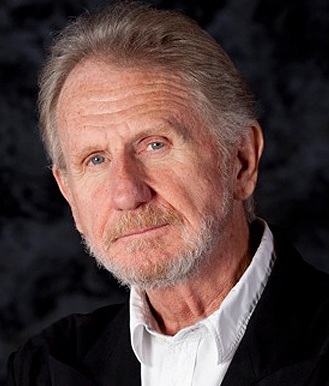
René Auberjonois

Since we played together as kids and delightedly attended Saturday afternoon movie matinees together and then mimicked the swagger and competence of the western heroes on the silver screen, it was a peculiar sensation to receive an Internet note from René Auberjonois.

Yesterday, René made a surprise contribution to the zendo roof fund here -- a job since completed, but whose costs still gnaw at my pocket. Out of nowhere, René made a contribution and offered words of condolence on the recent death of my mother, whom he knew. Perhaps he read about her in the New York Times.

On seeing his name, my mind skipped back over René's apparently-busy and successful acting career to a time almost seven decades ago. We were kids and it is strange to be reminded that there was a time when we were indeed kids. I didn't really remember much, but I did remember that René had wanted to be an actor at a time when I was still toying with the childish notion of being a cop or a fireman... in short, had no clue as to what I might want to be.

And here, yesterday, somehow the past fast-forwarded over all other intervening successes and failures and brought me back to a mysterious "then." I was happy for René and his Broadway/Hollywood/television curriculum vitae, but I was not entirely sure how the past -- the 'real' past we had spent together -- and present were linked or whether they even should be linked or could be linked and yet most assuredly were linked.

It was just a peculiar feeling: How did the 8- or 10-year-olds that we were ever turn out? Others might refer to jobs and families and travels ... but somehow that doesn't answer the very simple question, "how'ya doin'?" ... how's the 10-year-old I once knew? I wonder about René.

Hell, I wonder about me.

Wednesday, February 11, 2015

peeling a hard-boiled egg

Received in email ... something practical, though I haven't tried it yet:


Jon Stewart's departure

Ooooof!

Jon Stewart, who guides TV's ersatz-news on "The Daily Show," announced last night that for unspecified reasons in an unspecified future, he would be leaving the show.

Executives are scrambling to find a replacement, but a 'replacement' will never be found ... it's just more pablum group-think. Stewart, 52, was/is a one-off and what those executives need is another one-off, something outside the group-think, money-making box. It is outside their track-record capacities, as comedian Stephen Colbert has proved with his one-note, self-referential sketches.

The stories detailing Stewart's departure all refer to a younger generation's reliance since 1999 on his wry, skewering approach to current events. I am not one of the younger generation, but my reaction to his announcement was a sense of serious loss: Ooooof!

Stewart's essays and monologues took the news business to task for its slow slide into agitation and propaganda and entertainment -- the declawing of a news approach that has accepted "embedded reporters" and proved itself willing not to ask hard questions of those who threatened to cut reporters off from central political and business leaders.

The pussification of news is serious and Stewart pointed it out over and over again. He asked out loud the questions that reporters might once have asked internally ... isn't there a contradiction between what is said and what is done? This is a question an audience might likewise ask. Jon Stewart was their/my outlet... an encouragement to think. The laughter -- and there has been plenty of that -- cut a hole in the solemnity without detracting from the seriousness.

But I can imagine he would be tired and, like all who are good at what they do, painfully aware of the fact that he was beginning to sound a little too much like Jon Stewart. That, and the fact that the avalanche of pussification pressure is unremitting. Can one man hold back the night? Stewart took a swing at it and connected on a number of occasions, but never hard enough to revise the course of pussification and mediocrity of thought.

Stewart is bright, witty and personable. But there's no fitting ten pounds of shit in a five-pound bag. Funny juxtapositions are a wonderful way of drawing attention -- though not for the pussified who imagine Stewart was not goring their ox -- but then ... but then ... an awful lot of humorous things can become serious, as for example the U.S.-backed death tolls, the legislation that nurtures poverty, a legal system shoe-horned into a secret court (FISA and its expanded powers) and other depredations.

I suppose I should be happy at Stewart's coming instead of bemoaning his departure. But ... well, I bemoan anyway. A gaggle of yes-men does not strike me as representing "freedom of the press" or a nurtured nation.

Shit!

Tuesday, February 10, 2015

lying ... ain't it the truth?

Reading yet another knicker-twisted story about NBC news anchor Brian Williams and his misrepresentation of a war adventure in Iraq 12 years ago, I am irritated anew by words like "misspoke" and "misremembered." What irritates me most is that they detract from the juicy and useful world of "lying."

It's sort of like the oh-so-coy mealy-mouths who substitute the word "issue" for "problem" or hospitals which cannot seem to perform an "operation" when a "procedure" dovetails so much more nicely with insurance-company-speak.

If you listen to ethical or religious of philosophical talking heads, anyone might imagine that lying is considered a naughty or anti-social activity. And the volume of critical invective is turned up when institutions or individuals cloak themselves in trustworthiness and then get rightly accused:

"Liar! Liar! Pants on fire!"
It's heady stuff. Whether within or without, virtue oozes from the accuser's pores.

OK ... no one likes to be lied to or to be accused of lying.

But why?

At a serious level -- as opposed to a superficial, if fiery, one -- I think the answer lies in a single fallacious premise and that premise is imagining that anyone could tell the truth. The facts may demonstrate over and over again that "the whole truth and nothing but the truth" is dubious when it's not busy being ludicrous, but that doesn't seem to alter or revise the as-from-on-high premise.

Within and without ... same stuff, different day ... lying gets a bad rap... and "the truth will set you free." I know the truth and you know the truth, but we seem to butt heads when it comes to agreeing about the truth. And/or, the truth dwindles and morphs into some other, more truthful truth which puts the lie to the truth that preceded it.

It is the premise of 'truthiness' that could use a bit of examination. And with that examination, perhaps the twist in my knickers and yours could be loosened.

I guess I just don't like lying about lying.

Or something.

Monday, February 9, 2015

snow and cold

Snow and cold and stuck cars at our house:


"stolen valor"

NBC news anchor Brian Williams has gotten himself into hot water by claiming he was once in a helicopter hit by an RPG (rocket-propelling grenade) over Iraq. It happened 12 years ago and suddenly, with the testimony of those who were on the scene at the time, Williams' tale has excited words like "misremembered" and "lie" and a "betrayal of trust."

But, according to the blog post linked above,
The fiercest reaction to the Williams story, however, has come from online conservatives. Many conservative writers have accused Williams of "stolen valour" - a charge levelled at individuals who make false claims of war heroism in order to bask in the resulting adulation and privileges. They contend that the episode has permanently damaged Mr Williams credibility and should lead to his resignation.
"Stolen valor" -- now there's a phrase that makes me pause. You sort of know what it means because anyone who has worked in an office has seen the boss claim credit for what his workers have actually done. Or who hasn't heard some spiritual salesman quoting some late-great guru or text and, by implication, laying claim to a wisdom s/he only read about?

"Stolen valor" is disdained as shameful and mendacious in the very concrete instance of the battlefield.

And yet I cannot help but think of the politicians who wear American-flag lapel pins and praise "our hero troops" and thereby arrogate to themselves a heroism and patriotism that is woven out of whole cloth. Their public praise fairly oozes with a caring and zeal that no one calls out. When those doing the praising have not partaken of the fear and anger and love and wounds of the battlefield, how is their idle chatter not likewise "stolen valor?" When their children have managed to avoid taking up arms and perhaps suffered irreparable wounds within or without, how is this NOT "stolen valor?"

If Brian Williams' lies were the worst of "stolen valor," I think we'd all be in the pink.

Sunday, February 8, 2015

friends I have never met

I count as serious friends a number of people I have never met ... and I do not use the word "friend" lightly. This morning, a couple of them ambled across my mental park land, suggesting similarities that may or may not actually exist outside my mind. One is a lawyer. One is a Zen monk.

William Newman, the lawyer, ramrods the local branch of the American Civil Liberties Union and came to mind because he wrote a column that appeared yesterday in the local newspaper.

The topic was an inmate held at America's Guantanamo Bay prison in Cuba. Since Guantanamo stands at a pinnacle of what I think the United States does NOT embody and since the prison's applications are so profoundly and unconstitutionally shameless, naturally I gobbled up Bill's essay -- a bid to free one (and, by extension, others) of its prisoners. The man's name is Mohamedou Ould Slahi.

Some 6,800 miles to the west, Brian Victoria plies his trade as a Zen monk and educator in Japan. We are in contact now and then because Brian is a hell-raiser when it comes to the hypocrisies that invest and infect the religion -- if Zen will excuse that word -- he is and sometimes I am willing to tout. Notably, Brian wrote a book called "Zen at War" that detailed the complicit links between Zen Buddhism and the rapaciousness patriotism that imbued World War II and, by extension, Japan's invasion of and occupation in China. Since he wrote that book, he has been foolish enough to send me essays he was in the process of writing and later published here and there. I was a second pair of eyes.

This morning, it occurred to me that I am grateful to these men for doing the only thing that can be done when egregious unkindness is exercised -- point out the hypocrisy, aspect by researched aspect. Sweet and well-argued points may not stem the tide, but it suggests that without a factual basis, the issues involved devolve into a mindless shouting match in which sincerity replaces credibility: eg. I hate war, therefore war is hateful.

But I have to plead guilty to shouting and sincerity. It sets my hair on fire to think that anyone should be forced to
bleed or go hungry or die based on the blase policies of some greater, governmental entity. I get infuriated, but being infuriated and a couple of bucks will get you a bus ride. Still, in my mind there is a line-'em-up-and-shoot-'em Tasmanian devil which whirls insanely and at top volume. It stamps its foot. It weeps.

But when has weeping ever changed much?

Truth to tell, the fury I feel is directed at my two never-met friends as well. "Cut the well-reasoned crap. Just shoot 'em!" my mind insists. I am too old and tired to be dragged through the well-reasoned and viscous particulars. I want it my way and I want it now. The pain and suffering being inflicted deserves no less!

Like the Vatican's complicity in priest sexual abuse, Guantanamo and the almost universal religious support for a killing field religion may claim to abhor deserves consideration in more modulated and more fact-based tones. What else is there?

And yet, when all is said and done, facts do not persuade people and hence effect little, if any, change. Sweet reason is like Chinese water torture ... drip, drip, drip until the pain is unbearable. Facts don't persuade people ... beliefs, in all their glory and all their horror, do.

I admire my unknown friends for their patience and persistence. Amassing evidence may or may not prove the case, but since it is about all anyone can do, perhaps there is some hopefulness in creating a critical mass of revulsion.

My unknown friends have the patience and persistence I wish I had.

They may or may not win the case, but at least they are not losers.

Saturday, February 7, 2015

for my birthday .... please, please, puleeeeze!

Passed along in email ... a T-shirt I want for my birthday next month:


oh shit!


China's authorities have seized 7,600 toilet rolls and 20,000 packets of tissue printed with the image of Hong Kong chief executive CY Leung.
Hong Kong's Democratic Party, which had planned to sell the novelty items at a fair next week, called the seizure a violation of freedom of expression.
The tissues were confiscated from a factory in mainland China on Friday

Smokey the Bear journalism


Unlikely thieves?

Before Edward Snowden, there was the Citizens’ Commission to Investigate the FBI. In 1971, eight anti-war activists broke into the FBI office in Media, Pennsylvania. Among them were John and Bonnie Raines frequent anti-war protesters and the parents of three kids.
Yesterday, on the car radio, I listened to part of an interview with a couple who were part of the eight-person team who planned meticulously and then executed the theft of FBI documents. Here's the entire interview.

There was something uplifting about the thoughtful, moral positions they took. In hindsight, their efforts are burnished and patriotic in the best sense of the word. But at no time during the part of the interview I heard did either husband or wife play the righteousness card. What they did was what they did. They took responsibility then (making arrangements to have someone take the kids if they got caught, eg.) and they take responsibility now. And there was something upright and thoughtful in their delivery. Sure, they were activists, but that was their responsibility. If they want my applause, I will certainly give it, but I have a hunch they are not on the applause-o-meter circuit.

One small snippet of the interview hangs in my mind like a case of bad breath. After the theft, they offered the stolen documents to three newspapers -- the Washington Post, the Los Angeles Times and the New York Times. Each newspaper faced a quandary: What do you do with stolen documents even when they are clearly real? I can't remember, but I think the 1971 break-in, theft and subsequent offering to news outlets may have been the first.

Only the Washington Post decided to run with the ball -- and that against the advice of counsel. The other two, either by their own judgment or by a judgment based on the government's phone calls hollering "stop the presses," did not... until after the Washington Post took the plunge.

And as I listened to the radio, it occurred to me, not for the first time, that the New York Times with all of its thoroughness and care and accolades, really was a practitioner of Smokey The Bear journalism ... informative, perhaps, but unwilling to protect a nation it claimed to serve. I have seen its sonorous cadences in other instances (relegating questioners of Israel's activities to lesser roles in the hierarchy of news stories on tap, eg.) and can't help being irritated by the righteousness passed off as objectivity. On balance, the newspaper may do more good than harm ... but the parental, quasi-cuddling stop-forest-fires approach sticks in my craw.

Smokey knows best.

"expert opinion"

I suppose there are greater oxymorons, but one that danced into my mind this morning was "expert opinion." The importance of the contradictory nature does not lie in the parsing and dissecting and explaining of the two words. It lies in the laziness of the one who may use them in conjunction and then rests on their implications.

Mark Twain defined and expert as "an ordinary fellow from another town" and Will Rogers seems to have been on approximately the same frequency when he defined an expert as "a man fifty miles from home with a briefcase."

And of "opinion," Twain wrote: "Mind is plainly an ass, but it will be many ages before it finds it out, no doubt. Why do we respect the opinions of any man or any microbe that ever lived? I swear [I] don't know. Why do I respect my own? Well -- that is different."

Buddha was an expert. Jesus was an expert. Einstein was an expert. News organizations feel they have done their readers a good turn when citing the expertise of others. And perhaps Twain and Rogers are experts. The realms of "expert opinion" are endless.

Check it out. Read your own laundry list of those who live fifty miles from home, whose expertise is damn near flawless, and, more important, less assailable than your own. If an expert says what I say or I agree with what an expert says, my own expertise may rise in the eyes of others but also -- and this is the sticky wicket part -- in my own.

I sort of dislike bringing the topic up because I think that the moment "expert opinion" is brought into question, there is a subtle or gross defensive effort to escape the lash. The mind fidgets and fusses and runs hither and yon in an attempt to justify and explain and reshape my reliance on figures or positions I consider reliable ... most of them fifty miles or more from home. It feels like an attack, whereas I prefer to think of it as a reminder.

And what it reminds me of is my own damned laziness. Obviously I can't know everything and can't investigate everything and can't be an expert about everything, so why should I NOT rely on the actions and words of the man or woman fifty miles from home? If I didn't have my opinions, how could I know who I was?

The trouble arises when the question is put somewhat differently: If I did -- as I do -- have my opinions, how could I know who I am? Or, as Twain put it, "Loyalty to a petrified opinion never yet broke a chain or freed a human soul." Part of the devoted fidgeting and fussing that goes on in the mind when it comes to "expert opinion" lies exactly here -- in proving somehow that my opinions are not petrified: Look ma! I'm a loosey-goosey free-thinker willing to list to and digest and revise all my opinions, even the expert ones. So compassionate, dontcha know!


But is this true or is it simply an extension of my comfort-zone laziness? That's just a question, not an accusation or some tch-tch, über-moralistic critique.

Among the Internet dictionary definitions of "opinion" was one I thought was pretty good and pretty nervy: "belief stronger than impression and less strong than positive knowledge." For some, I think, there comes a time when positive knowledge (based, I assume, on experience) becomes more insistently desirable as a mode of living and being. 

Put less delicately, I get sick of my bullshit, expert and otherwise. And I am willing to do the work and sweat the sweat and suffer the lash of loneliness that comes calling when honest investigation kicks in? Hey man, take it easy -- I've got kids to raise, dishes to wash and a job to hold down!

The object of all this written re-chewed cud is not to suggest that "opinion," expert or otherwise, is off the charts -- stupid as well as foolish. My view is that everyone has his or her opinions. Like sex, everybody has one and there's nothing wrong or even particularly idiotic about it. Getting rid of opinions by means of some gushing and idealistic effort is a ludicrous waste of time. And that goes double for taking the counsel of those who may currently qualify as holding "expert opinions." Relativism, like absolutism, is a lazy man's game.

But to my way of thinking, it makes some sense to loosen the reins on expertise and opinion. Both may be par for the human course, but that doesn't mean I will be well-served by relaxing and lolling in their precincts. The trick, I think, lies in taking responsibility: I am responsible. Buddha, Jesus and Einstein may offer good pointers -- pointers worth attending to from where I sit. But if I am unwilling to investigate the taste of their tea, how can I possibly lay claim to knowing what tea actually tastes like? How can I be happy?

Yes, some people strike me as being pretty smart, pretty well-versed, pretty deserving of the laurels I see fit to dole out. Mark Twain and Will Rogers are two of them. I cannot disdain a wisdom that may seem greater than my own.

But to rest, like some news reporter, on the words of an "expert" strikes me as going too far. I'll do what I can to take responsibility for the wisdom I attribute to those who live fifty miles from home.

And that's my expert opinion.

Friday, February 6, 2015

snorting chocolate

Passed along in email:


BRUGES, Belgium (Reuters) - When Belgian chocolatier Dominique Persoone created a chocolate-sniffing device for a Rolling Stones party in 2007, he never imagined demand would stretch much beyond the rock 'n' roll scene. But, seven years later, he has sold 25,000 of them.
Inspired by a device his grandfather used to propel tobacco snuff up his nose, Persoone created a 'Chocolate Shooter' to deliver a hit of Dominican Republic or Peruvian cocoa powder, mixed with mint and either ginger or raspberry.

a "not dead" mummy


A mummified monk found preserved in Mongolia last week has been baffling and astounding those who uncovered him.
Senior Buddhists say the monk, found sitting in the lotus position, is in a deep meditative trance and not dead.

too scared to relax

As a newspaper reporter in a time when people read newspapers, there would be days on which I would be responsible for some locally-big, page-one news story. The story would be "breaking," meaning that aspects and results would be continuing even as the reporter wrote the story and met the deadline that cut off additional information: The paper needed to be wrapped up and shipped off to customers.

The nearer the deadline, the greater the stress. Sometimes calculations came down to minutes: Gather as much information as possible, return to the office and write the story with the city editor (the person charged with overseeing the resulting article) breathing down your neck.

Over time, I learned a little of how to handle the three-minute, page-one story: Gather the information at the accident scene or fire or political bombshell; return to the office; check the clock and then, with under five minutes to go before deadline, GET A CUP OF COFFEE and only then sit down and start typing furiously.

A typewriter was a hand-operated machine that preceded the alleged efficiency of the computer. In the newsroom, its use was almost invariably accompanied by a cup of coffee or surreptitious scotch, cigarette and cigar smoke in the air, and some loud and choice cussing. Writing a breaking story was pedal-to-the-metal work -- a furious dash to any breaking-news finish.

The story never was perfect and yet reporters often strove for perfection -- a complete and balanced and coherent story -- over and over again. Some were better than others. Whatever the success, it always implied failure: Human stories are never complete and words cannot ever truly convey them.

But within those parameters, diversion was crucial to the quality and coherence of the story ... a rest period in which the mental muscles relaxed. Three minutes to deadline? Take at least one for a cup of really bad office coffee.

Rest and relaxation may be anathema to work/money-addicted employers intent on squeezing every last drop of 'productivity' out of employees, but where they cannot factor in the literal financial benefits of relaxation, I think they are falling down on their job.

Now, it seems, Japan, a nation full of workaholics, is considering making a law that would compel employers to make sure their workers take vacation days and otherwise unwind.
Legislation that will be submitted during the parliamentary session that began Jan. 26 aims to ensure workers get the rest they need. In a break with past practice, it will become the legal responsibility of employers to ensure workers take their holidays....
Part of the problem has been that many people fear resentment from co-workers if they take days off, a real concern in a conformist culture that values harmony....
About 22 percent of Japanese work more than 49 hours a week, compared with 16 percent of Americans, 11 percent of the French and Germans, according to data compiled by the Japanese government. South Koreans seem even more workaholic, at 35 percent.
"Productivity" ... and the law of diminishing returns. On the one hand everyone would like to sell more widgets and is therefore keen to have workers work harder. On the other hand, if the work load gets to big -- as for example by not clearly defining the responsibilities of individual workers -- then corners will need to be cut and mediocrity will gain a foothold. Customers will only put up with so much mediocrity before they go elsewhere. And once they're gone, it is hard to win them back ... i.e. 'maximize profits.'

In Zen Buddhism, there is a saying: "A day without work is a day without eating." At a mundane level, this is a stab at the heart of social conscience, a quid pro quo of individual and social existence. Eating, obviously, is crucial to life. But without examining what it is that constitutes "work," how could anyone be other than a candidate for the ulcer farm putting out a mediocre product? How could anyone adequately know what work is if s/he didn't likewise know what relaxation was? Isn't this a package deal -- the one tending on the other? Could the richness of spiritual life be much more than a mediocre bluff if there were no ability to live comfortably in a world that ignored what passes for spiritual endeavor?

Sure, there are listless, lazy fuck-offs in any endeavor, but I'm not sure which is more debilitating to success -- the laziness that seeks to skirt the effort required for honest reward or the lock-step fire and brimstone of 'productivity.'

Thursday, February 5, 2015

lying: ain't it the truth?

Lying is an activity usually reserved either to keep something hidden or to attain a goal the liar is unwilling to straightforward about.

Religions and other well-coiffed social efforts tend to disdain and discourage lying, but when push comes to shove, I wonder if the truth, whatever it may be, could be revealed even in the best of circumstances. Anyone can lie, but can anyone actually tell the truth? I don't know.

One of America's most famous news anchors has apologised after a story he repeatedly told about coming under fire in Iraq was revealed to be untrue. 
NBC's Brian Williams said he was on a helicopter forced down in 2003, but veterans have now disputed his account.
Williams may be squirming after entering the news spotlight he is accustomed to shining on others, but his 'betrayal' of public trust hardly strikes me as unusual or even especially reprehensible in the world of agitation-and-propaganda he inhabits. He, like any CEO or individual, might wish to be believed and accredited, but which is more sensible? -- believing or disbelieving? Am I wrong or is trustworthiness/ethics these days based more on a majority sentiment and less on any verifiable fact?

Is truth as touted merely a matter of public accolade? If my ethics are bounded by a cheering public sentiment, does that make me moral? Is it lying or not to use words like "misspoke" when referring to lies? Is sincerity an excuse worth heeding? And if, by chance, a liar were to reverse course and lay his cards on the table, would that then imply he was telling the truth?

Don't get me wrong -- I do not intend to promote some slick, self-serving cynicism that doubts and tears down at every turn. I am not a Republican. But I am interested both in the willingness to tell lies (as I have) and the inability to stop doing so. Relativism is a cheap date.

As a delicately genteel nudge from the past once had it:

I love myself
I think I'm grand.
I go to the movies
And hold my hand.
I put my arm
Around my waist.
And when I'm fresh,
I slap my face.
I say so unabashedly: I prefer the truth. I do not like liars. I say these things without much investigation: Let's face it -- it sounds good and I like the warm nods and accolades that saying so may elicit. I freely admit that lies are some of the best implements when it comes to winkling out the truth. But into that stew, if it's to be worth a shit, I feel compelled at add the spiciness of, "OK try to tell the truth without lying. Go ahead! I D-double-dare you!"

Naturally, I can bring a hundred excuses to bear when it comes to lying: Everybody's doing it, so it must be OK; it's for the greater good; I forgot; it's a kindness; the dog ate my homework; I am sincere; I want to be a good person; I screwed the pooch even if I cannot know who or what the pooch is ... etc. etc. etc.

I guess Mark Twain had it about right when he said, "There are lies, damned lies and statistics." It's such a rich and nourishing field that I can hardly imagine anyone's putting the plough back in the barn.

Wednesday, February 4, 2015

Taiwan plane crash

A plane carrying mostly Chinese tourists has crashed into ariver in Taiwan, killing at least 19 people.
Dramatic video footage emerged showing the TransAsia Airways plane clipping a bridge as it came down shortly after take-off from a Taipei airport.
The plane, carrying 58 people, has broken up and the fuselage is lying half-submerged in the Keelung River. Rescue efforts are ongoing.


Tuesday, February 3, 2015

scientific "dunno"

Like scientific mysteries? Then check out the Oxford Electric Bell, a battery-powered device that's still ringing 175 years after it was made, the Smithsonian reports. Sitting in the Clarendon Laboratory at Oxford University, it makes a little metal ball move swiftly back and forth between two bells.

the authority game

This morning, in email, I was greeted by Albert Einstein and his observation,
To punish me for my contempt for authority, fate made me an authority myself.
The observation was appended to a blog post and served as a jumping-off point for rumination... a good hook that lodged itself with me as well.

How I have disliked authority and its often-twisted and manipulative wiles. No doubt others have too ... battling the uphill battle that culminates, sometimes with terrifying simplicity, in the fact that you are the boss and as such are responsible. After what may be a lifetime of carping, suddenly the dime drops and, yes, there is no other authority.

It really does take some getting used to, but facts, in the end, are easier than fictions.

Republican inability

Watching the TV news last night, there were the interviews that targeted the national budget proposal President Barack Obama has sent to the Congress for consideration. It's unthinkably enormous.

But once again -- as it seems too frequently in the past -- I waited in vain for a substantive Republican rebuttal to the Democrat initiative.

The Republican talking heads, as before, were willing to attack Obama's vision, but at no point did I hear even one of them saying, "I don't like Obama's approach. Here is a better one."

How can you believe someone whose point of view takes no risks, not to mention ignores the nation it has sworn to represent and nourish? The approach is so obviously self-serving and callow and shameless ... however popular. OK, you're kool at tearing down; now ... what can you substantively build?

three-person babies


MPs [members of parliament] will hold a crucial vote later [today] to decide whether to allow the creation of babies using DNA from three people.
They will have a free vote on the technique, which is aimed at preventing deadly genetic diseases being passed from mother to child.
The UK could become the first country to legalise three-person babies and it could help about 150 couples a year.It has sparked fierce ethical debate and senior Church figures have called for the procedure to be blocked.

outhouse wisdom/deep meaning?

Woke and rose at 3:30, before I had had a chance to consult the clock. By the time I did see it, I was already into a getting-dressed-getting-coffee mode and some ironic voice took refuge in Ben Franklin's 18th century, "early to bed and early to rise makes a man healthy, wealthy and wise."

Bill McKechnie, an longtime friend now dead, once revised this Poor Richard's Almanack touchstone to read, "early to bed and early to rise and you never see any of your friends." McKechnie's wit lay not just in the wry laziness that countered Franklin's Calvinistic hard work and uprightness, but also in the fucked-up rhythm. It made me smile at 3:30: How many of my friends were up and running at 3:30, an hour when the hard-working are often asleep? Well, at least McKechnie is getting his zzzzz's and I am anything but a hard-worker.

Almanacs in the 18th century were apparently as popular as they are today, being then as now a compendium that offered "a mixture of seasonal weather forecasts, practical household hints, puzzles, and other amusements," according to Wikipedia.

Outhouse pastimes, in short, but also a summing up of vast and desirable philosophies.

Hard work is generally the measure of anything worthwhile, but the notion that good results could be attained without a good sweat persists in the mind and deserves correction. A nutshell is often useful and easier than investigating the philosophy it represents.

It's interesting who picks up what nutshells around in a mental filing box. These silver-tongued bon mots are not exactly serious but neither are they entirely silly. They are not exactly important, but neither are they unimportant. For example, I grew up remembering Ben Franklin and also liking Beatles member John Lennon's "life is what happens while you are making other plans."

Like others, I imagine, sometimes I am willing to investigate the wit and wisdom that comes off my own lazy-bones tongue. But sometimes I just make an utterance as a dismissal -- a walking stick I can lean on in place of actual work: Here is something true, so there's no point in breaking a sweat. "Love they neighbor as thyself" is nifty enough so that, well, I can go back to bed and let others eat my virtuous dust.

I wonder what touchstones others are sewing or have sewn into their tapestries these days. It wouldn't surprise me to think that someone didn't know who the hell Ben Franklin was, let alone his almanac. Still the tendency to distill and rely on and sometimes investigate nutshells is hardly dead, I imagine.

So what are the touchstones of today? I grew up with mine; what are my children growing up with? What small nutshells litter their forest floor? Under what banners do they alternatively lounge and investigate, rely on and implement?

Maybe because it's early and I am vaguely surly, all I can think of is
It ain't what you've got; it's what you git.

Monday, February 2, 2015

"Kim"

Rudyard Kipling (1865-1936)
Ask the Great God Google for "Kim" and there are endless citations for Kim Kardashian, a self-promoting cultural icon of some sort here in the U.S. She seems to have made a lot of money and there is a strong current of measuring-by-money in today's often-cash-strapped times. It's tiresome and mediocre, but it's also real, so I guess, as with other gods, Google needs to be forgiven.

But I was after the novel, "Kim," by Rudyard Kipling, a turn-of-the-20th-century Nobel prize winner, after pulling the book off the shelf for a re-read. I needed Wikipedia or some other condenser of information to tell me the tale that I find magnetically-difficult to discern as I read the story itself. Surely my mother had read me this story when I was little, and I know I read it myself at one time or another ... and how the hell had I managed that: The uses of language often seem little more than a viscous gibberish... one that audiences had gobbled and digested with gusto when the book first appeared as a series of magazine articles in 1901. No shit -- it's like reading a foreign language masquerading as English.

"Kim" is the story of a teenaged white youth, burned brown by the sun, who wanders the streets of Lahore with his equally-impoverished friends. He becomes the disciple of a Tibetan lama and, more interestingly, becomes a spy in the tangential employ of the British who ruled India at the time.

But the style of writing at the time was not what it is today and that, for some reason, keeps me turning the pages. What mind -- let alone, what popular mind -- allowed magazine readers to gobble this up, to be thrilled and intrigued and most of all understanding what the hell the author was talking about?

In the entrance-hall stood the larger figures of the Greco-Buddhist sculptures done, savants know how long since, by forgotten workmen whose hands were feeling, and not unskilfully, for the mysteriously transmitted Grecian touch.
Nor is the quote above the most ornate-to-impenetrable in my mind. One thing's for sure -- it ain't Facebook with its reliably unreliable premises couched in up-to-date jargon. But in what way did magazine readers of that day leap into this tale of a pint-sized spy in the mysterious East? Kipling's writing won a Nobel prize, so presumably he was speaking the lingua franca of English.

There is something enticing about wading through this book. It's as if, on top of the story itself, there is some keyhole into the minds of those who might be my forebears. The impatience I might otherwise feel when someone can't seem to "get to the point" is on hold for the moment. But I am inclined to say that the book is not for the faint of heart, however rousing the story.

super moments in the Super Bowl

With almost no time remaining in the Super Bowl yesterday, first there was a spectacular reception by the Seattle Seahawks and then, unbelievably, there was a game-winning interception by the New England Patriots. The final score was 28-24.

It's nice to watch a much-touted game and have it turn out to be a pretty good game. Too often what is advertised as the "best" or the "biggest" or the "first-est with the most-est" turns out to be eyewash and hype that cannot compare with less-touted efforts ... it's frequent enough to make anyone steer clear of the alleged winners.

When I was a reporter, it didn't take long to figure out that if you wanted to know what the governor was doing, you never tried to talk to the governor ... always talk to someone further from the spotlight who was actually doing the work. Or, in the military, don't ask the general, ask the sergeant. Or in religion, don't consult the pope.

It was a good Super Bowl despite the feeding-frenzy hype.

making stuff up

Diaphanous....

As fiercely feminine as a long-tailed cat, inching nearer, belly to the earth....

Smooth and assured as the cue ball rolling across green felt....

Scudding off the rooftops like some fractured whipped cream....

I watch this morning's snowstorm and rush to light the narrative fuses, one by one, as if the storm were not enough, as if there were dots to connect and I were the just the self-involved magician to connect them.

I chalk it up to story-telling karma, another sounds-good bit of explanation, as if explanation could explain a snowstorm or a life. I do love stories and hence am more or less content to tell the lies that come to hand.

It's just a snowstorm of course, but still I need fix it, to plump it up like some pillow that could be made 'more' comfortable. True, stories interest me more than TV,  but sometimes it strikes me as a strange imperative ... so second-hand and yet not second-hand at all.

"Everything touches everything else" ... don't be fatuous! Wisdom is for nitwits.

I am a nitwit. Making stuff up is what I do. Is that really such a big deal?


The Hindus have the tale of a tinker who comes to town with a vat slung over his shoulder. He sets the vat in the middle of the town square and invites villagers to bring their new-woven cloth and he will dye it for them. The villagers line up.

The first villager says he would like his cloth "blue." The tinker lowers the cloth into the vat and out it comes, "blue." The next woman longs for "red." Into the the same vat the produced "blue" goes her bolt ... and out it comes, "red." And so it goes, down the line of villagers -- each expressing a preference and each having the preference met out of the same vat.

Finally, there is only one man left. He steps forward and says to the tinker, "I would like my cloth to be the color of what is in the vat."

I always loved the Hindu tableau. It seemed to have lived long enough to know that a furrowed brow and fierce determination could not really hold a candle to the stories that came with a smile of recognition, a bit of laughter, and an unfreighted message. Accessible. Hinduism seemed old enough to ply its trade without the laurels. It seemed to have lived long enough to be a grown-up: Just because there is no story is no reason not to tell a story.

Or anyway, that's the color of my cloth.

Sunday, February 1, 2015

politically-correct sharia


In basic training, the army private who took my particulars in order to create my dog tags was horrified to note that I had written "N/A" (not applicable) in the space reserved for "religious preference." We were in the South and the private, judging by his accent, was a product of that South in all its sometimes-ferocious religiosity.


"C'mon man!" he said to me in utter disbelief and with a sincerely-wounded look on his face, "you gotta be something." And because the pain on his face seemed unfeigned, I replied, "OK. Put down 'Unitarian.'"

The pain on his face was replaced by suspicion. "What's that?" he asked in a tone suggesting I was not going to put one over on him and profess a sneaky devil worship. I thought a minute, looked again at his young and earnest face and figured there was no point in making his life any more difficult than it already was. "It's a kind of protestant," I said, fudging things a bit, but wiping the pained suspicion from his face.

"OK," he said. "How do you spell it?"

And so it was that the two tags that hung around my neck as they did for every soldier read "UNITARIAN." At the time, it was as far removed from religion as I could think of while still toeing the religious mark.

And because basic training was full of training exercises and mental conditioning, my religious preference damn near got me out of going to the mandatory religious meeting that was part of basic training -- one for Catholics, one for Jews and one for Protestants. When my squad leader asked me why I hadn't lined up for one of the segments, I told him I was a "Unitarian," hoping he wouldn't know what it was and would be too embarrassed to ask and so I might avoid another droning meeting where little or nothing would be learned. My squad leader was not quite that stupid. Close, but no cigar. "What's that?" he asked. And I was forced to say something, after which he sent me off with the Protestants to listen to a spiritual pep talk.

And I survived.

More than that, although I didn't know it at the time, I learned something about the culture in which I lived. I wasn't a raucous atheist or anything. I just didn't care much for religion and wasn't above the occasional snarky riff. But I was educated: Learning about what didn't/doesn't interest me is worth learning. Religion in the military is a terrific bit of contradiction and hypocrisy, but it's human and understandable and, more important, it's enormously popular. Anyone with two brain cells to rub together knows that when in the midst of a popular belief, it is wise to investigate before contradicting.

I survived the military's nod to spirituality as I had survived morning and mealtime prayers in a high school founded by a religious organization. Likewise I survived Bible class and am grateful I was forced to take it. No one pissed and moaned about "church and state" -- Bible class was just part of the curriculum. Those who believed something else were not excluded ... in a culture that is Christian-based in its majority, they were simply being educated to their surroundings. Education is more important than belief ... even very politically-correct belief.

This morning, a friend sent along a blog critique entitled, "Not a very PC thing to say: How the language police are perverting liberalism". The target of the essay is a Mississippi school district that has refused to honor court rulings on the inclusion of "God" et al in its curriculum. The court said don't do it; the school district said up-yours. Atheists, humanists and those with minority sexual preferences take umbrage at their exclusion within what might be thought of as a kind of Christian sharia. Its cruelty can be a no-kidding-around matter.

But it also occurs to me that if everyone is acknowledged and everyone is 'included,' the real-time impact of a particular point of view is often reduced to pablum. If human beings could actually be corralled and defined within an ethical barbed wire, how true would that be? It might be kinder and less cruel, but how true? 

Isn't a part of America's current disenchantment with politics the recognition that bamboozling the electorate with no clearly-stated position is hardly the truth? Being all things to all (wo)men really won't wash... in politics, religion or personal relationships. And if that is true, then perhaps it would be better to investigate the leaning that actually exists and ....

Survive on a more realistic, better informed and less politically-correct footing. Until there is some honest understanding of why your personal-favorite idiots might think what they do, won't we all remain idiots?


Oh well ... I'm not entirely sure what this ramble is in aid of.