Friday, January 16, 2015

"good taste"


Inch by grudging inch, I get the sense that "good taste" is losing its grip.

"Good taste" is what those wishing to escape some "bad taste" pat each other on the back for.

But the truth is that "good taste" stuff has its appeal. Good taste in art. Good taste in literature. Good taste in clothes. Good taste in companions. Good taste in cars. Not everyone wants a tattoo of a heart pierced by a dagger and dripping blood over the assertion: "I love Mom."

Good taste can be beautiful and it is not something someone with "impeccable taste" would want to be without. It's one of those Boy Scout badges that tends to lack attention ... right up until someone or something tries to take away that badge.

Good taste means something, but what it means is hard to come by ... which doesn't mean it doesn't mean anything and could be dismissed out of hand. The popularity of "Downton Abbey"  or the unending documentaries about the queen of England and her consorts underscores the argument.

Depending on the day of the week, good taste may merely mean civility or knowing the differences among various wines.

But the Internet has been relentless and today, a news story announces that a writer for the Boston Globe's Internet arm had been sacked after he mocked the story of an FBI arrest of a bartender who remarked that he might poison Republican congressman John Boehner. Boehner is apparently a man who likes his booze, but it's really not journalistically de rigeur to mention it.

Associate Editor Victor Paul-Alvarez allegedly did so in a "news story" (I can't find the entire original article) and was promptly sacked. Among the assertions of the original article was this:
Had he been poisoned as planned, perhaps his pickled liver could have filtered out the toxins.
Boston.com issued a treacly mea culpa using words like "transparency" to distance itself from the bad taste/unprofessional gaff. It was hard not to imagine that a hoped-for good-taste/high-standards reputation was under threat.
Rather than remove any reference to [the article] or pretend it didn’t happen, we are handling with transparency and self-awareness.
News organizations, like people, would like to be believed, to be credible and to be principled. There are unwritten rules that often boil down to, "I won't mention you're fat if you won't mention I'm ugly."

The Internet has dug deep holes in the civility and aggrandizement of "good taste." It may mean less than it once did, but to suggest that it is lacking brings yowls of protestation.

The problem seems to rest on the fact that those asserting their trustworthiness and good taste are unwilling or unable to do the work that would prove the assertion. Instead, the instantaneousness of the Internet leaves those who would like to be liked gasping like fish on a dock. The best they can muster is the assertion that "I tell the truth because I say so."

How tasteful is that?

Thursday, January 15, 2015

the Zen monastery, the Catholic nunnery


Received in email this morning two depictions of monastic manipulation and misfortune -- one at the Zen monastery, Dai Bosatsu, where the exploiter Eido Shimano once held sway, and the other a review of a book called "The Nuns of Sant' Ambrogio." The latter tells the 19th century tale of cloistered Catholic nuns and the sexual and power antics of one of them... and makes me think it might make a good TV series, a kind of darker, religiously-angled version of "Downton Abbey."

How similar the potential for cloistered corruption! Though not the same, 19th and 20th century are really not that different: Institutions whose claims to purity are forever shadowed by the potential and actualization of corruption.  Maybe the rule of thumb should be, "Everyone screws everyone else. The trick is to learn to enjoy it."

How do you warn anyone about this fault line in the world of holiness? You can't ... such is the implacable desire for purity and peace.

Wednesday, January 14, 2015

"The Pledge of Allegiance"

The Pledge of Allegiance was at first accompanied by an arm salute. After the Nazis swept to power, the similarity in Nazi and American salutes led to a protocol in which the right hand was placed over the heart during recitations.
In the brick-thick cold, across the rutted and icy street, stands the street lamp that has been there ever since I moved in. Its blue-ish cast seemed to add to the cold this morning. Blue, like grey, is such a cold color.

But beyond the street lamp was the moon -- a something-short-short-of-a-half-moon crescent resting in the heavens without effort or purpose.

It made me think how human it is to create a useful or inspiring philosophy and then, as part of the package, inject an aspect that shoots that philosophy in the foot. Religion, for example, may look to codify and enshrine some deeper understanding, but the more it is shaped and coddled, the further it retreats from what it claims to proclaim.

Here in the United States, there is something called "The Pledge of Allegiance." Its assertions are sometimes repeated by school children and politicians and others desiring to express their fealty and love. It's pretty simple:
I pledge allegiance to the Flag of the United States of America, and to the Republic for which it stands, one Nation under God, indivisible, with liberty and justice for all.
The phrase "under God" was added in 1954, during a Cold War with 'godless' communists like Russia. The pledge has been tweaked in the time since it was invented in 1892 and "under God" constituted the last of the tweaks.

A number of objections have been raised over time, but the pledge retains its "under God" proviso in much the same way the dollar bill does with its "in God we trust."

What interests me is not the legal or moral or personal objections to this phrasing, but rather the fact that in the midst of asserting a unity of purpose, a proviso is added that does nothing so much as to assert divisions in what is said to be "indivisible."

Indivisibility strikes me as being like the moon ... wonderful and unassailable and un-improvable and ineffable: It's simply true and no addition will make it somehow true-r. The willingness to tack yet another tail on the donkey that has a perfectly good tail is ... what?... silly or self-defeating or deflating or suicidal, perhaps?

Someone proclaims a unity and in that proclamation insists on a division between, in this case, "God" and "man."

The tendency to correct the uncorrectable, to improve the unimprovable, to inject friction where none exists ... what a strangely human thing to do. It's like the old expression, "He's so dumb, he'd fuck up a wet dream."

Growing up, I recited the Pledge of Allegiance in accordance with school policy. I can remember thinking how somehow lumpy it seemed to tack on "under God." It just felt off-kilter, irrespective of religious persuasion.

And the same is increasingly true of the moon and spiritual endeavors. Knowledge, like a street lamp, casts a wonderful light. But it just ain't the moon.

Monday, January 12, 2015

cleric forbids building of snowmen

A prominent Saudi Arabian cleric has whipped up controversy by issuing a religious ruling forbidding the building of snowmen, describing them as anti-Islamic.... "May God preserve the scholars, for they enjoy sharp vision and recognise matters that even Satan does not think about."

Helen Eustis, my mother, dies at 98


A day after being admitted to the hospice care unit of Beth Israel Hospital in New York on Saturday, my mother, Helen White Eustis, 98, died at 8:22 p.m. yesterday (Jan. 11, 2015). She was transferred from her Manhattan apartment to hospital as a means of assuring that she could receive morphine as needed for pain. Previously, she had said she wanted to die at home, but the issue of pain was too pressing, and besides, she was largely unresponsive to her environment -- meaning she did not really recognize those around her.

There was little to call surprising about her death. It was time and she died and, as my Zen teacher's teacher used to say, she "joined the majority."

Others are wracked and riven and saddened by the death of a mother, but I am not yet sure exactly what I feel. A piece of my whole cloth has been revised and perhaps the emotional shift will hit me harder as time passes.

Some voice within would like me to be more upset, but that's not what is on the menu at the moment. I do find myself trying to define her life, obituary-fashion, and yet am reluctant to do so, partly because my knowledge is spotty and partly because there is something untrue about the 1-2-3 recitations that slip off tongue or pen when someone dies.

I would like to think of her as whole and contradictory, just like any other human being. No doubt that will fade and there will be a pigeon hole in which to remember and laugh and be amazed and grieve.

At the moment, I remember her anti-intellectual intellectualism -- a courageous and sometimes searing capacity that led her to decline an invitation to join Mensa, a coalition of very bright people whose brightness gave meaning to their organization. Likewise she dropped out of a graduate attempt to get a Ph.D. in English after she realized that the love she felt for tale-telling was being segmented and bagged and ... well, it was sort of like trying to explain laughter and she was a person who preferred to laugh.

She was born Dec. 31, 1916. Her mother died in the flu epidemic of 1918 and her father, who had joined World War I by enlisting in Canada because the United States had not yet made up its mind, later committed suicide: The strangulation of the white, well-to-do WASP-dom surrounding him in Cincinnati, where my mother was born, was too damned much ... or anyway, that's what I suspect.

All that Downton Abbey politesse and 'breeding' (American style) killed him and led my mother to run away from home by going to Smith College, a de rigeur and approved institution that, thank God, was far from her well-heeled and diffident surroundings and seemed to be an escape from the sere constrictions of the comme-il-faut.

Marrying my father, one of her English professors, was yet another step away from Cincinnati. I was their only child. My mother married and divorced twice -- once to my father, Alfred Young Fisher, who worked in a scholar's world that drove my mother nuts, and once to Martin Harris, a more loose-limbed fellow who helped photograph World War II and had, if I had to guess, admiration for intellect without pecking and clawing to enter its groves and the pretensions that scented them. She joined the Communist Party when it was fashionable, but found soon enough that its strictures were another narrow enclosure.

And after college, she wrote. "The Horizontal Man" won an Edgar for a distinguished bit of mystery writing. Later she would write "The Fool Killer" and "Mr. Death and the Red-Headed Woman" and a book of short works entitled "The Captains and the Kings Depart." She wrote for the then up-scale magazine The New Yorker and once declined to allow publication of a story in which she had used a word like "scrunch" ... the New Yorker said it was not a word and she said she didn't give a shit -- it was her word. She wrote articles for all sorts of magazines, giving it up only when it went out of fashion to offer a well-argued thesis (called thinking) ... later, as now, an argument could not be cemented without the adducing of "expert" opinion, a sissy's world that demeaned both reader and writer.

During her writing years, she hob-nobbed with the likes of Truman Capote and Carson McCullers and a collection of other nut jobs who were very good writers.

It was during her writing years that she sent me to a boarding school. From the fourth-and-a-half grade until grade eight, I went to North Country School in Lake Placid, N.Y. On the first night there, realizing I would not "go home" in any literal sense, I cried and cried as any child might when his worst nightmare -- the nightmare of abandonment -- had been realized.

North Country, which a shrink would later say had "saved your ass," was a progressive school filled with organic farming, hiking on weekends, kids with daily chores, may of them centered on a barn full of horses and attended by chickens, pigs and sundry cattle ... all of which showed up on the dinner table. By the sixth grade, my mother asked me if I wanted to quit North Country to come home and live with her. I didn't have to think about it and the word left my tongue without difficulty: "No." This was a woman who, when I was little, once told me "I should have had an abortion."

She kept on writing even when I did go home and begin taking classes at the de rigeur Collegiate School. Where North Country was loosey-goosey, Collegiate was academically rigorous. And it was at about this time that my mother began to drink and pop pills addictively. Living with an alcoholic was no picnic. She sent me to dancing school and she was once so insistent that I went out and bought a tuxedo ... which I disliked and never wore.

She drank and sent me to pick up her "prescriptions." It was only after I quit college for the second time and joined the compulsory army of the time and went to a Europe that was further from home than she had been from Cincinnati that she hit the addict's bottom and joined Alcoholics Anonymous.

Through it all, her mind was her playground. She remained intellectually gutsy. It was she who introduced me first to Hindu Vedanta and later Zen Buddhism. She was not beyond exploring the god or gods she could not, in the end, embrace. The fact that I got involved in Zen was not beyond her understanding, but it was not compelling enough for her to accept: There were always hills in the distance.

All of this, and a host of other minutia, cluster and whisper in my mind. It is arrogant and unfair to mention them, in one sense. Too limited. Too limiting ... just as descriptions of anyone who is dead are convenient to the one doing the describing but full of holes as far as the one being described.

No doubt there is so much more to say, but I cannot, at the moment, say it. And when I do muster the memory and inclination to mention it, that too will be full of smoke and mirrors and a long way from the truth.

So it goes. I do wish her a peaceful and loving journey.

Sunday, January 11, 2015

Charlie Hebdo outrage


Media mogul and News Corporation owner Ruppert Murdoch has pissed off a lot of people by suggesting that until Islam acknowledges and stamps out its radical elements, it must be held responsible for last week's slaughter at the French satire magazine Charlie Hebdo.
Maybe most Moslems peaceful, but until they recognize and destroy their growing jihadist cancer they must be held responsible.
After entering the wrong building at first, two armed men finally got it right and invaded the Charlie Hebdo offices in Paris on Wednesday and killed 12. The two themselves were subsequently killed. The attack was premised on the magazine's irreverent cartooning of Islam.

Murdoch's tweet evoked a firestorm of response, against which he later defended himself with the observation, "political correctness makes for denial and hypocrisy." Today, thousands turned out in Paris -- abetted by world leaders who cannot afford to do otherwise -- in support of a free expression of ideas, anti-Islamic sentiment and a host of other motives.

Much as I dislike doing it, I have to agree with Murdoch -- "political correctness makes for denial and hypocrisy."

As someone who is willing to support the beneficial possibilities of spiritual life, I am unwilling to support the implicit notion that if enough people agree, spiritual life is therefore true and virtuous and good and not-to-be-criticized.

When it comes to a serious -- as distinct from solemn -- spiritual life, agreement is not good enough and is bound to be riven with bloodshed, whether metaphorical or literal.

But neither do I agree that spiritual persuasions should, in Murdoch's words, "destroy" its corrupt and extreme elements: That is like trying to douse a fire with gasoline.

Rather, for those who do what they can to clarify their own solemnities and political correctness, I think a full-frontal embrace of their own extremist potential is the only way to bring that extremism to heel.

Righteousness is not enough. Laying claim to an entirely pure and benevolent activity merely opens the door to the sort of shock and outrage and unthinking agreement that amounts to political correctness rather than an intimate peace.

Embrace it: Spiritual life or religion or whatever it's called is made up of people like me ... and quite unlike me. Whether a million people agree is not, in the end, the yardstick for serious spiritual effort. It's warming. It's agreeable. It's socially comforting. But it's no where near anything that might be called true. Holding tight to what is virtuous and approved only leads to confusion and anger... a phase, perhaps, but hardly a worthwhile destination.

OK, religion has its potential for good. But, since religion is made up of quite-imaginative people, that potential is ipso facto shadowed by a capacity for screwing the pooch. Why would anyone want to pretend it is not? It's OK to screw the pooch. It's human. But that doesn't mean it's not worthy of attention and investigation rather than catcalls of disapproval.

Destroy the cancer of extremism? WTF?!

This argument is not intended to suggest anyone go out on a killing spree, whether verbal or literal. It is intended to suggest that until religion and its devotees acknowledge the potential for very personal harm -- and until that harm is brought into the fold of understanding -- religion will remain little more than a kaffeeklatch of social self-congratulation.

And peace will go begging.

Dishonoring by praise is still dishonor.

Saturday, January 10, 2015

mother dying


Last night, my mother's minder called from New York to say that my mother, at 98, had become unresponsive and the medical attendants said she might live two hours or two weeks. The circumstances of the present vie with the panorama of the past ... what to feel, what to think, what to do.


By agreement, she was transferred to a hospice where pain medication could be administered. It is unlikely I will see her again -- I live a couple of hundred miles from New York and medical matters nag me as well. I wish I could say I was simply sad ... but that would be too tidy. If I thought I could ease her burden, I would. If I thought I could ease my burden, I would. I wish I could be as assured as those who will say, "I am so sorry," but it isn't going to happen and besides, I don't want to dishonor my mother.

Friday, January 9, 2015

misdirection


Psychologists are interested in the principles of magic because magicians have been carrying out informal behavioural experiments on people for centuries and have built up a huge array of techniques – many psychological – to create their mind-bending effects. Tricks often rely on manipulating people’s expectations, misdirecting their attention and subtly influencing decision-making – all the kinds of things that intrigue psychologists.
The above made me wonder whether Wednesday's slaughter of 12 satirical magazine employees in France might not help diminish the misdirection that the word "terrorism" instills.
Charlie Hebdo, a satirical magazine based in Paris, France, has been attacked by extremists for the second time in 15 years. This time, masked gunmen stormed their offices and murdered 12 employees, injuring at least 8 others — including 4 reportedly in critical condition. This horrifying attack on the magazine comes just after they tweeted a cartoon depicting Islamic State militant group leader, Abu Bakr al-Baghdadi. 
By this morning, leading suspects were said to be surrounded. News of the slaughter dominated last night's news.

I haven't read the magazine, but sense it was/is a not-terribly-well-done, stick-in-your-eye tease that embraced razzing Islam at its extremes. Small wonder, in one sense, that those extremes might take exception.

But what I wonder is whether the addition of the inflammatory and ill-defined word "terrorism" might not have been dealt a blow. The word is a delight to people like Dick Cheney and other exceptionalists around the world who feel, as the alleged terrorists do, that their way is the right way and woe betide anyone who disagrees... death is too good for scumbags like that!

But the horror of the Paris shooting spree rested, unless I am mistaken, not so much on "terrorism" as it did on the wanton taking of human life. Socially, killing is frowned upon in many if not most instances. So what happened at Charlie Hebdo was first and foremost a series of homicides. Not any particular kind of homicides, just homicides. The post-facto addition of the word "terrorism" hardly made much difference to those shot dead. "Terrorism" was a self-serving add-on and as such, a misdirection ... some murders are better than others.

What would it be like if the word "terrorism" were excised from the politically-useful arsenal and we were all content to disparage murder? Wouldn't that be enough? I don't know about you, but if someone puts a bullet in my brain, I doubt if I will be concerned about the shooter's politics or religion or nationality.

Farewell "terrorism?"

Well, not in my lifetime. The tool is just too handy for those who would terrorize the world.

Misdirection is a kool tool.

boob busters


BEIJING (AP) — At the end of December, a popular television series chronicling China's most famous empress suddenly went on a four-day hiatus. When it returned on New Year's Day, the low-cut necklines and squeezed bosoms had vanished....
No one has claimed responsibility for the awkward cropping, but it is widely believed to be the work of the country's prudish censors.
I am as much a fan of decolletage and other displays of the come-hither female chest as the next horndog, but in honesty my old fart is somewhat in sympathy with the ill-advised Chinese hierarchy, though not for the same reasons.

What the current boobs-on-parade cultural penchant reminds me of most is the second-rate comedian who gets on stage and peppers his (it's almost always a 'his') monologue with the apparently-daredevil use of the word "fuck." If he says "fuck" often enough, maybe the audience won't notice his lack of humorous material. A cheap date if ever there was one.

And likewise if a movie or TV female presence shows enough cleavage, maybe the audience won't notice what a self-centered airhead she or her character is or what a lackluster plot is on display.

When push comes to shove, it seems to me that sex-appeal is dependent not so much on what is shown, but rather on what is not shown or is quietly suggested as it rouses up a vivid imagination. In early America, for example, it was once considered risque for a woman to display an ankle. An ankle?! Who ever went bonkers over an ankle? But of course all you have to do is say something is forbidden to have it invite on a gimlet-eyed focus.

I wonder: If women were in charge in China or anywhere else, would there be a faction hellbent for leather on banning the cod piece?

Ready?

Set!

Don't think of a purple cow!

It's all sort of like spiritual precepts, I think ... inviting, twinkling, seducing, and elevating the ordinary to the extraordinary. A censorious world in which babies come from storks has a certain -- what shall I call it? -- sex appeal, maybe.

Thursday, January 8, 2015

Lifesavers

This oldie-but-goodie was passed along in email today and despite all tenderized sensibilities, I can't resist posting it:


write about what you know


When I was in my teen-aged years, I once whined to my mother in a context I can't really remember, "But I don't know what to write about!" She, as a published author, was unfazed: "Write about what you know," she said without breaking a sweat.

As a teenager, I heard this advice, which would be repeated by others as I grew older, as both uncaring and infuriating: What the fuck did that mean?! How did that advance my cause?!

But then I thought about it and the conclusion I reached was that I didn't really know much about anything I wanted to write. I knew I wanted to be applauded or agreed with as a result of writing, but what did I actually know?

I knew, for example, that I was at the time a virgin, but what red-blooded blossoming male wants to admit that, let alone write about it? Or, I knew that the hypocrisy of adults made me angry, but in order to write about that, I would have to examine the panorama of what created that hypocrisy and investigation did not appeal much: It was so much easier to hurl the "hypocrite" label and relax in my righteous, but largely unexamined, easy chair.

Write about what you know.

The koan in that statement, as time passed and experience gathered, became clearer and clearer: What I knew was heavily dependent on what I did not know. The more I knew, the more I was aware of what I did not know. This happens with people who choose to grow up, I have a hunch.

But if what you don't know weights the imbalanced scales, how could anyone write about what they knew? You could play the mild-mannered and humble writer who couched every statement in a "maybe," but that was not much fun and took the juice out of writing. Diffidence has its limits and there is a voice within that growls impatiently, "Spit it out, for Christ's sake!" The academic's insistence on subjunctive modifiers is ... well, line 'em up and shoot 'em all ... it's too damned exhausting for words!

This of course takes the wannabe writer back to the basis on which he or she wants to write. How many essays has anyone read in which the writer is clearly trying to please or convert someone else, in which every noun and verb is carefully chosen with an eye towards raising the writer's stock in someone else's eye? It can be artful, but it is cloying and gutless and insincere. That ain't writing.

Write about what you know? What does that mean?

Well, I guess it means to write about what I know and what I don't know and not fuss too much about the distinction. It's just writing, for heaven's sake.

I might, for example, write about the fact that I am no longer a virgin, but that strikes me as incredibly banal in view of the population growth around the world.

How about anchovies? I hate anchovies and could write about that with some gusto ... as if I knew something about it.

I guess writing requires a willingness to be a fool. Foolishness is a topic anyone might recognize as valid and 'knowable' and, on occasion, comforting.

wiser ... maybe

Somewhere within, there has always been a secret place that felt lonely and left out -- a wee patch that felt guilty because, however righteous and courageous and true the social agreement was -- however much I agreed with a sentiment or movement -- still I could not give myself over to it with the same enthusiasm and thus social connection that others could... or anyway seemed as if they could.

What was the matter with me? Look at all those others whose enthusiasm and pontificating seemed to indicate a bare-ass thrall to, say, civil rights or anti-war sentiment or spiritual conviction or abominating right-wing cruelties or whatever. What the hell was the matter with me?! Somehow something held back. Was I a coward or a fool? It sure felt like that sometimes. I desperately wanted to join and be part and be warm ... but I could never quite do it. Sometimes it felt twisted and anti-human and ... well, shit!

After enough noticing of this characteristic, I learned to live with it. Loneliness and insufficient commitment were a character flaw ... tough titty! There was no intellectual or emotional eyewash that would allow me to escape, to join, to be warmed, to cheer or jeer in complete, orgasmic agreement and how I secretly longed to nuzzle and be warmed.

When all my friends were ass-over-appetite with excitement and praise for "On the Road" during the ascension of the "The Beat Generation," I too thought the book was exciting (and it did manage to inspire me to hitchhike across the country twice), but I also could see why Jack Kerouac's efforts had been rejected by so many publishers. It wasn't a very good book.

Good, yes, but not that good.

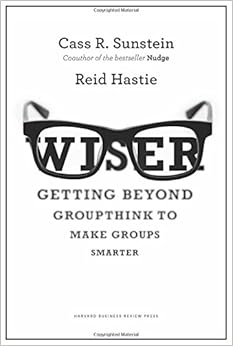
Last night, watching TV, an interview by Jon Stewart on "The Daily Show" somehow pierced my armor and made me feel less alone, less cowardly, less strangely inhumane. Stewart interviewed Cass Sunstein, author of a book called "Wiser: Getting Beyond Group Think." Sunstein seemed to be a pleasant enough egghead who managed to keep the TED-talk lecture tone to a minimum.

But what he said -- while obvious enough -- cut through my lifetime of uncertainty.

Briefly, Sunstein had done two surveys on hot-button issues like climate change. One survey convened a group of liberals to discuss. The other brought together conservatives who addressed the same issues. And what those surveys showed was that when like-minded liberals started to discuss something, they tended to ratchet up the liberalism. The same thing happened among conservatives. The result was that the two groups were increasingly unable to talk to each other. Their righteousness took on a life of its own and the issue under consideration grew more rather than less intractable. When individuals from each group came together, without the hoo-rah of group agreement... there was much less inability to solve problems or at least talk.

Sounds like Congress, right? Hang out with the people who agree with you and never get anything done. But it also sounds like an individualized characteristic as well. The longing to be part of a group of whatever kind -- to be warm and secure and protected and supported -- overrides much of what passes for common sense. The personal ramifications cannot be overstated in my opinion: If you really care about something, you would be wise to get the fuck out of the way. Consider spiritual life, for example. Or book burning. Or racism. Or "terrorism." Or war. Or "love." Or the slaughter of French satire-newspaper workers.

The upshot of Sunstein's words, from where I sat, was not to enjoin a kind of embittered skepticism or sign on to the least generous and most arrogant interpretation of La Rochefoucauld's maxim, "The intelligence of the mass(es) is inversely proportionate to its number."

Rather it was to point out that the human characteristic of bonding, while important and true, was not, when it comes to serious matters, entirely or even largely true. Agreement is useful right up to the point where it bars the door to actualization. An agreeable environment is not the same as a benevolent or even terribly sensible outcome.

And more important than pointing out the capacity of others to burn books or genuflect mindlessly to doctrine or manipulate the facts to accord with a rousing single-mindedness is to take a look in the bathroom mirror.

Assuming anyone took the subject seriously.

PS. It is hard in this subject realm not to think, associatively, of the seduction scene in the 1974 satire/comedy "Blazing Saddles." In it, Lili von Stupp, the Germanic white sex siren of the old west, has been tasked with seducing the new black sheriff in an effort to derail his lawful intentions. In the scene, she changes into something "more comfortable," invites the sheriff to "loosen his bullets," turns out the lights and then says ....

A video of the scene is somehow not available, but the voice conveys the action and the presumptions of the situation.

Wednesday, January 7, 2015

asleep, awake kaleidoscope


Like a kaleidoscope, the last 24 hours have seemed in their way to be fractured-perfect. How or why, I haven't got a clue and suspect that any clues I or anyone else might apply would be more self-serving than accurate. The "last 24 hours?" Fiddlesticks! For all that ... fractured-perfect.

I dreamed of laughter and woke up laughing.
I dreamed of tears and woke up bathed in sorrow.
I dreamed of what was below the surface and woke up below the surface.
I dreamed of love and woke up refreshed.

Literally ... not metaphorically.

Awake and asleep were coincidental, hardly relevant in some sense. All talk of awake and asleep ... why bother with that waste of time?

It all began, if it began at all, yesterday.

-- At midmorning, my son brought me the phone. "It's some woman about Black Moon Zendo," he said as he handed me the phone.

"Black Moon Zendo," a thing of the past, a thing I had built, a thing I had taken seriously, a thing now dissolved. Inwardly, I sighed ... everyone pays the price or reaps the glory from a past that no longer holds sway but once did. As I put the phone to my ear, I suspected there might be some diffident, sincere, outreaching conversation about Buddhism and practice and, below the surface, some relief for someone wanting relief.

I was relieved to hear that it was only the incense company from which I had bought incense in the past. Good incense. The company has a habit of checking in periodically (but not insistently) to make sure this customer was sufficiently stocked and, coincidentally, add to its bottom line with a renewed order. I had always been pleased with Shoyeido, but that time was in the past. I seldom burn incense any longer after years of lighting it, bowing, enjoying.

"So you want me to take you off our list?" the polite young woman asked.
"Yes," I said. "That would probably be best. But I would like to thank you for the past. Shoyeido did a good job."

And just like that, just like incense, Shoyeido receded further into the past and yet left a redolence on the recollecting air ... a scent that was invisible and gentle and yet adamantine in its inescapability.

-- With the phone in hand, I placed a call to a longtime friend who, out of the blue, had send me a pretty substantial check whose subject line read "for work received." The check was dated Dec. 30. When he came on the phone, I said my sincere, if joshing, thanks: Had he lost his mind along with his diminishing muscle tone?

"Well," he said disingenuously, "there was all that work you did 40 years ago." He has enough money so that the check probably did not represent a big sacrifice from where he sat. But to me, on a fixed income, it was a surprising and helpful wow.

Forty years ago, we had worked time and again on a house he has in the hills near here. A real colonial farmhouse that was rich and beloved in its own 1800's past. My friend had mended the house and improved it with a gentleness that spoke to his love of antiques (his business) and the spirit that infuses them. These days, he is both angry and saddened by the phony-baloney antiques purveyors who can talk up their own expertise and make the most possible money ... and love nothing ... not to mention being blowhards by way of expertise. The "Antiques Roadshow" kind of stuff. Money? Sure. But money alone? It was/is a travesty from his point of view.

Anyway, we had worked on the house and barn, gotten filthy and cleaned up, been exhausted by one exercise or another ... and felt great as things moved along. Two days ago, the check arrived and he said it was for the work for which no dollar amount was necessary or even, really, equivalent. Sweating, swearing, shaping and drinking a beer at the end of the day ... it was friendship in the making, though how that worked was not open to discussion.

-- But the check was the check and it was of an amount sufficient to pay off the mortgage on the house I live in -- a gouging monthly bill that wreaks havoc on a fixed income. So I went to the bank and jumped through the hoops that allowed me to pay it off and thus bring a little less stress to the monthly outlays. The house was priced at something like $103,000 when I signed on. Yesterday's payoff represented a cumulative bill (over 25 of so years) of something like a half a million dollars. I shoulda been a banker, but my past didn't work that way.

After the paperwork, the bank exec and I chatted. She, like Shoyeido, had a bit of past to remind me of, a past I hardly thought much about.

"I always read your (newspaper) column," she said of my increasingly-reluctant monthly efforts in the local paper. "They always make me feel good. I don't know if that's your intention, but that's what happens."

It was a nice compliment, of course, and I said the socially-respectable thank-you, but the truth was I didn't know if that was my intention at all. Once out the door, columns, like incense, go into some overstuffed closet in my mind -- a place where the past is consigned, the door closed and ... well, that's that; no need to pull it out and go through it as if it were still as compelling as it once was. And yet, there it is ... lingering, lingering, lingering and to pretend I am truly shut of it is both stupid and lazy. Good deeds and bad amount to about the same thing ... an overstuffed closet that is inescapably part of the house.

Anyway, the mortgage got paid off and I bought some flowers and champagne for my wife and, for a little while, both of us smiled at our good fortune ... good fortune that rose up out of the past and lingered in the present ... all that effort, all the memories that dangled on the Christmas tree called a house. Was it the past or was it the present expressing itself? Anyone who claims to answer that question is a bald-faced liar. Kaleidoscopes are things to enjoy.

-- Overnight, I dreamed and then found my dreams slipping without effort into the wakefulness that followed. They were just dreams, but I generally don't remember them and, when I do, it takes me back to the shrink who once helped to realign my pretty-rigid and shuddering lifestyle. "Remember your dreams and write them down" had been his only instruction as if knowing that 'intelligent' people can talk up a storm and explain anything, but dreams don't accede to such socially-acceptable blandishments. The question always comes along, "If you're so fucking smart, how come you're not happy?"

I remembered my dreams for my shrink and he made suggestions that I
was free to ingest and digest or not. It could be pretty intense ... an intensity that hardly remains these days, but some of the skills or approaches remain. Last night, I dreamed.

At first it was a subway platform with a modest crowd waiting. Subways and basements were always my tip-off to what's happening below the surface and behind the scenes ... a no bullshit arena. Anyway, I waited and grew restive about the delay with everyone else. Finally, a sooty utility train (the guys who fix stuff) emerged from one tunnel, slid slowly though my station, and exited further down the track. It had been the hold-up of the passenger train that followed shortly behind it. I got on.

A saucy little Japanese boy was cutting up along the bench next to me. He looked me in the eye and grinned. He wasn't raising hell, but looked like a hell-raiser who could laugh. We kept eye contact as he postured ... we smiled ... we knew each other, but lacked a common language. I gave him a small glass of beer. A man appeared and took umbrage at my gift. I offered him the beer to taste and thus judge how naughty I had actually been. He said nothing about the beer, but introduced me to the boy's father, a young Japanese man who told me in fractured English that his wife had died two years ago. I said I was sorry and suddenly I was overcome with grief. I reached out to touch him. He moved very close in, accepting my touch. His face came closer and closer to mine and suddenly I knew he wanted a kiss. My social mind said something about not kissing men on the lips, but then I knew that that was bullshit and I kissed him gently and gathered him in and wept.

Like all dreams, you had to be there: The factual fractured bits and pieces cannot convey the feeling and understanding and love and sorrow that infuse a dream. It was powerful ... sort of. It was perfectly ordinary... sort of. But whatever it was, it seemed to come with me, faithful as a tail-wagging hound....

I opened my eyes to the still-almost-full moon out the window. It was bright. The idea that I might distinguish between appreciations when asleep and appreciations when awake ... well, it struck me as mildly dumb -- sort of like looking back on a love of cap pistols or dolls -- and entirely unnecessary except when conversation lagged over the dinner table or in a gossip gathering.

Awake, asleep ... same stuff. Just twist the kaleidoscope a little and you'll see what I mean.

Tuesday, January 6, 2015

encounter at the barber shop


Because I had begun to look like one of those cartoon cats that gets its tail stuck in a light socket, I went to the barber yesterday. One person was in the barber's chair and a white-haired fellow was waiting his turn while reading the local paper.

Since reading months-old magazines did not appeal to me, I asked the fellow who was waiting if I could take a section or two of the paper.

"Go ahead," he said. "I'm just checking the obituaries to make sure I'm not included."

It was an old-duffer's kind of witticism and I liked being in the company of someone whose age and outlook I might share. By way of passing time, I asked the fellow what he had thought of the newspaper's seemingly endless coverage of a woman who had planned and then executed her own death by not eating. The series was titled "Death with Dignity."

The question and topic didn't seem to make him squeamish.

"It's ticklish," he observed of the topic in general. There are so many varying circumstances (grinding pain, depression, immobility, etc.) attending on death that deciding to end this life has no single appropriate philosophy. He told me of a distant relative whose 19-year-old daughter had had a massive heart attack while jogging and for the last couple of years had been confined to bed ... a 'vegetable' who could not move or speak and whose parents were legally barred from a 'merciful death' option.

"Would she want to live?" he asked rhetorically. "No one knows or can know."

I said I liked the newspaper series because it said implicitly what so many are loath to express: This life is entirely yours. Laws, opinions, religions, etc. can all go suck an egg in the end. It's yours in success and yours in failure; yours in competence and yours in incompetence... even in a vegetative state.

An aging (or even young) person may not have much, but this life remains untouchable by others. That fact strikes me as important... and largely overlooked because so much of what went before has been made dependent on the outlook of others. Being responsible is lonely... and rather exciting at first. Later, perhaps, the obviousness settled down and made you wonder how or why you had ever thought otherwise.

Soon enough, the white-haired man took his turn and got his hair cut. I basked in a small conversation that had no real punch line or conclusiveness, but simply ended by circumstance with some line like, "to be continued...."

Monday, January 5, 2015

"All Forms of Life are Sacred"


Passed along in email today was this article by Chris Hedges, a lesson in morality and/or food for thought: "All Forms of Life are Sacred."

ascending to third-world status


According to a snippet of a TV show I saw last night, the attitude towards and backlash against the class divide in England began even before the advent of World War I.

The sinking of the Titanic in 1912 provided evidence that those below decks fared sometimes disastrously worse than those above. 92% of the 168 men in second class perished compared to 68% of the 175 in first class. The disparity had an impact that added to other simmering social conditions.

The advent of electricity and the telephone and the typewriter and demand for improved labor conditions all chipped away at a society in which the privileged were assured and numbed by their privilege and those serving them were getting no better than they deserved.

As the 'guns of August' in 1914 inched closer, those to-the-manor-born went forward with all the regalia that had accompanied them heretofore -- coming out parties, tailors, tails at dinner time, summer retreats ... you know, the "Downton Abbey" stuff. Those "below stairs" knew their place and kept to it, though a sense of discontent simmered with the industrial changes.

My mother once said that "the greatest change in the 20th century was the loss of servants." I think she had a point and to the extent that she did, anyone might imagine that those accustomed to servants would most-emphatically not-be-amused.

As much as anything, the war and technology collapsed the world of the manor house. But that doesn't mean the world of the manor, however revised and tawdry, doesn't have its latter-day exponents.
The smart-home concept is known in tech circles as the Internet of Things. Current iterations primarily include our ability to control gadgets such as lights and security alarms or view data remotely through a smartphone app. At the International CES gadget show in Las Vegas this week, manufacturers will promote more devices and functionality. Some gadgets will be able to talk directly with one another, not just to an app. The four-day show opens to the public Tuesday.
Acquisitiveness, with its American spin, is the new aristocracy. The aristocracy of Edwardian England did have a sense of noblesse oblige, meaning that those in the catbird seat were compelled by 'decency' to look out for those less fortunate. And they did ... in much the same way a good horseman would look after his horses.

Aristocracy in its acquisitive format generally lacks any sense of moral compulsion or compass. It's enough that I have mine and it's up to you to see yourself up the ladder to "first class." Acquisitiveness does however create the kind of third-world disparities making themselves felt in the United States. In its pell-mell rush to third-world status, there are signs of 'hope' that serve to underscore extant disparities in the U.S.

In Detroit, an economically-distressed community, there is a move afoot to convert cast-off ship containers into homes to repopulate a blighted landscape.
Come spring, the house-in-progress will be delivered to Detroit'sNorth End neighborhood and secured on a foundation where a blighted home once stood. After finishing touches and final inspections, the 40-foot-long former container will feature 320 square feet of living space with two bedrooms, a bathroom and a kitchen, and will serve as home base for a university-student caretakers of a neighborhood farm and agricultural research activities.
The story does not say there will be apps-galore to ease the burden of this agrarian class, but there is a sense that those in the catbird seat are grudgingly willing to do something about the ragamuffins below decks. 320 square feet is about the right size for servants' quarters, and if they can grow their own food, it's a win-win situation for the new -- if less discreetly rapacious -- Edwardians... they get servants who do not require too much maintenance.

One difference between the earlier aristocracy and today's accumulators is that those in the catbird seat have learned to embrace, rather than shy from, war. Perpetual war -- topped off with the whipped cream and cherry of "terrorism" -- means that those below decks are kept in check if not in thrall: World War I holds no horror when the horror is kept simmering by those in the catbird seat. The only difficulty with this scenario -- or at least I imagine it -- is that the horror, when it arises, will take place not on some distant shore, but rather in our own third-world back yard.

Do they have an app for that?

Sunday, January 4, 2015

scaling the granola peak

Yesterday, for the first time in my life, I got a hankering for some granola cereal and, lo and behold, made some. The earthy-crunchy crowd may snicker at so late an arrival to the world of the earthy crunchy, but I'm old enough to look foolish without feeling it's anything out of the ordinary.

I enjoyed making it and it tastes good and costs a hell of a lot less than what is sold in supermarkets. The hardest part was finding the willingness to collect the various ingredients. As far as I can see, you can put damn near anything in the mix. It looks a bit like pig fodder, but it tastes good.

After the ingredients, there's a little elbow grease, a little baking and voilà.

Now if I could summon the energy to figure out how to make a Marsala sauce -- something I could add to damn near anything -- my comestible life would probably be complete.

shhhh ... genius at work


Like the word "hero," "genius" doesn't mean much in a vacuum. The "genius" is smarter than you and me, but how does the alleged "genius" feel about it?

Wouldn't the "genius," like the "hero," be in the best position to assess the mantle placed around his or her shoulders by others? Perhaps so, but whether those applying the word would listen to such assessments and act according to them is very much in doubt ... in fact, those applying the words can be downright deaf and intransigent about having their own, 'spot-on' way.

Here in America, the vein of anti-intellectual sentiment is nevertheless balanced by a delicious awe at some intellectual achievements. The occasional social ineptness of genius can be a matter of ridicule: "He's so smart that he couldn't find his own ass with both hands." And those straining at stool to be known as "a genius," the wannabes, can receive even more opprobrium. But the same testy critics can applaud wildly when a space probe lands on a comet... pure genius!

But what do those who attract the word "genius" have to say? And what reason would they have to lie?

In a BBC article entitled "Six Lessons We Can Learn from Geniuses," the lessons are not-so-surprisingly common-sensical: Be willing to work; think outside the obvious; be willing to be wrong; follow the evidence rather than the group agreement; don't expect that your answer will be the answer; accolades are nice but not the point; etc. In other words, think.

The fact that one person can think better than another is hardly more surprising than the fact that some people can run the mile in under four minutes. Some can, some can't. Setting aside the viciousness of academic competition, there is no 'becoming' a genius ... you practice, you do what you do, sometimes to effect, sometimes not. When/if anyone calls you a genius, it better not be you -- that would be pure ignorance. But when presidents gather round to designate "heroes" and lesser minds rise to their feet to applaud the "genius" ... well, how true does it really ring? Others may only imagine the genius or hero is being diffident when s/he disclaims the label, but it must be pretty confusing to be lauded for what you could not escape in the first place.

Or, as Sheila Nirenberg of Cornell University put it:
It’s a funny word: the word ‘genius’ .... I just sort of ignore it and just go on with life. You just do what you do independent of whatever label’s attached to you. I don’t know really how else to explain it.
Einstein, Gandhi, Buddha, the Dalai Lama, the combat vet, the mother watching her offspring at the playground or the mechanic at the local Sunoco station ...

Pure genius and a couple of bucks will get you a bus ride.

Using genius makes some sense.

Claiming genius, whether within or without, does not.

Saturday, January 3, 2015

invasion of the kangaroos


"A plague of locusts?" -- sure. But a plague of kangaroos?

Yanks like me who have only seen a kangaroo in a zoo or a movie may marvel, but it's no damned joke in Queensland, Australia, where road kill is common enough to excite police warnings and fertile fields are scraped dry.
"Sooner or later, they will take our place - there will be no grazing left if we don't do something about it."

see better -- stop looking

In the army, we were instructed to improve our night vision capabilities by not looking directly at an object. Somehow, looking to the side of the pertinent target made it more visible.

I wonder if the same isn't true in spiritual life -- you see better when you stop looking, know better when you stop knowing, understand better when you stop understanding.

what is indispensable

In Buddhism, there is reference to "the imponderables" -- topics on which students are advised not to dwell because they are fruitless and detract from Buddhist practice.

But at a less august level, I think everyone has a laundry list of things that are indispensable in life ... things which, whether frivolous or serious, may seem quite serious indeed.

Two that occur to me this morning are:

Aloe

and

Duct tape.

nostalgia's lash

A friend of a certain age and with, I imagine, some of the same propensities as I have at my age, sent along the following adviso:


Those who are old enough will recognize the sense of grumpiness that arises with a dwindling sense of social connection and usefulness that age provides.

With age, each reflection and pronouncement seems to be invested not so much with an eye to the future and its possibilities, but with a past and its teachings. It's as if you had become your father's saying, "I remember when hamburger was five cents a pound." Simultaneously, there is a great deal of sympathy for a younger crowd who hear such pronouncements while their eyes fill up with a skepticism that reads, "Who the fuck cares?! The past and a couple of bucks will get you a bus ride!"

[I realize that there are those youthful souls who are more mealy-mouthed and sycophantic and who will be at great pains to praise the "wisdom" of old timers. But the impact is largely the same, though somewhat more polite: The past is the past; there's no real learning from it until anyone chooses to experience that learning ... all over again, from an elderly point of view.]

But those of a certain age, as the poster indicates, can be increasingly saddened to have lost or be in the process of losing the sense of the future with its plans and helpfulness and acquisition and joy. Each day has a "miserable" cast because, well, been there and done that and, like my father, I have my own versions of "hamburger at five cents a pound."

Like some quiet, painless leech, the past and its apparent nostalgia rises up among the elderly and sucks the blood from the bushy-tailed involvements of youth and a social connection in which others are likewise convinced by the future. It's lonely.

Well, today all this occurred to me in a somewhat different light.

Those of a certain age may do their damnedest to remain socially relevant and connected and hopeful and in the flow that leads to the future and its imagined improvements, but it doesn't work very well. "Hamburger" -- and other bits of nostalgia -- simply seems more relevant based on experience. Like some soft, insistent vortex, it sucks you in. As muscle mass dwindles, so too does the willingness to imagine you could know an unknowable future ... however popular the activity.

But is there anything more tentative and occasionally idiotic about getting sucked into the past than there is about getting sucked into the future? Both are inexact and, when you get down to it, unknowable -- edited to suit the tastes of those who cannot escape the present they dwell in. Whether "miserable" or "delightful," it's just the name of the game rather than the name of the actual and factual.

Don't get me wrong: I'm as much a fan of a good story and the social contact it can provide as the next fellow. The growly assholes who say with a straight face that "we have to dwell in the present" are just busy trying to ward off a well-imagined future that is, in the end, unimaginable. But there's nothing wrong with a good story, so long as it is recognized as just that -- a story.

Anyway, I felt somewhat relieved to think that my shuffling nostalgias are not all that different from the bright-eyed-and-bushy-tailed projections of those younger and stronger and smarter than I. They, of course, aim to rule the future that cannot be ruled. I, of course, aim to rule a past that cannot be ruled.

All of us are sitting around the camp fire swapping tall and sometimes enjoyable tales beneath a starlit sky.

If reconfiguring the future is your gig, enjoy it.
If reconfiguring the past is your gig, there's no reason not to enjoy that as well. Nuthin' wrong with a good nostalgia story.

Did I ever tell you that there was a time in my life when gasoline was twenty-five cents per gallon or that I had a sometimes unhappy upbringing?

Your turn: Tell me about your efforts to lead a "more compassionate" or "improved" or "intelligent" life.

Twinkle, twinkle, little star....

Friday, January 2, 2015

piano sales decline

Stores dedicated to selling pianos ... are dwindling across the country as fewer people take up the instrument and those who do often opt for a less expensive electronic keyboard or a used piano. Some blame computers and others note the high cost of new pianos, but what's clear is that a long-term decline in sales has accelerated.

becoming an illegal alien

When I grow up, I want to be an "illegal alien" in the United States. That way I can be sent back to a country whose natural resources or strategic location have been targeted by exceptionalist Americans as needing a democracy that can extract a wealth they themselves are unwilling to sweat for.

With the Republicans within spitting distance of taking over political power in a capital that is wrestling with unemployment -- and a poverty that does not afflict its numbers -- I can see that the likes of Dick Cheney, Mitt Romney, John Boehner may see my plight as righteous: Someone's got to maintain a semblance of structure in the land I fled. Someone's gotta do the inequitable heavy lifting. It might as well be me and what the hell -- I'll have a job, assuming I live long enough to do it.

The fact that I left my country for fear my children might not eat or live in relative safety is not the concern of any high-minded ruler of the "greatest democracy in the world" -- you know, the one in which any patriot worth his salt wears an American-flag lapel pin.

People might ask why I would choose to leave the land of my birth in the first place if I were simply going to be sent back. But you have to understand these things: "God has a plan," and it is up to the exceptionally gifted to make it work right. People like me have to learn our place and fruitless efforts are part of the greater scheme of things. There are those endowed with the one true vision -- the "chosen" as many religions call them. Their benevolence is overarching and undeniable ... and woe betide those who challenge that benevolence.

Who knows, maybe when I grow up, I too can have a lapel pin and wash their floors or pick their peas.

Thursday, January 1, 2015

New Year's celebration

My offspring and their affiliates, all in their 20's, went downtown for New Year's celebrations last night. It's a pretty big bash here in Northampton, with lights and fireworks and drinking and a ball that falls up rather than down as at Times Square in New York.

Not one of them made it to midnight, when the ball fell 'up.'

"It was too cold," said my older son.

I was in bed and asleep while all this was going on, but the reactions of my kin made me wonder what activities exist these days in which people suffer the downside just in order to say they had been there and done that... to get together so that their lives and the lives of others might contain the same DNA of memory.

Oh well -- whatever ... Happy New Year!


Palestinian gambit


RAMALLAH, West Bank (AP) — Turning up the pressure on Israel, the Palestinians announced Wednesday that they are joining the International Criminal Court to pursue war-crimes charges against the Jewish state — a risky, high-stakes move that brought threats of retaliation from Israel and criticism from the U.S.
Palestinian President Mahmoud Abbas acted a day after suffering a defeat in the U.N. Security Council, which voted down a resolution setting a three-year deadline for the establishment of a Palestinian state on lands occupied by Israel.
It'll never work, but perhaps Abbas has pointed a way for others to address the camouflaged depredations of world policy-makers. Could we expect, for example, that U.S.-led attacks in the Middle East, Russian incursions in Crimea and other righteously-defended blood-lettings might be aired in a more factual and less righteous light?

Who knows, perhaps even the amorphous and self-serving use of the word "terrorism" could receive some corrective surgery.

OK ... if wishes were horses, beggars would ride. But what beggar -- what mother with bloodied children or combat veteran missing a leg -- has not hoped to ride?

"literature"


Sitting in a doctor's office awaiting a little slice-and-dice on an eye socket, I whiled away the time with an article in the New Yorker, an American magazine that once had a very uppity reputation for good writing. Later the magazine was bought by the Newhouse publishing dynamo, whose bedrock interest in quality was linked more egregiously to the income it could produce ... it was nice to be known for quality, but if you couldn't provide quality, take the money and run.

Anyway, I got sucked into a pretty well-written piece as I whiled away the time. And it made me wonder if, with the advent of the Internet, there was/were any longer something called "literature." And from there, whether "literature" had ever really had the laurels it might lay claim to in, say, the classroom or white-whinery.

"Literature," for those unfamiliar with the word, is writing of guys and gals like Shakespeare, Flaubert, Homer, Chaucer, Dante, Tolstoy, Cather, Goethe ... and a laundry list of others that an educated person might -- in some circles -- be expected to read. Not "like it" necessarily, but to read and recognize and fashion some cultural lifestyle shawl from.

One of an Internet dictionary's definitions of "literature" is this:
writings in prose or verse; especially :  writings having excellence of form or expression and expressing ideas of permanent or universal interest
 Literature was the kind of stuff high school and college students wrote papers about, discussed the meaning of ... you know, the homework angle. And, looking back, I am happy to have been subjected to the lash of literature, but I can't really say I know why, or what, precisely, is or isn't literature. Perhaps only a person who has been run through the literature mill could query the actual-factual meaning of "literature."

As homework, I can remember hating Shakespeare. But after being taken -- much against my will -- to see one of the plays, it occurred to me that Shakespeare was basically a gussied-up soap opera, replete with wondrous emotions, like love and jealousy and anger and conniving and honor and ... and don't forget the clothes... they were wowsers.

This recognition did not come as some counter-cultural, it's OK-to-be-uneducated insult to all the pansies running around saying "literature." OK... maybe a little. But what really interested me was that literature was the same shit on a different, human day. Puffed up literature was just the puffed up people who decided to puff it -- and by extension themselves -- up. Since puffing up was a pastime hardly limited to the literati, the playing field was simply leveled: There is good writing and bad writing and writing in between and it was all like anchovies ... I hate 'em but someone else may find Nirvana in them.

A stand-alone virtue or greatness of literature is ,,, well maybe it's sort of true, but it's not very true. And that's OK because that's the way things are... or seem to me.

All I was really wondering this morning was, "Is there a 'literature' being created today?" I guess if we wait long enough, there is. Like dead people, literature gets better with age.

Wednesday, December 31, 2014

"Origami Holiday Tree"

Passed along in email, the "Origami Holiday Tree" at New York's Natural History Museum:


no one remembers; no one forgets

Thin as a piece of toilet paper, the local newspaper arrived today stuffed with New Year's Eve recollections. "Stories that Endure" read one headline. "Pictures of the Year," said another. An applause-o-meter for 2014 and a lot of news organizations do it ... telling me what I have forgotten and perhaps would like to remember. Also, of course, a lot of news staff are off, so cut-and-pasting what is already on hand is easier than gathering news.

But the recollections have a strange flavor. Yes, there were high moments and low, but to say that they "endure" is to overstate the fact that I would hardly need a reminder about a story or event I actually did remember. "Endure" is congratulatory, but it rings hollow as well.

No one remembers anything accurately. True, there are scars or touchstones to mark past events. There is something that is brought forward, but the fact that it is brought forward means it is not remembered accurately. It has become a story and as such is, in one sense, as flaccid as a dead fish.

World War II forgets World War I.
"We will never forget," say some Jews of the Holocaust.
"It's as if it were happening all over again," says the veteran haunted by memories of combat.
"It was the happiest day of my life," say others of all sorts of circumstances.
"We laughed and laughed...."

But at the same time that no one remembers accurately, they also do not forget. There are scars and blue ribbons to mark the accomplishments and failures. Somehow, I am the sum of my lifetime -- a lifetime I cannot remember and cannot forget. In the congratulatory or derogatory recollection, there is a truth that is exemplified in the falsehood of remembrance.

If an example is needed, I always think of the pregnant woman giving birth yet again: In the midst of the current anguish, what woman doesn't think, "I will never, EVER, do this again!" It's too much, too painful, too wracking.

Until it's time to give birth anew.

No one remembers pain or pleasure accurately. How boring life might be if they did. No one remembers. No one forgets.

I'm not sure what to make of all this outside the fact that I think it is worth noticing and getting used to. Stories that "endure" do not really endure ... but it may be useful or fun to think they do because, after all, they do, somehow, endure.

I remember....

I forget....

I....

I guess I should remember that I forget, if that seems memorable.

Tuesday, December 30, 2014

give "meaning" a rest

Stupidity is no excuse, but what would it be like to give all these "meanings" a rest?

I can't think of a single example in my own life of "finding meaning" that didn't involve thinking well of myself.

As Sarah Palin might say, "How's that finding-meaning thingie workin' for you?"

Not that it's bad or naughty or something, but what would it be like to just give it a rest?